Episode Details
Back to Episodes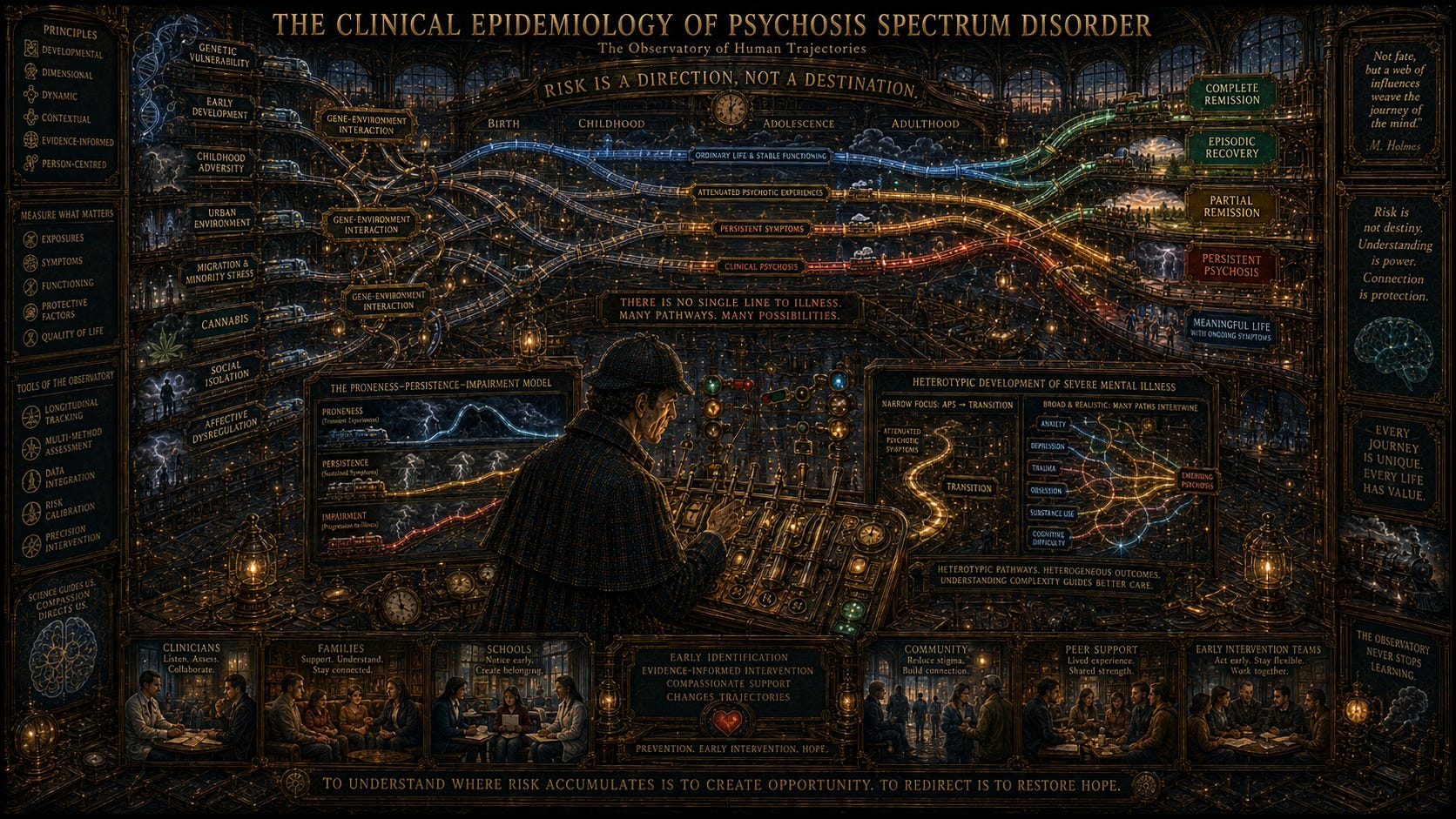
PSYCH 096: The Clinical Epidemiology of Psychosis Spectrum Disorder
Description
Medlock Holmes enters a vast railway control room where thousands of human journeys are represented by illuminated tracks.
Some routes remain smooth throughout life.
Others begin with subtle diversions: delayed development, social isolation, anxiety, depression, trauma, or unusual perceptual experiences. Most of these tracks eventually return to the main line. A smaller number continue towards persistent psychosis and significant impairment.
Holmes is not searching for a single cause.
He is trying to understand why apparently similar lives follow different trajectories.
This chapter introduces the clinical epidemiology of psychosis spectrum disorder: the study of how vulnerability, onset, persistence, and outcome vary across populations-and what inherited and acquired factors may explain that variation.
The investigation immediately moves beyond schizophrenia as a rigid category. Psychotic symptoms occur across schizophrenia, schizoaffective disorder, bipolar disorder, depression, substance-related states, and the general population. Modern epidemiology therefore increasingly examines a broader psychosis spectrum, combining diagnosis with symptom dimensions, severity, stage, functioning, context, and personal experience.
Holmes begins with inherited vulnerability. Family, twin, and adoption studies establish a substantial genetic contribution, but genes do not operate in isolation. Identical twins are not perfectly concordant, and genetic risk overlaps extensively with bipolar disorder, depression, autism, ADHD, and intellectual disability. What is inherited is not a predetermined disease, but a varying sensitivity to developmental and environmental pressures.
He then follows the environmental tracks.
Some begin before birth through maternal illness, nutritional deprivation, obstetric complications, fetal hypoxia, low birth weight, or disturbed early neurodevelopment. Others emerge during childhood and adolescence through urban upbringing, migration, minority status, discrimination, neighbourhood fragmentation, childhood adversity, stressful life events, and substance exposure.
Cannabis becomes one of the clearest clues. Risk rises with frequency, potency, and earlier use, while heavy exposure is associated with a substantially increased likelihood of psychotic disorder. Yet even here, cannabis is neither necessary nor sufficient. Most people who use cannabis never develop psychosis, and many people who develop psychosis have never used it. The substance acts within a larger architecture of vulnerability.
The same principle applies to city living and migration. Neither the city nor migration itself creates psychosis. Risk appears to gather through social defeat, exclusion, discrimination, isolation, reduced trust, and weakened community connection. Holmes discovers that neighbourhoods rich in social cohesion may be protective, while living as a visibly marginalised minority within an unsupportive environment may amplify vulnerability.
The investigation then turns towards early warning signs. Children who later develop psychosis are, as a group, more likely to show subtle motor, language, cognitive, or social differences. Some experience attenuated psychotic symptoms during adolescence. Yet these signs have poor predictive precision because they are common, nonspecific, and usually transient.
Holmes recognises a crucial limitation in narrowly searching for mild psychotic symptoms as though they inevitably progress into schizophrenia. Psychosis often develops heterotypically: anxiety, depression, trauma responses, obsessive symptoms, substance misuse, and functional decline accumulate before attenuated psychotic experiences emerge. The transition is less like crossing a single diagnostic border and more like a landscape becoming progressively crowded with different forms of distress.
The chapter proposes a dynamic sequence:
Prone