Episode Details
Back to Episodes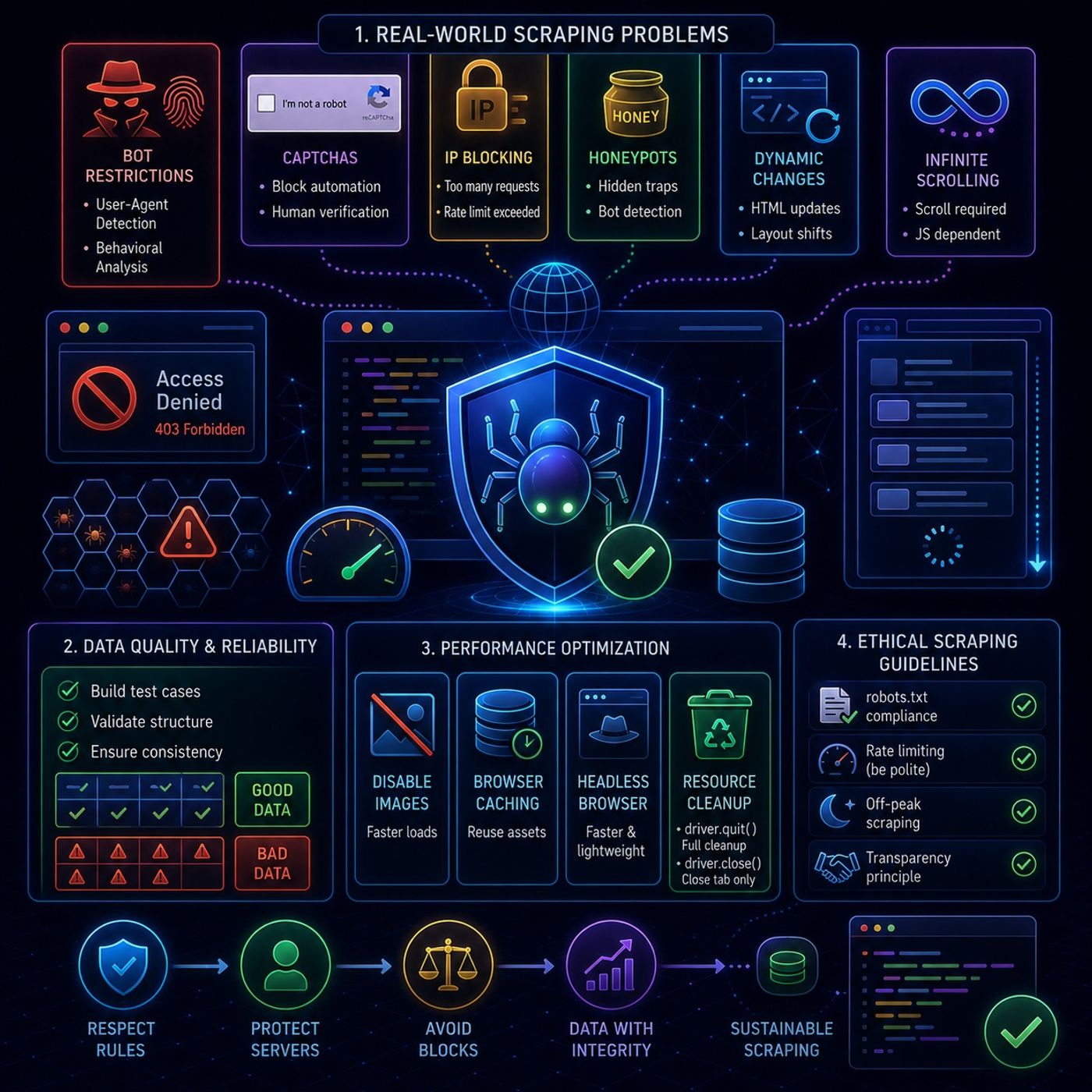
Course 40 - Web Scraping with Python | Episode 39: Overcoming Challenges and Optimizing Performance
Published 1 week, 1 day ago
Description
This module is essentially the “real world survival guide” for web scraping — it moves away from pure tooling and focuses on what actually breaks scrapers in production and how to behave responsibly while scraping at scale.🚧 1. Real-World Scraping ProblemsModern websites actively defend themselves against automation, so scraping is rarely “just code and go”.🚫 Bot RestrictionsWebsites may block automated traffic using:
Because bad scraped data can:
- User-agent detection (recognizing Selenium / bots)
- Behavioral analysis (click speed, navigation patterns)
- Designed to distinguish humans from automation
- Often blocks login pages, search pages, or high-value data
- send too many requests
- scrape too fast
- ignore rate limits
- temporarily block your IP
- permanently blacklist it
- invisible links
- fake endpoints
- non-visible HTML elements
- HTML layouts change
- class names get renamed
- elements move or get removed
- requires scroll automation
- requires dynamic request handling
- often tied to JavaScript APIs
- build test cases for scraped output
- validate structure before saving
- ensure consistency across runs
Because bad scraped data can:
- corrupt datasets
- break ML pipelines
- produce misleading analytics
- prevents browser from loading heavy assets
- drastically reduces page load time
- reuse previously loaded assets
- avoids redundant downloads
- faster execution
- lower memory usage
- ideal for automation servers
- driver.quit() → closes everything (safe cleanup)
- driver.close() → closes only current tab
- defines what bots are allowed to access
- ignoring it can violate site rules or laws
- avoid rapid-fire requests
- prevent server overload
- run jobs during low traffic hours
- reduces impact on real users
- not disguise malicious intent
- not impersonate real users
- behave predictably and responsibly
- Technical robustness (avoid breaks)
- Performance efficiency (don’t waste resources)
- Ethical