Episode Details
Back to Episodes“Research Report: A genetic basis for potential nociception in lac bugs (Kerria lacca; Hemiptera: Kerriidae)” by Meghan Barrett
Description
Prepared by: Claudinéia Pereira Costa, PhD; Meghan Barrett, PhD
Note: This report has not been peer-reviewed and has only been generated for the Forum. Results should be interpreted with caution, though we do follow peer-reviewed methodologies.
Executive Summary
- We analyzed the publicly-available Kerria lacca (Hemiptera: Kerriidae) genome, which was generated from late-stage, sessile adult females, for evidence of nine receptor genes in seven orthologous gene families related to heat, cold, chemical, and mechanical nociception in other insects.
- Finding any of these genes does not prove nociception is present; functional assays and confirmation of these receptors in nociceptors would be needed.
- Finding these genes are absent does not prove nociception is absent; other genes may exist for nociception and different insect groups have evolved their own receptors.
- Nevertheless, finding presence/absence of these genes may be probability-shifting compared to true ignorance of their presence/absence.
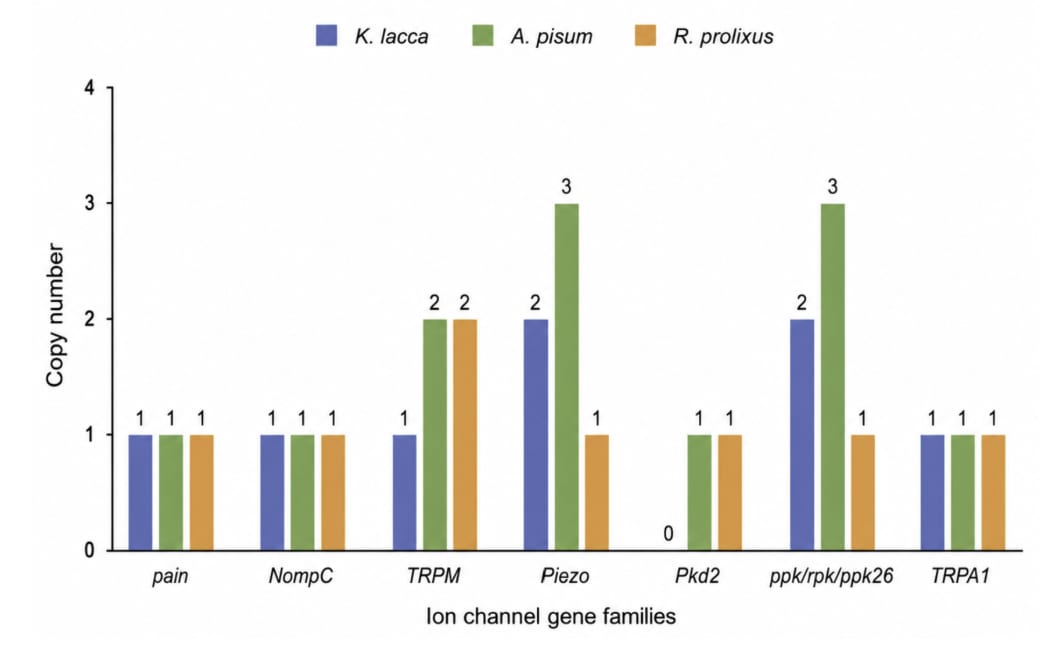
- We find K. lacca has six of seven gene families, including genes that (in other species) encode for proteins with noxious heat, cold, chemical, and mechanical responsiveness.
- Pkd2, which in fruit fly larvae is expected to have a direct role in cold sensing in Class III multidendritic neurons, was not detected in the search.
- These data do not prove [...]
---
Outline:
(00:36) Executive Summary
(02:14) Introduction
(08:51) Findings and Discussion
(08:55) Strong support for genes that may encode responsiveness to noxious heat, chemical, and mechanical stimuli in adult female K. lacca genome
(10:22) K. lacca gene copy number profile is similar to other hemipterans for these gene families
(11:21) Noxious cold-sensing channel Pkd2, with function known from fruit flies, was not detected; but, other mechanisms for cold-sensing could still be present, as cold-sensing is critically understudied in arthropods
(14:55) Further research confirming the nociceptive functions of the proteins encoded by these genes, as well as their expression in nociceptors, is needed to confirm nociception in K. lacca
(16:24) Methods
(16:27) Obtaining the Genome
(16:46) Gene Family Analysis
(20:00) Code Availability
(20:31) Acknowledgements
The original text contained 1 footnote which was omitted from this narration.
---
First published:
August 17th, 2026
---
Narrated by TYPE III AUDIO.
---
Images from the article:
Apple Podcasts and Spotify do not show images in the episode description. Try
Listen Now
Love PodBriefly?
If you like Podbriefly.com, please consider donating to support the ongoing development.
Support Us