Episode Details
Back to Episodes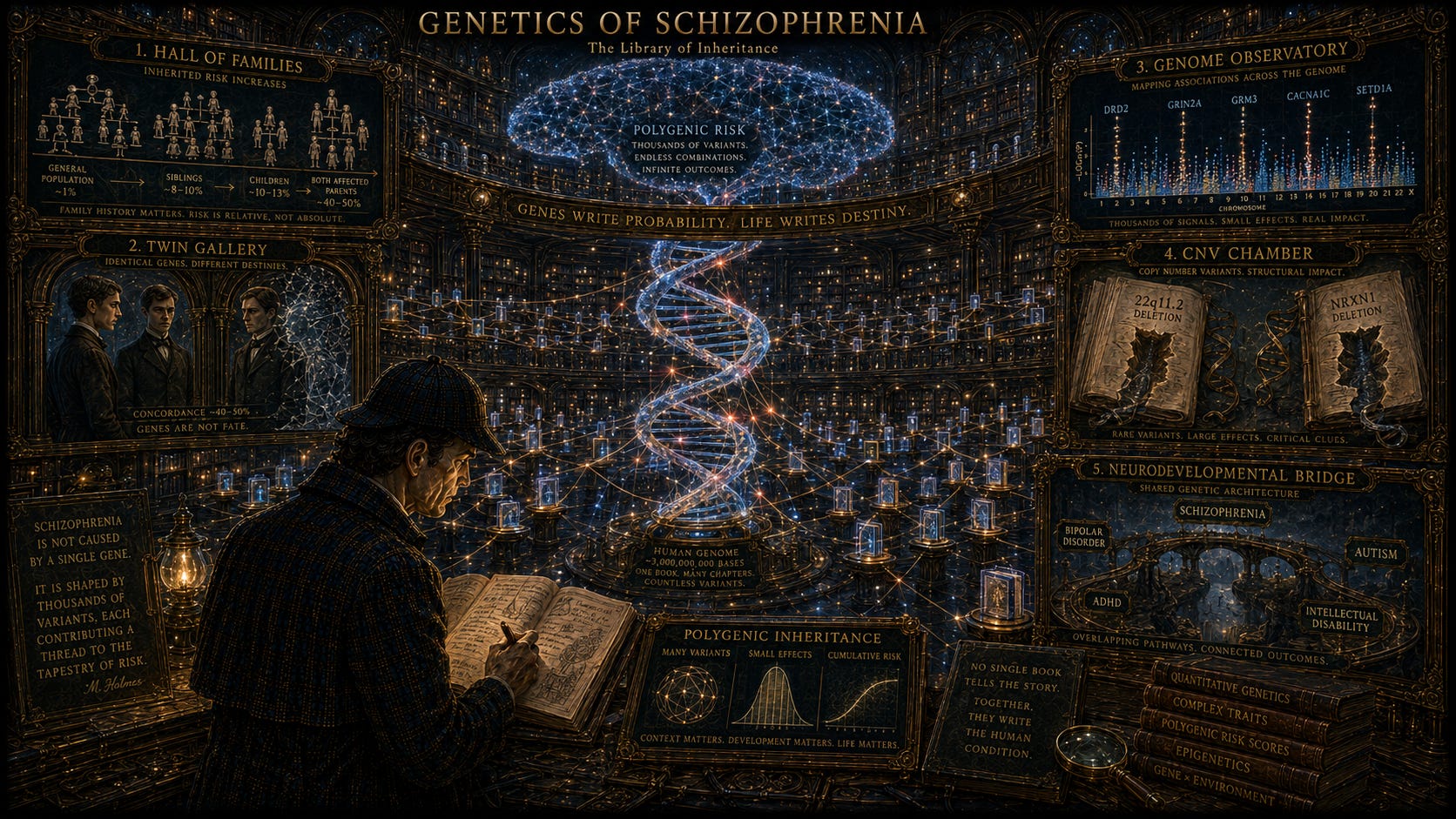
PSYCH 095: Genetics of Schizophrenia
Description
Medlock Holmes enters perhaps the most intricate room in the entire Psychiatric Archive.
Above the doorway is engraved:
“The Library of Inheritance.”
Thousands of leather-bound books stretch from floor to ceiling.
Each volume represents a human genome.
Holmes expects to find a single book labelled The Schizophrenia Gene.
Instead, he finds nothing of the sort.
The librarian smiles.
“You are looking for one culprit.”
“There are hundreds.”
“And none acts alone.”
Holmes immediately understands.
Schizophrenia is not caused by one defective gene.
It is the consequence of many genetic variations interacting with one another, with brain development, and with the environment.
He walks into the Hall of Families.
Portraits cover the walls.
Some families have no illness.
Others contain several generations affected by schizophrenia.
One large family tree glows brighter with every affected relative.
The pattern is unmistakable.
The closer one’s biological relationship to an affected individual, the greater the risk.
The general population carries approximately a 1% lifetime risk.
A sibling carries roughly a 10% risk.
A child of one affected parent has around a 13% risk.
When both parents have schizophrenia, risk rises dramatically-approaching 45–46%. Holmes realises that genes clearly matter, but they are not destiny.
The next chamber contains identical mirrors.
Each pair reflects identical twins.
Holmes notices something fascinating.
When one monozygotic twin develops schizophrenia, the other does not always.
The concordance is only around 50%.
If genes were the entire story, concordance would be 100%.
Instead, twin studies estimate schizophrenia heritability at approximately 80%, leaving an important role for environmental and developmental influences.
Across the corridor lies the House of Adoption.
Children leave one family and grow up in another.
Despite completely different homes, children born to parents with schizophrenia continue to carry increased risk.
The illness follows biological inheritance more strongly than upbringing alone.
Adoption studies therefore provide some of the strongest evidence that schizophrenia has a substantial genetic basis independent of the shared family environment.
Holmes now reaches the most modern room of the archive.
Rows of computers illuminate billions of DNA letters.
This is the Genome Observatory.
Scientists no longer search one gene at a time.
Instead, they compare millions of genetic variants across tens of thousands of individuals.
This approach is known as the Genome-Wide Association Study (GWAS).
Rather than discovering a single mutation, GWAS has identified hundreds of genetic loci that each contribute only a tiny increase in risk.
Most variants individually alter risk by only a few percent.
Their power comes from acting together.
A gigantic city skyline appears.
Every building represents a different gene.
Holmes notices that the tallest towers belong to genes involved in:
* synapse formation
* glutamate signalling
* calcium channels
* neuronal development
* synaptic plasticity
One tower bears the familiar name DRD2-the dopamine D₂ receptor.
Nearby stand GRIN2A, GRM3, CACNA1C, CACNB2, and many others.
Holmes smiles.
The genetics are pointing toward the same biological pathways long sus