Episode Details
Back to Episodes
Episode 498: Octopolis
Description
Further reading:
https://sharonahill.substack.com/
https://metazoan.net/54-octlantis/
https://metazoan.net/109-octopolis-and-octlantis/
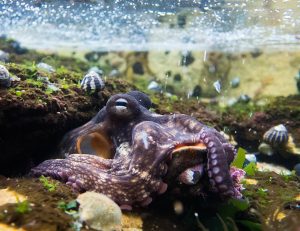
Scientists discover an underwater city full of gloomy octopuses
The gloomy octopus [photo by Niki Hubbard – https://www.inaturalist.org/photos/118664956, CC BY 4.0, https://commons.wikimedia.org/w/index.php?curid=123044473]:
Show transcript:
Welcome to Strange Animals Podcast. I’m your host, Kate Shaw.
As I’ve mentioned before, I really don’t like April Fools Day, which is April first. I especially don’t like it when someone makes an April fools day post online and just leaves it there afterwards. It’s too easy for other people to stumble across it and think it’s real. This goes double for strange animal and cryptid reports.
I subscribe to geologist Sharon Hill’s Pop Goes the Cryptid articles, and on March 31 she talked about a hoax called the North American Pine Squid. It got popular around Halloween of 2024. It’s said to be a black squid or octopus that lives in pine trees in remote, heavily forested places like the Pacific northwest and the Appalachian mountains. Most of the time it eats small animals like birds and squirrels, along with pine cones, but if someone walks underneath its tree, the pine squid grabs the person, pulls them up into the tree, and they’re never seen again.
But you don’t have to worry, because the pine squid isn’t a real animal. It’s also not even a new story. It’s based on another hoax called the Pacific Northwest tree octopus, which dates back to 1998. In the case of the tree octopus, it wasn’t created as a hoax or an April fool’s joke but as a study about whether children can tell if a website is reliable or not. The researchers made a page with information about a type of octopus that lived in the ocean but that also climbed trees. Then they asked several classrooms of children around age 11, from different schools in different countries, to read the page, look at the pictures provided, and answer some questions.
The study found that most of the children thought the page contained reliable information. Only a few figured out that the tree octopus wasn’t real. The study has been used repeatedly to argue that children need more lessons in how to evaluate a website to know if it contains reliable information, and of course that’s always a good thing. But it makes me a little angry too, because how were the kids supposed to know that octopuses can’t climb trees? There are so many amazing and strange animals out there, a tree octopus sounds perfectly normal if you don’t know very much about octopuses. So I argue that kids should be taught about everything, and taught in as interesting a way as possible so that they remember it better. The same goes for adults.
But this episode isn’t actually about April fools day, tree