Episode Details
Back to Episodes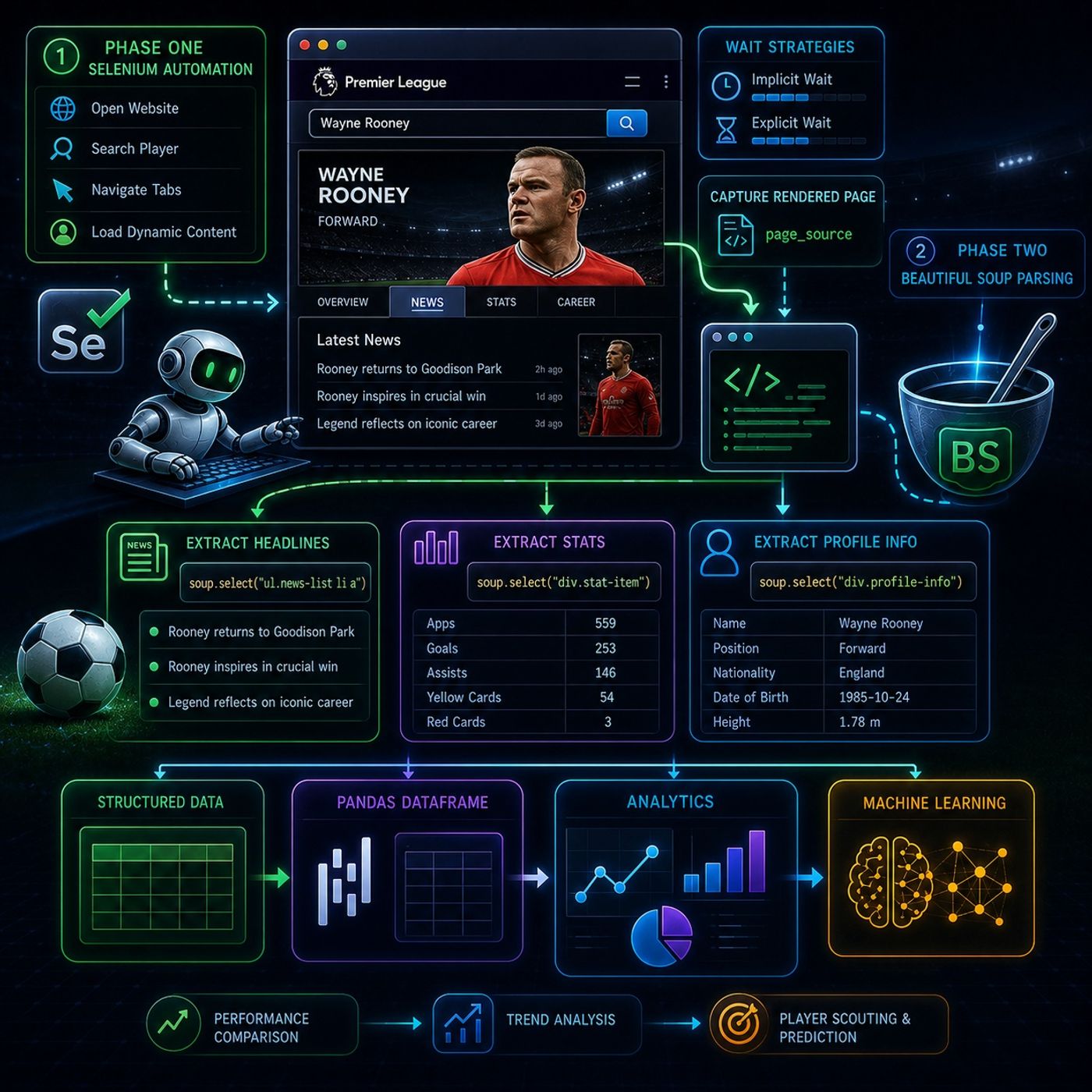
Course 40 - Web Scraping with Python | Episode 38: Scraping Dynamic Premier League Stats and News with Selenium and BeautifulSoup
Published 1 week, 2 days ago
Description
This episode is a practical end-to-end example of the Selenium + Beautiful Soup hybrid scraping pattern, applied to a real sports data use case (Premier League player pages).⚽ Goal of the ProjectScrape structured data about Wayne Rooney from a dynamic football website, including:
Beautiful Soup = data extraction engineThey are not competing tools — they are complementary.📌 Why this approach scalesThe episode highlights a key idea:Player-agnostic designOnce built, the same script can:
You can listen and download our episodes for free on more than 10 different platforms:
- News headlines
- Career statistics
- Player profile information
- Content is JavaScript-rendered (dynamic)
- Page structure changes after interaction
- Static scraping alone would fail
- Opens the Premier League website
- Navigates to the player section
- Uses search to find Wayne Rooney
- Clicks through profile tabs (news, stats, etc.)
- Loads content dynamically via JavaScript
- Requires user interaction (clicks, navigation)
- Doesn’t expose all data in initial HTML
- Global delay applied to all element searches
- Selenium keeps retrying until element appears
- Waits for specific conditions:
- element becomes clickable
- element is visible
- DOM finishes loading
- Selenium grabs the final DOM using page_source
- Selenium is slow for repeated extraction
- Beautiful Soup works on local HTML memory
- Parsing becomes significantly faster
- Locate or structured containers
- Extract text cleanly from tags
- Target stat containers
- Read:
- labels from attributes
- numeric values from text nodes
Beautiful Soup = data extraction engineThey are not competing tools — they are complementary.📌 Why this approach scalesThe episode highlights a key idea:Player-agnostic designOnce built, the same script can:
- scrape any player profile
- reuse the same selectors
- scale across hundreds of pages
- Convert scraped data into tables using Pandas
- Compare players statistically
- Track performance over time
- performance prediction
- sentiment analysis on news articles
- scouting models
- Selenium → reach the data (dynamic navigation)
- page_source → freeze the state
- Beautiful Soup → extract efficiently
- Pandas/ML → analyze downstream
You can listen and download our episodes for free on more than 10 different platforms:
Listen Now
Love PodBriefly?
If you like Podbriefly.com, please consider donating to support the ongoing development.
Support Us