Episode Details
Back to Episodes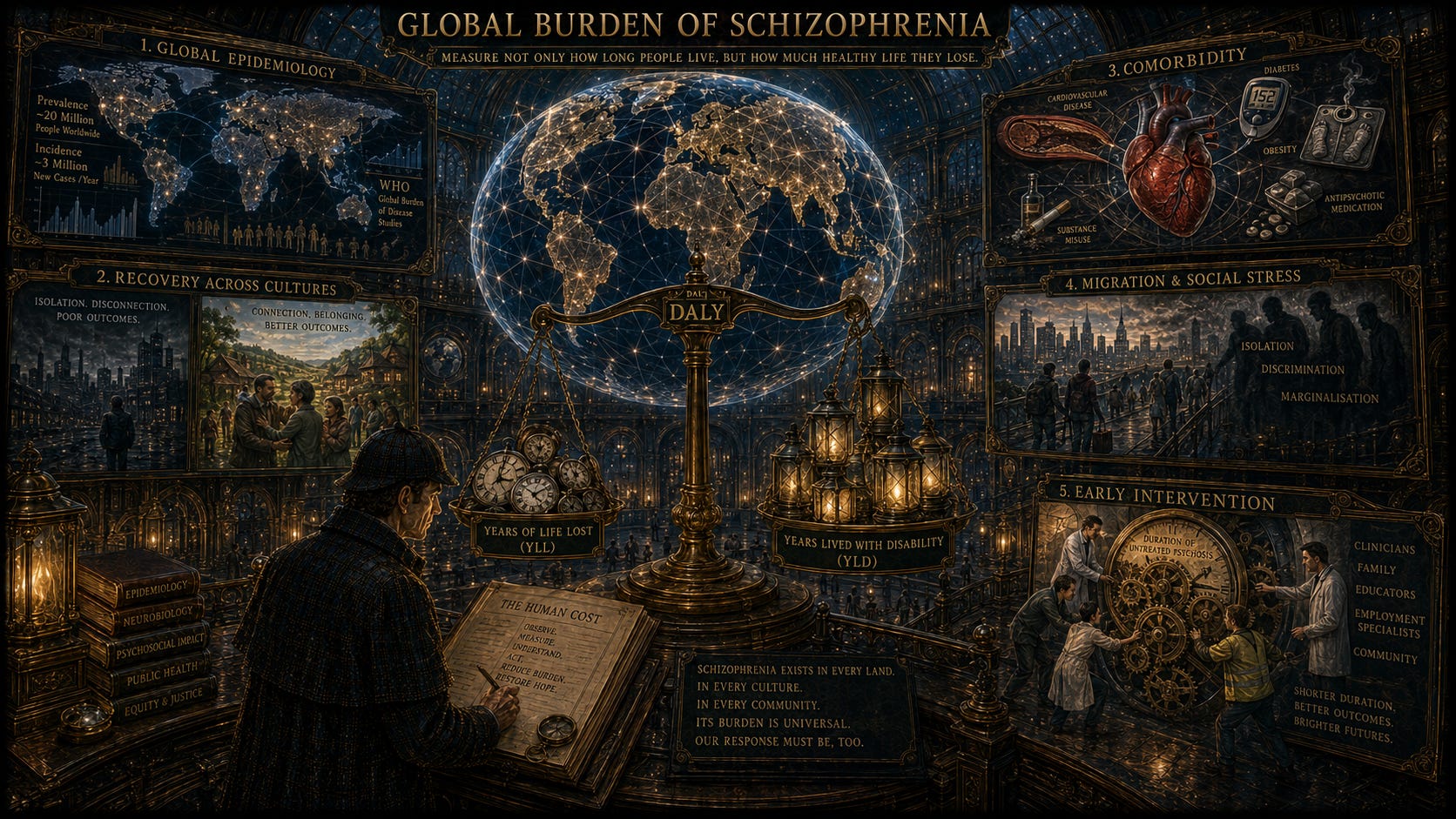
PSYCH 094: Global Burden of Schizophrenia
Description
Medlock Holmes arrives at the Hall of Human Burden.
Unlike previous investigations, this hall contains no microscopes, MRI scanners, or genetic maps.
Instead, the walls are covered with clocks.
Some clocks have stopped too early.
Others continue to tick, but their hands barely move, representing lives lived with profound disability rather than early death.
Holmes quickly realises that measuring illness is not simply about counting deaths.
Many illnesses kill.
Others steal decades of healthy living.
Schizophrenia belongs overwhelmingly to the second group.
At the centre of the hall stands an enormous balance labelled DALY - Disability-Adjusted Life Years.
One side is engraved Years of Life Lost (YLL).
The other reads Years Lived with Disability (YLD).
Together they reveal the true cost of disease-not merely how long people live, but how well they live. Schizophrenia contributes relatively less through mortality than through prolonged disability, making it one of the world’s leading causes of disability among young adults.
Holmes walks through a giant world map.
Every continent glows.
No country is dark.
The lesson is immediate.
There is no human society free from schizophrenia.
Whether in highly industrialised cities, isolated villages, or traditional rural communities, schizophrenia appears wherever human beings live. Although prevalence varies modestly between regions, remarkably similar syndromes emerge across cultures. Voices comment. Thoughts seem controlled. Delusions develop. Negative symptoms erode motivation and social engagement. The illness speaks different cultural languages but follows recognisable biological patterns.
He pauses beside an older collection of maps.
Some early psychiatrists once believed schizophrenia was largely a Western disease.
Modern epidemiology overturned that assumption.
Large international studies, particularly those coordinated by the World Health Organization, demonstrated that schizophrenia occurs globally and can be recognised reliably using standardised diagnostic criteria.
Holmes now enters the Hall of Numbers.
Worldwide, lifetime prevalence remains close to 0.7%, or roughly 7 people per 1,000, while annual incidence is approximately 0.2–0.3 new cases per 1,000 population. These figures vary somewhat between countries, but far less dramatically than many other chronic diseases.
Yet another room tells a more unsettling story.
Although schizophrenia affects a relatively small proportion of the population, those affected lose many years of healthy life.
People with schizophrenia die, on average, 14–20 years earlier than the general population.
Contrary to popular belief, suicide is not the largest contributor to premature mortality.
Cardiovascular disease now accounts for the greatest share of excess deaths, driven by smoking, obesity, diabetes, sedentary lifestyles, metabolic effects of antipsychotic medication, and unequal access to physical healthcare. Suicide remains tragically common, particularly during the early years of illness and around hospital discharge, but heart disease has become the dominant killer.
Nearby, Holmes discovers a corridor labelled Migration.
The walls display families who crossed borders seeking opportunity.
Unexpectedly, schizophrenia becomes more common-not because migration changes genes, but because migration often changes environments.
First- and second-generation migrants frequently experience higher rates of schizophrenia than host populations, especially when social exclusion, discrimination, isolation, and loss of community support accompany migration. The illness appear