Episode Details
Back to Episodes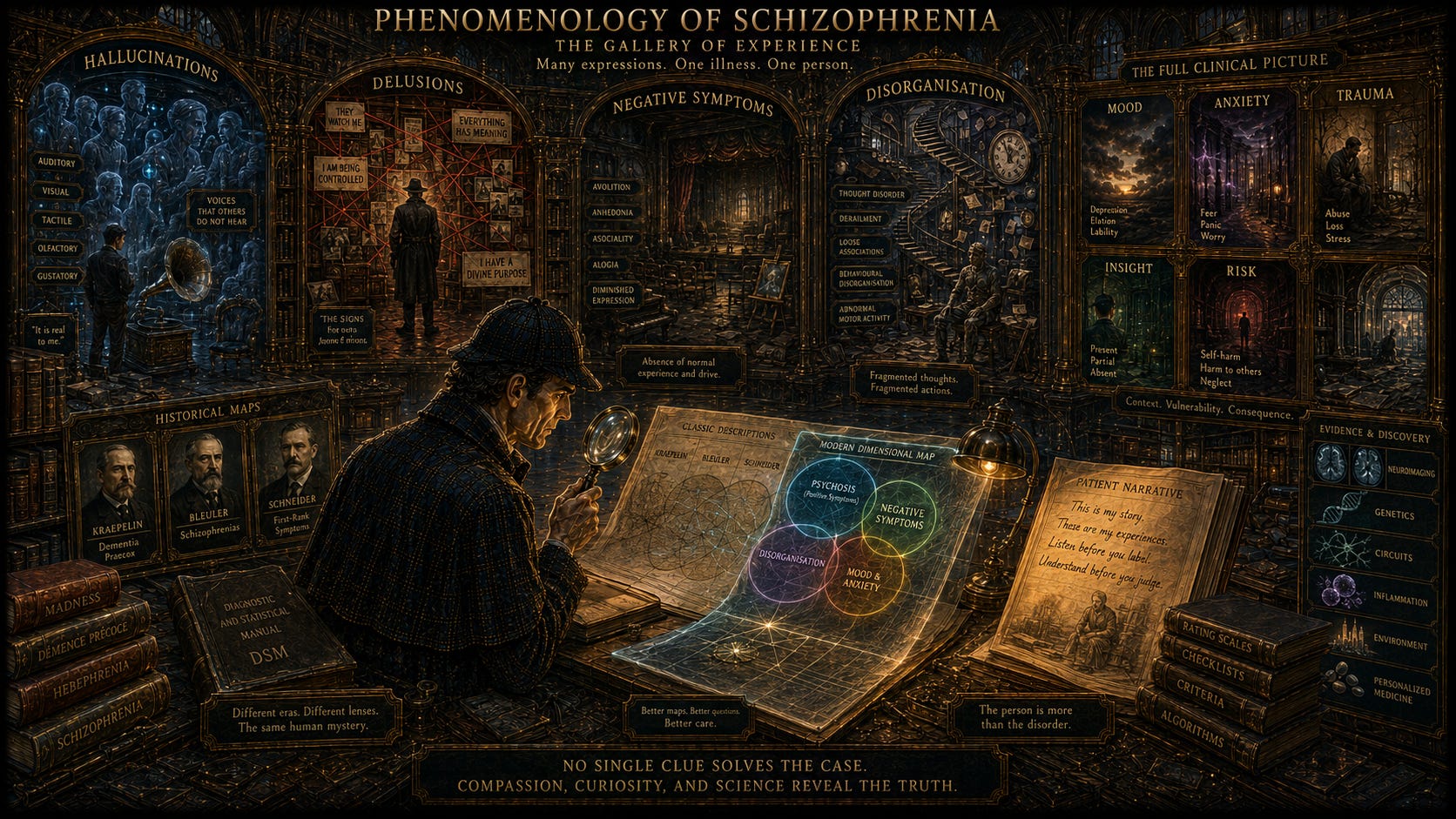
PSYCH 093: Phenomenology of Schizophrenia
Description
Medlock Holmes enters an enormous archive filled with thousands of witness statements.
Some describe voices no one else can hear.
Others speak of thoughts being inserted, removed, or broadcast beyond the boundaries of the mind.
Some accounts are crowded with elaborate conspiracies. Others contain only a few sparse words, long silences, diminished expression, and a life gradually emptied of purpose.
Every file is different.
Yet all have been placed beneath the same heading:
Schizophrenia.
Holmes immediately recognises the central challenge. There is no definitive laboratory test that confirms the diagnosis. No single hallucination, delusion, movement, or pattern of speech belongs exclusively to schizophrenia. The disorder remains defined through phenomenology: the disciplined study of what a person experiences, how those experiences are expressed, and how they change across time.
The investigation begins with history. Kraepelin organised the illness around course and deterioration, describing dementia praecox as a disruption of intellect, emotion, and volition. Bleuler shifted attention towards the fragmentation of psychological functions and his Four As: disturbed associations, autism, abnormal affect, and ambivalence. Schneider later attempted to improve diagnostic reliability through first-rank symptoms such as thought insertion, thought withdrawal, thought broadcasting, passivity experiences, and voices commenting or conversing.
Each investigator illuminated part of the landscape.
None captured the whole country.
Modern diagnostic systems therefore rely not upon one pathognomonic clue, but upon patterns of symptoms, duration, functional change, and exclusions. Hallucinations, delusions, disorganised speech, abnormal behaviour, and negative symptoms must be interpreted alongside mood episodes, substance exposure, medical illness, developmental history, and longitudinal course.
Holmes then divides the archive into several great chambers.
The first contains psychotic symptoms. Hallucinations may arise in any sensory modality, although auditory voices are most common. Delusions range from persecution and reference to grandiosity, passivity, religious meaning, and altered ownership of thought. Yet neither hallucinations nor delusions are unique to schizophrenia. Their diagnostic significance lies in their severity, persistence, context, and relationship with the rest of the syndrome.
The second chamber contains negative symptoms.
Here the clues are quieter and more easily missed: avolition, anhedonia, asociality, diminished emotional expression, and alogia. These symptoms often predict disability more powerfully than hallucinations or delusions. Holmes also learns to distinguish primary negative symptoms from those caused by depression, medication, institutional deprivation, fear, or distracting psychosis. What appears to be absence of motivation may have several entirely different causes.
The third chamber contains disorganisation.
Speech becomes tangential, vague, derailed, or incoherent. Behaviour loses its internal structure. Gestures become purposeless, clothing inappropriate, affect incongruent, and ordinary action strangely fragmented. Thought disorder is not a disorder of what someone believes, but of how ideas are linked and communicated.
Around these principal chambers lie others that psychiatry has sometimes neglected: depression, anxiety, trauma, obsessive-compulsive symptoms, agitation, hostility, suicidality, impaired insight, and cognitive difficulty. These are not decorative details. They shape risk, distress, engagement, functioning, and treatment.
Holmes realises that phenomenology requires more than checking boxes.
A voice may be threatening, comforting, commanding, or companionable. A delusion may be fleeting or systemati