Episode Details
Back to Episodes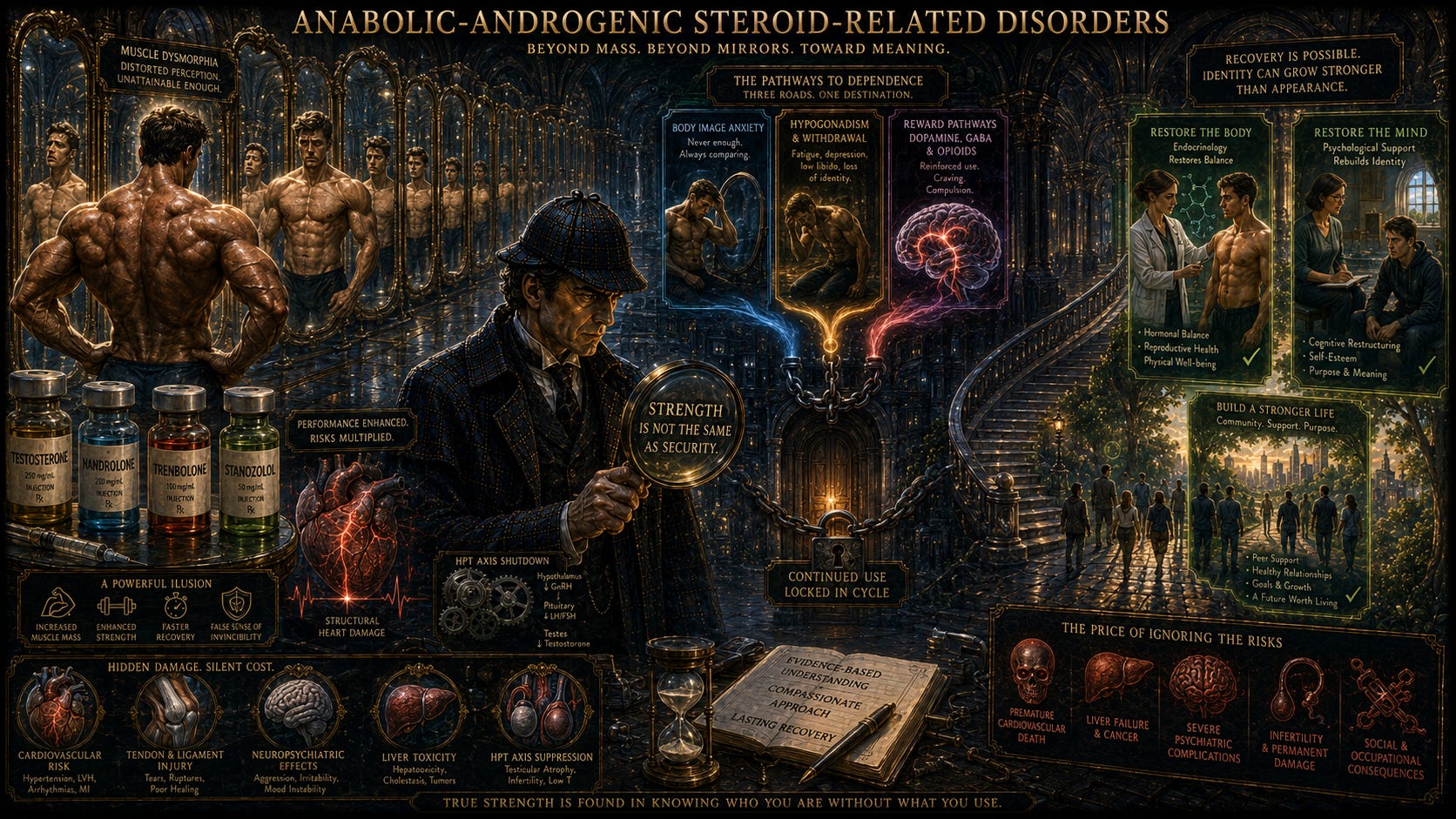
PSYCH 091: Anabolic-Androgenic Steroid-Related Disorders
Description
A famous bodybuilder walks into Medlock Holmes’ consulting room.
He is physically magnificent.
Broad shoulders. Sculpted chest. Powerful arms.
Yet Holmes notices something else.
The man cannot stop looking at his reflection.
Every polished surface becomes another mirror.
Every missed gym session feels catastrophic.
Every slight reduction in muscle size feels like losing part of himself.
Holmes quickly realises that this is not simply a story about muscles.
It is a story about identity.
Most people think anabolic-androgenic steroids (AAS) are drugs used by elite athletes chasing Olympic medals.
Holmes discovers the opposite.
Today, most users are ordinary men seeking a more muscular appearance rather than sporting success. The average age of first use is approximately 23 years, much later than most other illicit substances, and use is overwhelmingly confined to males.
Holmes begins by separating two commonly confused substances.
The drugs used by bodybuilders are anabolic-androgenic steroids, synthetic derivatives of testosterone designed to increase muscle growth while also producing masculinising effects.
These are entirely different from corticosteroids such as prednisolone, which reduce inflammation and have virtually no muscle-building properties. Confusing these two families of steroids remains remarkably common among both patients and clinicians.
The detective then asks a more interesting question.
If testosterone is a natural hormone, why does it become dangerous?
The answer lies in dosage.
Medical testosterone replacement simply restores normal physiological levels.
Illicit users often consume 10 to 100 times therapeutic doses, frequently combining several different steroids simultaneously (”stacking”) to achieve enormous supraphysiological androgen concentrations.
The result is extraordinary muscle growth.
But Holmes knows that biology never grants gifts without demanding payment.
As the investigation progresses, Holmes uncovers a fascinating paradox.
The body becomes stronger.
The brain becomes less stable.
Most users experience little psychiatric disturbance.
However, a vulnerable minority develop profound psychological changes.
Some become unusually energetic.
Need less sleep.
Feel invincible.
Become impulsive.
Spend recklessly.
Display intense irritability.
Others develop frank mania or even psychosis with grandiose or paranoid delusions. The risk increases substantially with higher steroid doses, particularly above the equivalent of 1,000 mg of testosterone per week.
Then comes the opposite problem.
When the steroids stop, testosterone production collapses.
The hypothalamic-pituitary-testicular (HPT) axis has been suppressed by months of external hormones.
Instead of euphoria comes exhaustion.
Instead of confidence comes depression.
Instead of libido comes sexual dysfunction.
Some men become severely depressed during withdrawal, and a minority require antidepressants-or even electroconvulsive therapy-for prolonged episodes.
Holmes soon encounters the most surprising diagnosis of all.
Muscle dysmorphia.
Unlike anorexia nervosa, where individuals see themselves as larger than they are, these men see themselves as too small, even when objectively extremely muscular.
Every mirror lies.
Every comparison hurts.
Every kilogram of lost muscle feels like personal failure.
This distorted body image becomes one of the strongest drivers of continued steroid use.
Holmes realises the steroids are no longer building muscle.
They are medicating fear.
The detective next investigates dependence.
Unlike co