Episode Details
Back to Episodes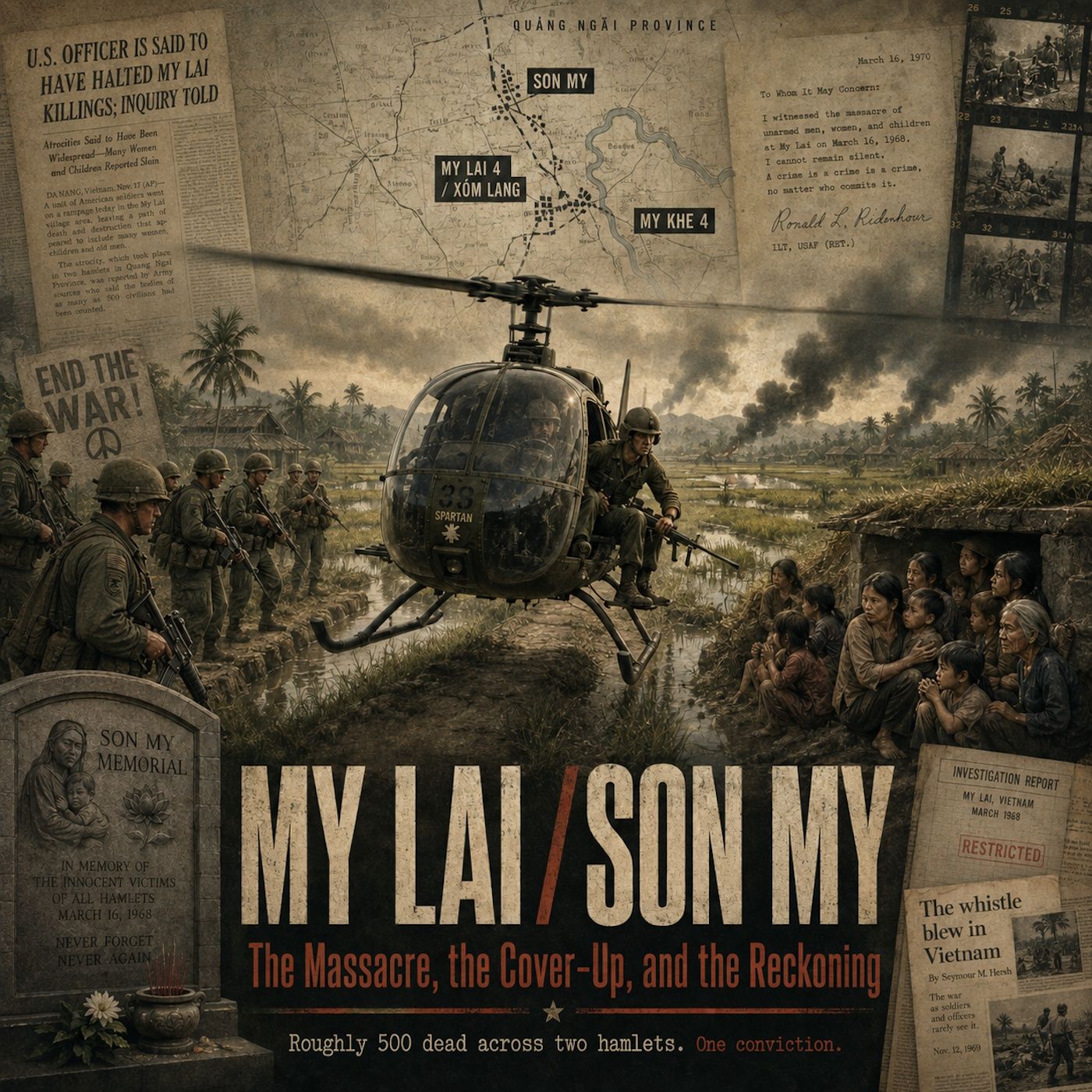
The Massacre At Son My
Published 1 month, 1 week ago
Description
On the morning of March 16, 1968, an American helicopter pilot named Hugh Thompson dropped a smoke grenade to mark a wounded Vietnamese woman so a medic could reach her. He flew a circuit and came back a few minutes later. She was dead, and an American officer was standing over her.
Within the hour, Thompson would land his helicopter between armed American infantry and a bunker full of civilians and tell his own door gunner to open fire on Americans if they opened fire on the villagers.Almost everyone has heard of My Lai.
Almost everything most people believe about it is wrong or badly incomplete. It wasn't one village. It was a village complex called Son My made up of four hamlets, and the place we call My Lai 4 was actually a sub-hamlet named Xom Lang that American mapmakers mislabeled. It wasn't one company, because two separate American infantry units killed civilians in Son My that morning, several kilometers apart, under the same task force headquarters. And it wasn't one man, because the Army's own inquiry identified roughly 30 officers and enlisted men who either committed crimes or helped bury them afterward, up to and including a major general commanding a division.This episode walks the whole operation from the beginning.
The attrition strategy and the body-count culture that made dead Vietnamese the measure of a good officer. Quang Ngai Province, the free-fire zones, and why American troops called the area Pinkville. Task Force Barker, an ad hoc unit thrown together from three companies that had never worked with each other, under a colonel who had commanded the brigade for exactly one day when the massacre happened. Charlie Company's three months of losing men to mines and booby traps without ever getting a fight, including the February 25 minefield and the booby trap that killed Sergeant George Cox on March 14.
The memorial service on March 15, and the briefing Captain Ernest Medina gave that night, which remains the most disputed half hour in the case.Then the morning itself. Artillery preparation beginning around 7:22 a.m., a landing zone that turned out to be completely cold, and a company that came off the aircraft firing at people who were not shooting back. Charlie Company took no incoming fire that day and captured 3 weapons. The only American casualty shot himself in the foot. What they reported afterward was 128 enemy killed.
The episode covers the irrigation ditch, where somewhere between 70 and 80 people were gathered and shot, and the trail junction to the south where another 20 to 30 were killed. The men who refused to fire, and what happened to them, which was nothing. The rapes and mutilations documented by the Peers Inquiry. Hugh Thompson, Lawrence Colburn, and Glenn Andreotta in detail, including the child Andreotta carried out of the ditch alive, and the 30 years it took the Army to award those three men the Soldier's Medal. Andreotta was killed in action on April 8, 1968, three weeks after the massacre.
There is a substantial section on My Khe 4, the second massacre, which almost nobody has heard of. Bravo Company, a different battalion, different officers, men who never attended Medina's briefing and had never met William Calley, killing roughly 90 civilians in a coastal sub-hamlet on the same morning and reporting 38 enemy dead. It only came to light because investigators digging into My Lai tripped over it.The back half is the concealment and the reckoning. Colonel Oran Henderson's April 1968 investigation, which concluded about 20 civilians had been killed inadvertently.
The Viet Cong leaflet that was substantially accurate and was used as proof the whole thing was fabricated. Tom Glen's letter to General Abrams in late 1968 and the young major who reviewed it. Ronald Ridenhour, a door gunner who heard about it secondhand in April 1968, spent months quietly interviewing witnesses, and mailed a letter on March 29, 1
Within the hour, Thompson would land his helicopter between armed American infantry and a bunker full of civilians and tell his own door gunner to open fire on Americans if they opened fire on the villagers.Almost everyone has heard of My Lai.
Almost everything most people believe about it is wrong or badly incomplete. It wasn't one village. It was a village complex called Son My made up of four hamlets, and the place we call My Lai 4 was actually a sub-hamlet named Xom Lang that American mapmakers mislabeled. It wasn't one company, because two separate American infantry units killed civilians in Son My that morning, several kilometers apart, under the same task force headquarters. And it wasn't one man, because the Army's own inquiry identified roughly 30 officers and enlisted men who either committed crimes or helped bury them afterward, up to and including a major general commanding a division.This episode walks the whole operation from the beginning.
The attrition strategy and the body-count culture that made dead Vietnamese the measure of a good officer. Quang Ngai Province, the free-fire zones, and why American troops called the area Pinkville. Task Force Barker, an ad hoc unit thrown together from three companies that had never worked with each other, under a colonel who had commanded the brigade for exactly one day when the massacre happened. Charlie Company's three months of losing men to mines and booby traps without ever getting a fight, including the February 25 minefield and the booby trap that killed Sergeant George Cox on March 14.
The memorial service on March 15, and the briefing Captain Ernest Medina gave that night, which remains the most disputed half hour in the case.Then the morning itself. Artillery preparation beginning around 7:22 a.m., a landing zone that turned out to be completely cold, and a company that came off the aircraft firing at people who were not shooting back. Charlie Company took no incoming fire that day and captured 3 weapons. The only American casualty shot himself in the foot. What they reported afterward was 128 enemy killed.
The episode covers the irrigation ditch, where somewhere between 70 and 80 people were gathered and shot, and the trail junction to the south where another 20 to 30 were killed. The men who refused to fire, and what happened to them, which was nothing. The rapes and mutilations documented by the Peers Inquiry. Hugh Thompson, Lawrence Colburn, and Glenn Andreotta in detail, including the child Andreotta carried out of the ditch alive, and the 30 years it took the Army to award those three men the Soldier's Medal. Andreotta was killed in action on April 8, 1968, three weeks after the massacre.
There is a substantial section on My Khe 4, the second massacre, which almost nobody has heard of. Bravo Company, a different battalion, different officers, men who never attended Medina's briefing and had never met William Calley, killing roughly 90 civilians in a coastal sub-hamlet on the same morning and reporting 38 enemy dead. It only came to light because investigators digging into My Lai tripped over it.The back half is the concealment and the reckoning. Colonel Oran Henderson's April 1968 investigation, which concluded about 20 civilians had been killed inadvertently.
The Viet Cong leaflet that was substantially accurate and was used as proof the whole thing was fabricated. Tom Glen's letter to General Abrams in late 1968 and the young major who reviewed it. Ronald Ridenhour, a door gunner who heard about it secondhand in April 1968, spent months quietly interviewing witnesses, and mailed a letter on March 29, 1