Episode Details
Back to Episodes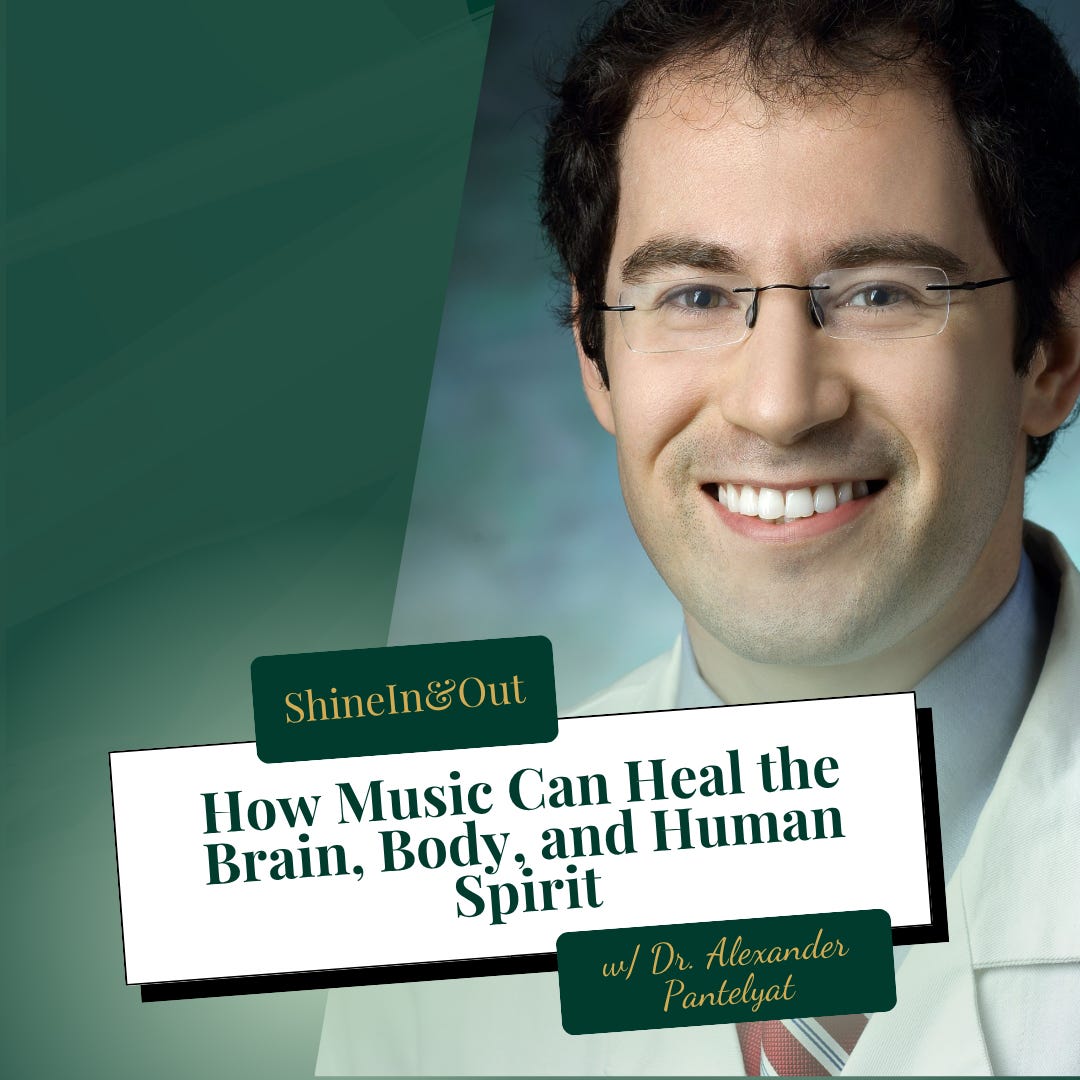
How Music Can Heal the Brain, Body, and Human Spirit | Dr. Alex Pantelyat
Description
What if music is more than something we listen to?
What if it can influence how the brain moves, remembers, connects, and heals?
In this fascinating episode of Shine In & Out, Samantha Stoltz sits down with Dr. Alexander Pantelyat, MD, FAAN, neurologist, movement disorders specialist, and co-Founder and Director of the Johns Hopkins Center for Music and Medicine, to explore the growing science behind music as medicine—and the deeply human experiences that make music so powerful.
Dr. Pantelyat's work focuses on movement disorders and neurodegenerative diseases, including Parkinson's disease, while his research explores how music-based rehabilitation may support movement, memory, cognition, and quality of life.
Together, Samantha and Dr. Pantelyat explore why music can affect people so differently, how rhythm can influence movement, why certain songs can unlock powerful memories and emotions, and why personalized approaches may be essential when using music therapeutically.
But the conversation goes beyond neuroscience.
They also explore music as a source of stress relief, emotional connection, social cohesion, and even some of life's most profound experiences. From playing music together in community to the chills and peak emotions music can create, this episode asks what music might reveal about the brain—and about what it means to be human.
✨ In This Episode:
• How music can influence the brain and body• The science behind music as medicine• Music-based rehabilitation for Parkinson's disease and neurodegenerative conditions• How rhythm can help support movement and motor function• Why music can trigger powerful memories and emotions• Why different people respond to music differently• The importance of personalized and precision music medicine• How making music together can strengthen social connection• Music, memory, cognition, and aging• How music can help prevent or reduce burnout• Why music may be deeply connected to human evolution and social cohesion• What music can teach us about being human
🎙️ About Dr. Alexander Pantelyat
Alexander Pantelyat, MD, FAAN is an Associate Professor of Neurology at the Johns Hopkins University School of Medicine. He is the founder and director of the Johns Hopkins Atypical Parkinsonism Center and co-Founder and Director of the Johns Hopkins Center for Music and Medicine.
His research focuses on atypical parkinsonian disorders, cognitive aspects of movement disorders, and music-based rehabilitation of neurodegenerative diseases.
Chapters:
(00:00) Introduction and Dr. Pantelyat’s clinical focus
(00:13) Becoming a movement disorders neurologist
(00:53) A family legacy of neurology
(02:09) Why observation-based diagnosis drew him to the field
(03:53) Playing violin since age seven
(05:21) Keeping music as solace instead of a profession
(07:32) Orchestral, chamber, and solo music life
(09:25) The occupational injury risk for musicians
(10:39) Mental pressure, identity, and self-sabotage in music careers
(12:51) Burnout, music, and protecting joy
(13:37) Music, womb rhythms, and evolutionary theories
(14:05) Drumbeat, social cohesion, and battle trance
(16:31) Why music reaches where language cannot
(16:56) Stroke patients singing despite language loss
(18:18) Melodic intonation therapy and music-based rehab
(19:23) Dopamine, chills, and personally meaningful music
(21:10) Anticipation, reward, and the caudate nucleus
(23:22) Expectations, emotion, and physiology
(25:25) Music before surgery and reduced anxiety and pain
(26:47) Precision music medicine and personalization
(29:49) The Barcelona Music Reward Questionnaire
(30:45) Overstimulation, silence, and different calming music needs
(32:15) Music, memory, and dementia
(34:29) AI, playlists, and scalable music tools