Episode Details
Back to Episodes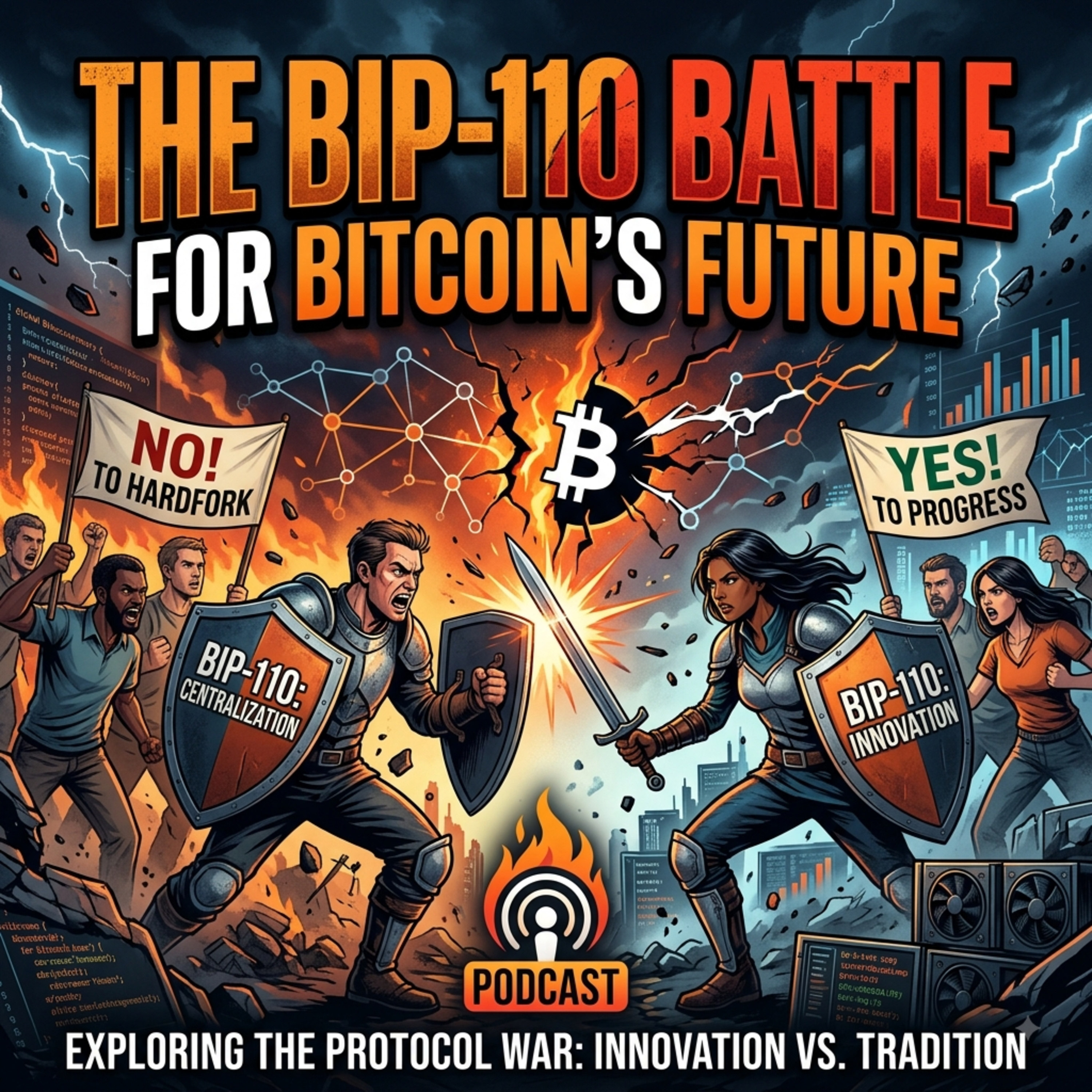
🔥 BIP-110: Is Bitcoin Under Attack? ⚔️ The Battle for Bitcoin’s Soul ₿
Description
Who Really Controls Bitcoin? The BIP-110 Battle for Bitcoin’s Future
Who actually owns Bitcoin — and who has the power to change its rules?
In this AI-generated deep dive, we explore the explosive BIP-110 controversy and the battle over what Bitcoin should ultimately be: decentralized, censorship-resistant money, or a permissionless platform where anyone can compete for block space.
BIP-110 emerged in response to the growing use of Bitcoin block space by Ordinals, BRC-20 tokens, Runes and other forms of arbitrary data. The proposal attempted to restrict the mechanisms used by these protocols through seven new consensus rules and was designed as a temporary soft fork.
But the technical proposal quickly became something much bigger — a philosophical battle over Bitcoin's identity, governance and decentralization.
In this episode, we examine:
• What BIP-110 actually proposed and why it was created
• How SegWit and Taproot helped enable the explosion of on-chain data
• Why supporters viewed inscriptions as spam and a threat to Bitcoin's decentralization
• Why opponents argued that Bitcoin must remain neutral and permissionless
• The debate between sound-money purists and protocol-neutrality advocates
• How a User-Activated Soft Fork (UASF) could challenge miner influence
• Why Bitcoin Core developers and other major figures opposed the activation strategy
• The economic risks facing miners if block-space demand changes
• What a contentious chain split could mean for exchanges and wallets
• Replay risk and the operational nightmare of managing two competing chains
• How Bitcoin ETFs, institutional investors and sovereign holders could be affected
• The potential regulatory implications of proving that Bitcoin can coordinate transaction filtering
• How AI-generated content and bots could manipulate perceived social consensus
• The attempted BIP-110 activation around block 961,632
• Why miner support reportedly remained at only around 2.5–2.6%
• How a minority chain briefly emerged before falling far behind the main chain
• The false panic surrounding previously created Taproot UTXOs and the grandfathering provision
• What the failed activation revealed about the balance between developers, nodes, miners and economic users
• And perhaps the biggest question of all: what happens when autonomous AI agents become major users of blockchain block space?
The BIP-110 episode ultimately raises a much bigger question than whether inscriptions belong on Bitcoin.
Who really has the power to decide what Bitcoin is?
Developers write the code.
Nodes enforce the rules.
Miners produce the blocks.
Exchanges and institutions provide economic liquidity.
And users ultimately decide which version of the network has value.
As AI agents become increasingly capable of generating transactions, writing software and spending money autonomously, the next major Bitcoin governance battle may no longer be humans arguing with humans.
It could be humans versus machines competing for the same scarce block space.
This is the BIP-110 story — and what it may tell us about the future of Bitcoin.
This episode is an AI-generated analysis and discussion based on the source material provided for the episode.