Episode Details
Back to Episodes
Episode 497 Megarachne
Description
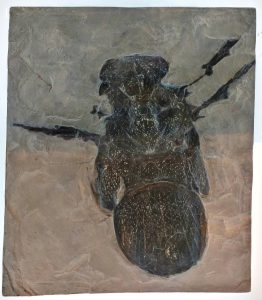
Megarachne as we know it now:
Show transcript:
Welcome to Strange Animals Podcast. I’m your host, Kate Shaw.
Megarachne is only known from two specimens, neither of which is complete, which adds to the confusion. It lived around 300 million years ago in what is now South America. It was described in 1980 from the first specimen discovered and was named Megarachne, which means big spider. The scientist who described it thought it was a type of primitive spider related to modern tarantulas, but much bigger. He estimated its legspan was 20 inches, or 50 cm, with a body length of just over 13 inches, or 34 cm. That made it the largest spider ever known by a lot.
Other palaeontologists, especially arachnologists who specialize in spiders and their relations, weren’t convinced Megarachne was a spider. But it wasn’t until 2005 when a more complete specimen was discovered that anyone could say for sure what it was. The second specimen made it clear that it wasn’t a spider at all but a sea scorpion, or eurypterid, and not an especially large one compared to some. It probably grew to 21 inches long, or 54 cm.
But by then, Megarachne had gotten really popular as a giant spider. It was in the BBC documentary Walking with Monsters, although the producers changed its name to Mesothelae right before it aired, which was just after the new findings about Megarachne came out. Mesothelae is a suborder of big spiders from parts of Asia that retain many traits of ancestral spiders. It was a valiant attempt by the BBC to make the documentary less incorrect, but of course the spider they were talking about still wasn’t a spider and no spider known has ever grown that large.
But while Megarachne isn’t a giant spider, and isn’t even a very big eurypterid, it is important since not very many eurypterids are known from South America. It also appears to be closely related to Mycterops and Woodwardopterus, similar-looking euripterids from North America and Europe. But some researchers think it’s not as cut and dried as it sounds. Instead of three similar creatures living in different areas, they think there’s something else going on.
Eurypterids were arthropods, the phylum that includes insects, arachnids, and crustaceans, among others. Arthropods have an exoskeleton that they molt periodically as they grow, and many arthropods have complicated life stages compared to other animals. When a shark hatches, it looks like a miniature adult and just grows larger as it gets older, but when an arthropod hatches, it usually doesn’t look anything like its adult form. Some arthropods go through many stages of life before reaching the adult body plan. Crustaceans have numerous larval stages, for instance, that often look very different from the adult. Some researchers think that Megarachne, Mycterops, and Woodwardopterus were all the same animal, and that the differences are due to it being in three different stages of development when it died and was preserved.
We don’t have any way to know if this was correct, of course, not until we hopefully find more fossil remains. Other eurypterids did appear to go through some physical changes during maturation, as far as researchers can tell with the remains we have, but Megarachne, Mycterops, and Woodwardopterus belonged to a different family from other eu