Episode Details
Back to Episodes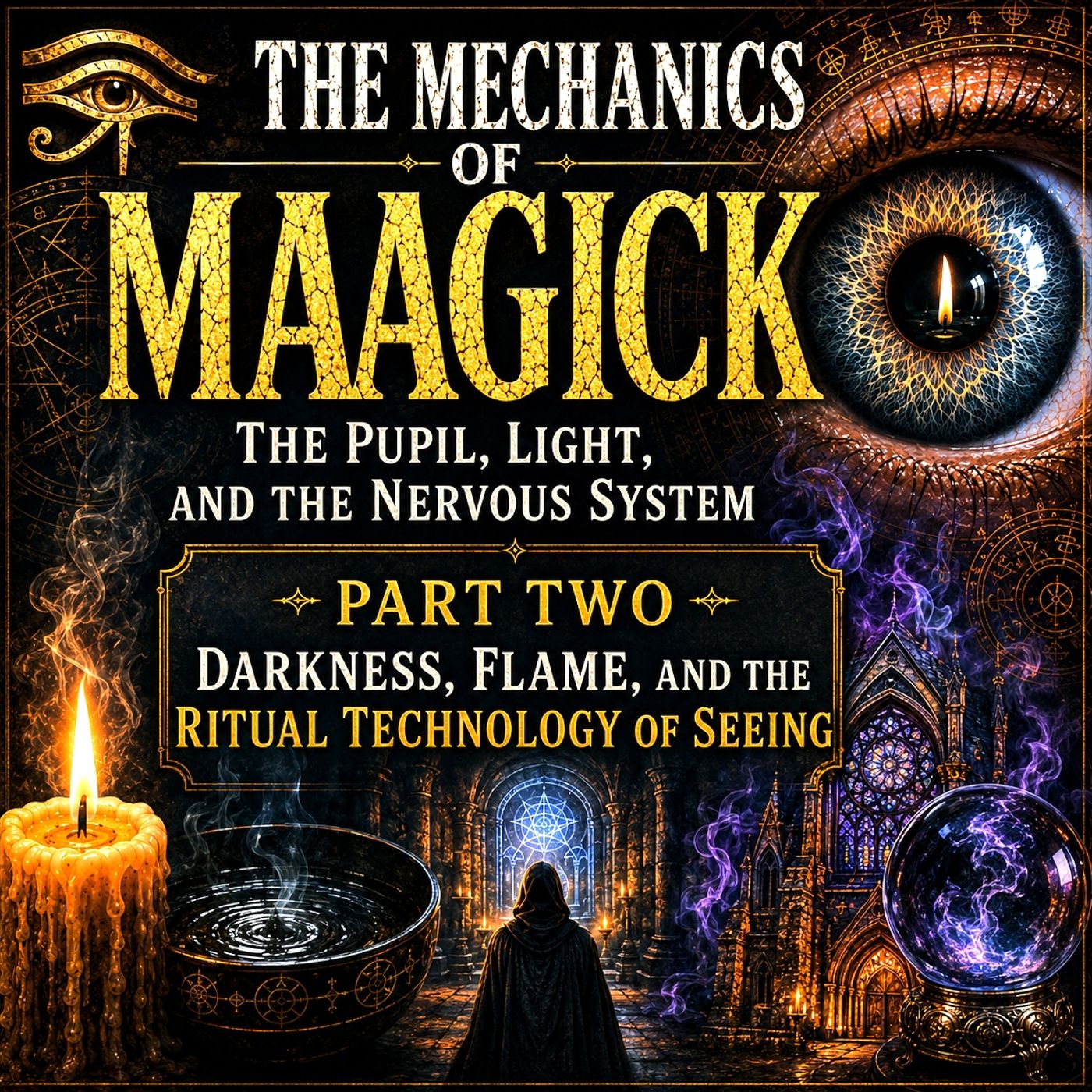
The Mechanics of Magick: The Pupil, Light, and the Nervous System Part Two- Darkness, Flame, and the Ritual Technology of Seeing
Published 2 months, 1 week ago
Description
If you enjoy this episode, we’re sure you will enjoy more content like this on The Occult Rejects. In fact, we have curated playlists on occult topics like grimoires, esoteric concepts and phenomena, occult history, analyzing true crime and cults with an occult lens, Para politics, and occultism in music. Whether you enjoy consuming your content visually or via audio, we’ve got you covered - and it will always be provided free of charge. So, if you enjoy what we do and want to support our work of providing accessible, free content on various platforms, please consider making a donation to the links provided below.
Thank you and enjoy the episode!
Links For The Occult Rejects
https://linktr.ee/theoccultrejects
Occult Research Institute
https://www.occultresearchinstitute.org/
Substack
https://substack.com/@theoccultrejects?r=7auau0&utm_campaign=profile&utm_medium=profile-page
Cash App
https://cash.app/$theoccultrejects
Venmo
@TheOccultRejects
Buy Me A Coffee
buymeacoffee.com/TheOccultRejects
Patreon
https://www.patreon.com/TheOccultRejects
Darkness, Sensory Deprivation, Caves, and Visionary Conditions
Ustinova, Yulia. Caves and the Ancient Greek Mind: Descending Underground in the Search for Ultimate Truth. Oxford: Oxford University Press, 2009.
Use for: caves, descent, darkness, ancient Greek revelation, incubation, inspired prophecy, and altered states in underground sacred settings.
Lewis-Williams, David. The Mind in the Cave: Consciousness and the Origins of Art. London: Thames & Hudson, 2002.
Use for: caves, prehistoric imagery, altered consciousness, visual phenomena, and symbolic environments. Use carefully because some interpretations of prehistoric religion remain debated.
Eliade, Mircea. The Sacred and the Profane: The Nature of Religion. New York: Harcourt, 1959.
Use for: sacred space, threshold, the difference between sacred and profane space, and the way religious environments reorganize orientation and meaning.
Zuckerman, Marvin, and Nathan Cohen. “Sources of Reports of Visual and Auditory Sensations in Perceptual-Isolation Experiments.” Psychological Bulletin 61, no. 1, 1964: 1–20.
Use for: sensory deprivation, perceptual isolation, visual/auditory sensations, and internally generated experiences under reduced stimulation.
Wackermann, Jiří, Peter Pütz, and Carsten Allefeld. “Ganzfeld-Induced Hallucinatory Experience, Its Phenomenology and Cerebral Electrophysiology.” Cortex 44, no. 10, 2008: 1364–1378.
Use for: Ganzfeld states, reduced/uniform sensory fields, pseudo-hallucinatory imagery, altered perception, and EEG findings.
Metzger, Wolfgang. “Optische Untersuchungen am Ganzfeld.” Psychologische Forschung 13, 1930: 6–29.
Use for: early Ganzfeld research and the effect of homogeneous visual fields on perception.
Shenyan, O., et al. “Visual Hallucinations Induced by Ganzflicker and Ganzfeld Differ in Frequency, Complexity, and Content.” Scientific Reports 14, 2024.
Use for: modern comparison between Ganzfeld and flicker-induced visual phenomena. Useful if connecting this episode back to the earlier flicker-light show.
Candlelight, Firelight, Sacred Atmosphere, and the Agency of Light
Bille, Mikkel, and Tim Flohr Sørensen. “An Anthropology of Luminosity: The Agency of Light.” Journal of Material Culture 12, no. 3, 2007: 263–284.
Use for: light as a social, material, emotional, and cultural agent; how light shapes atmosphere, social meaning, and movement.
Bille, Mikkel, and Tim Flohr Sørensen, eds. Elements of Architecture: Assembling Archaeology, Atmosphere and the Performance of Building Spaces. London: Routledge, 2016.
Use for: architecture, atmosphere, materiality, embodied space, and how built environments shape experience.
Pallasmaa, Juhani. The Eyes of the Skin: Architecture and t
Thank you and enjoy the episode!
Links For The Occult Rejects
https://linktr.ee/theoccultrejects
Occult Research Institute
https://www.occultresearchinstitute.org/
Substack
https://substack.com/@theoccultrejects?r=7auau0&utm_campaign=profile&utm_medium=profile-page
Cash App
https://cash.app/$theoccultrejects
Venmo
@TheOccultRejects
Buy Me A Coffee
buymeacoffee.com/TheOccultRejects
Patreon
https://www.patreon.com/TheOccultRejects
Darkness, Sensory Deprivation, Caves, and Visionary Conditions
Ustinova, Yulia. Caves and the Ancient Greek Mind: Descending Underground in the Search for Ultimate Truth. Oxford: Oxford University Press, 2009.
Use for: caves, descent, darkness, ancient Greek revelation, incubation, inspired prophecy, and altered states in underground sacred settings.
Lewis-Williams, David. The Mind in the Cave: Consciousness and the Origins of Art. London: Thames & Hudson, 2002.
Use for: caves, prehistoric imagery, altered consciousness, visual phenomena, and symbolic environments. Use carefully because some interpretations of prehistoric religion remain debated.
Eliade, Mircea. The Sacred and the Profane: The Nature of Religion. New York: Harcourt, 1959.
Use for: sacred space, threshold, the difference between sacred and profane space, and the way religious environments reorganize orientation and meaning.
Zuckerman, Marvin, and Nathan Cohen. “Sources of Reports of Visual and Auditory Sensations in Perceptual-Isolation Experiments.” Psychological Bulletin 61, no. 1, 1964: 1–20.
Use for: sensory deprivation, perceptual isolation, visual/auditory sensations, and internally generated experiences under reduced stimulation.
Wackermann, Jiří, Peter Pütz, and Carsten Allefeld. “Ganzfeld-Induced Hallucinatory Experience, Its Phenomenology and Cerebral Electrophysiology.” Cortex 44, no. 10, 2008: 1364–1378.
Use for: Ganzfeld states, reduced/uniform sensory fields, pseudo-hallucinatory imagery, altered perception, and EEG findings.
Metzger, Wolfgang. “Optische Untersuchungen am Ganzfeld.” Psychologische Forschung 13, 1930: 6–29.
Use for: early Ganzfeld research and the effect of homogeneous visual fields on perception.
Shenyan, O., et al. “Visual Hallucinations Induced by Ganzflicker and Ganzfeld Differ in Frequency, Complexity, and Content.” Scientific Reports 14, 2024.
Use for: modern comparison between Ganzfeld and flicker-induced visual phenomena. Useful if connecting this episode back to the earlier flicker-light show.
Candlelight, Firelight, Sacred Atmosphere, and the Agency of Light
Bille, Mikkel, and Tim Flohr Sørensen. “An Anthropology of Luminosity: The Agency of Light.” Journal of Material Culture 12, no. 3, 2007: 263–284.
Use for: light as a social, material, emotional, and cultural agent; how light shapes atmosphere, social meaning, and movement.
Bille, Mikkel, and Tim Flohr Sørensen, eds. Elements of Architecture: Assembling Archaeology, Atmosphere and the Performance of Building Spaces. London: Routledge, 2016.
Use for: architecture, atmosphere, materiality, embodied space, and how built environments shape experience.
Pallasmaa, Juhani. The Eyes of the Skin: Architecture and t