Episode Details
Back to Episodes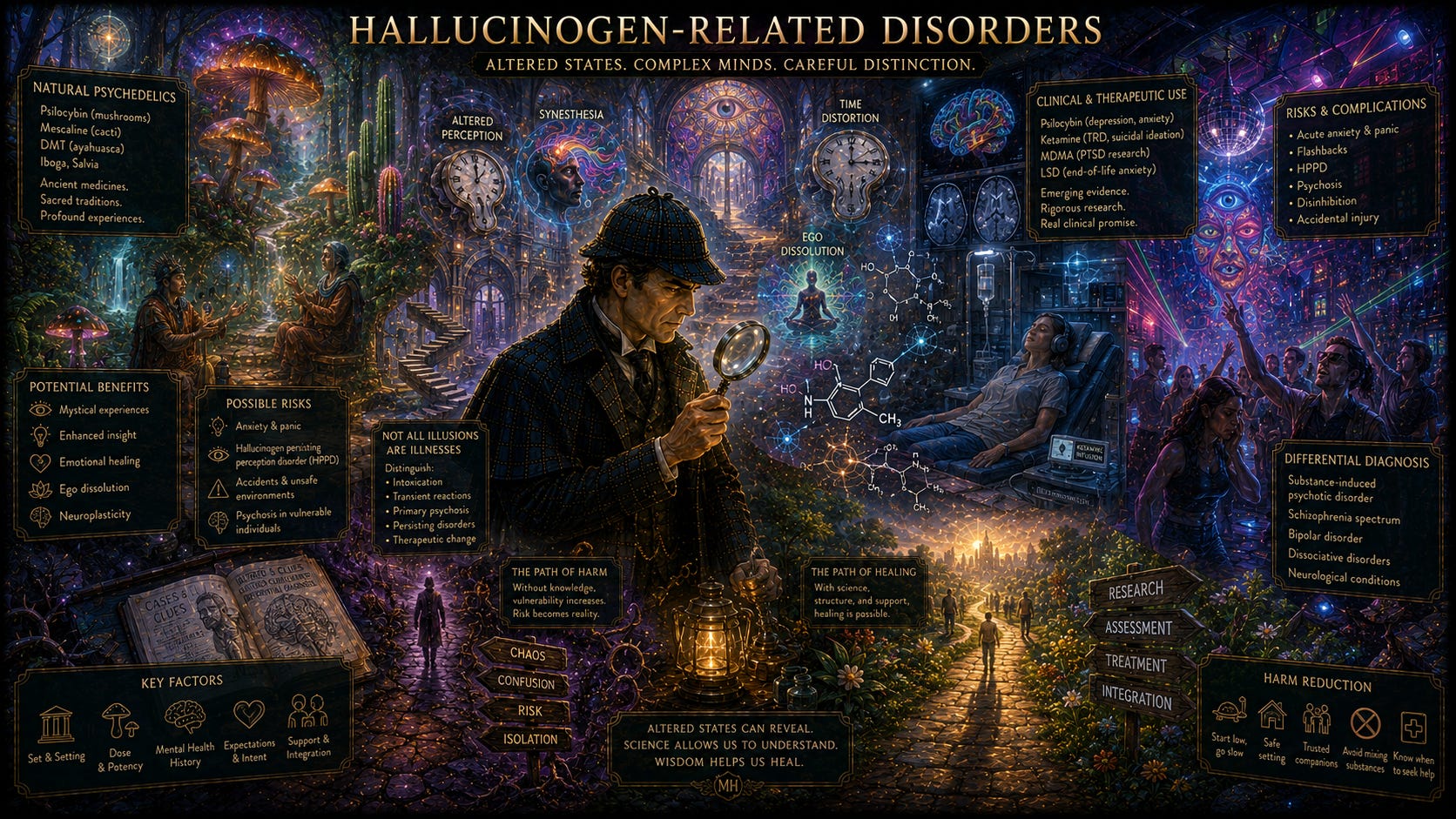
PSYCH 086: Hallucinogen-Related Disorders
Description
Medlock Holmes is called to investigate a series of extraordinary reports.
One witness describes colours that seem alive. Another believes time has stopped. A third feels completely detached from their own body, while another speaks of overwhelming love, profound spiritual insight, or terrifying paranoia. Some recover within hours, while others continue to experience disturbing visual phenomena months or even years later.
At first glance, every case appears to point towards severe mental illness.
Yet Holmes notices an important clue.
These experiences all follow exposure to substances capable of profoundly altering consciousness.
This chapter explores the fascinating and rapidly evolving world of hallucinogen-related disorders. Unlike many other psychoactive substances, hallucinogens primarily alter perception, awareness, emotion, and the sense of self while often leaving consciousness intact. Rather than simply causing intoxication, they reshape how reality itself is experienced.
Holmes discovers that “hallucinogen” is actually an umbrella term covering remarkably different substances. Classic psychedelics such as LSD, psilocybin, mescaline and DMT primarily act through serotonin receptors and produce vivid perceptual changes and altered states of consciousness. Dissociative agents such as ketamine and PCP disrupt the normal integration of sensory information, creating feelings of detachment from the body and environment. MDMA occupies another category altogether, enhancing emotional connectedness and empathy while also carrying significant medical risks. Other naturally occurring compounds, including salvinorin A and ibogaine, produce unique alterations of consciousness through entirely different neurochemical pathways.
As Holmes interviews each individual, he realises that the same substance can produce vastly different experiences depending on the person, their expectations, and the environment in which it is taken. The concepts of “set” and “setting” emerge as critical determinants of whether the experience becomes therapeutic, frightening, enlightening, or dangerous.
Most episodes resolve without lasting harm, but some do not.
Holmes encounters individuals overwhelmed by panic during intoxication, others developing prolonged psychotic symptoms, and some experiencing persistent visual disturbances long after the drug has left their body. Hallucinogen Persisting Perception Disorder (HPPD) reminds him that, for a small number of people, altered perception can continue long after the original experience has ended, creating significant distress despite intact insight.
The chapter also explores one of psychiatry’s most intriguing paradoxes.
For decades these substances were viewed almost exclusively as drugs of misuse. Today, carefully controlled clinical research is once again investigating psychedelic-assisted therapies for treatment-resistant depression, post-traumatic stress disorder, addiction, and end-of-life distress. Ketamine has already become an established treatment for resistant depression, while other compounds continue to be evaluated in rigorous clinical trials.
Holmes recognises that this changing landscape creates new responsibilities for clinicians. Patients may increasingly ask about psychedelic therapies, experiment with self-treatment, or present with complications of recreational use. Understanding both the potential benefits and the risks becomes essential.
By the conclusion of the investigation, Holmes reaches a balanced perspective.
Hallucinogens are neither miracle medicines nor simply dangerous drugs.
They are powerful tools capable of profoundly altering consciousness. Used in uncontrolled settings, they may produce medical emergencies, psychological trauma, or persistent psychiatric disorders. Used carefully within structured therapeutic environments, they may eventually transform aspects of psychiatric tre