Episode Details
Back to Episodes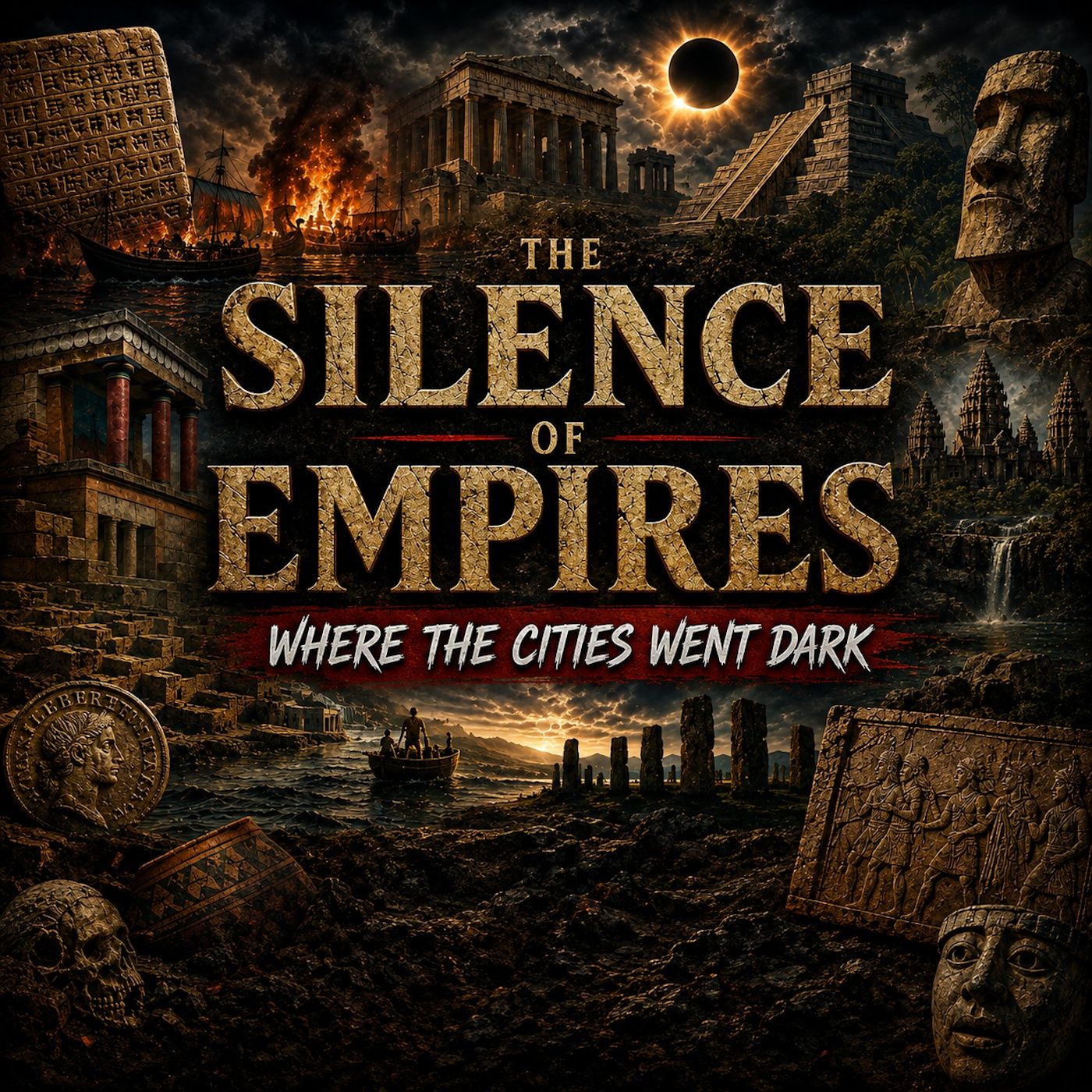
The Silence Of Empires
Published 1 month, 2 weeks ago
Description
Around 1200 BC, a king named Ammurapi dictated a letter from the port city of Ugarit describing seven enemy ships, burned towns, and an army that was somewhere else. That tablet was still sitting in the ruins more than 3,000 years later when a French archaeologist pulled it out of the ash. It's the only case in this entire episode where somebody put the emergency on the record while it was still happening.
Everywhere else, the silence is the story. In this episode we work through the civilizations that flourished for 30 generations and then simply stopped, and we look at what the evidence actually shows rather than the version most of us got in school.We cover the Late Bronze Age collapse and the Sea Peoples, including the 3 consecutive drought years that Cornell researchers dated to roughly 1198 through 1196 BC using juniper tree rings, and the discovery that the Hittite capital at Hattusa was emptied of its archives and valuables before anyone set fire to it.
We go to Minoan Crete, to the town at Akrotiri that was buried in ash with no bodies and no valuables left in it, and to the disputed sanctuary at Anemospilia, destroyed around 1700 BC, where 4 skeletons were found and no full excavation report was ever published. We take apart Mortimer Wheeler's massacre at Mohenjo-daro, which never happened, and look at what the weakening monsoon and the shifting rivers actually did to the Indus cities between about 2600 and 1900 BC.We spend real time on Rome.
The denarius falling from roughly 98 percent silver under Augustus to a coin under 5 percent silver by the 260s AD, copper with a wash thin enough to rub off in your pocket. Something like 26 claimants to the throne in the 50 years between 235 and 284. The pottery, roof tiles, and coffins that vanish from the archaeological record across the western provinces. Odoacer shipping the imperial regalia to Constantinople in 476 while nobody alive treated it as an ending. And the year 536, when the sun went dim across three continents and stayed that way, followed by volcanic eruptions in 540 and 547 and a cold period that ran until about 660.
Then the Maya, where we can read the dates carved on the monuments and watch the lights go out city by city, from the unfinished altar at Copán with two blank faces, commissioned in 822, to the last Long Count date anywhere, carved at Toniná in January of 909. Along the way, the royal court at Cancuén, 31 people found dismembered in a palace cistern around the year 800 with their jade still on them. Chaco Canyon, where a dynasty traced through mothers was buried in one room roughly 6 feet square for about 330 years.
Cahokia, and the 53 young women laid out in two orderly rows inside Mound 72, all of them local. Angkor, where the people who ran the waterworks left a century before the waterworks failed. And Rapa Nui, where the collapse everybody has heard about did not happen, and the one that did was documented in writing by the people who carried it out, ending with a recorded population of 111 in 1877.
Email Brian
Join Our FREE Newsletter
Get Brian's Books
Leave Us A Voicemail
Visit Our Website
Have a forgotten historical mystery, disturbing event, unsolved crime, or hidden conspiracy you think deserves investigation?
Send your suggestions to brian@paranormalworldproductions.com.
Disturbing History is a
Everywhere else, the silence is the story. In this episode we work through the civilizations that flourished for 30 generations and then simply stopped, and we look at what the evidence actually shows rather than the version most of us got in school.We cover the Late Bronze Age collapse and the Sea Peoples, including the 3 consecutive drought years that Cornell researchers dated to roughly 1198 through 1196 BC using juniper tree rings, and the discovery that the Hittite capital at Hattusa was emptied of its archives and valuables before anyone set fire to it.
We go to Minoan Crete, to the town at Akrotiri that was buried in ash with no bodies and no valuables left in it, and to the disputed sanctuary at Anemospilia, destroyed around 1700 BC, where 4 skeletons were found and no full excavation report was ever published. We take apart Mortimer Wheeler's massacre at Mohenjo-daro, which never happened, and look at what the weakening monsoon and the shifting rivers actually did to the Indus cities between about 2600 and 1900 BC.We spend real time on Rome.
The denarius falling from roughly 98 percent silver under Augustus to a coin under 5 percent silver by the 260s AD, copper with a wash thin enough to rub off in your pocket. Something like 26 claimants to the throne in the 50 years between 235 and 284. The pottery, roof tiles, and coffins that vanish from the archaeological record across the western provinces. Odoacer shipping the imperial regalia to Constantinople in 476 while nobody alive treated it as an ending. And the year 536, when the sun went dim across three continents and stayed that way, followed by volcanic eruptions in 540 and 547 and a cold period that ran until about 660.
Then the Maya, where we can read the dates carved on the monuments and watch the lights go out city by city, from the unfinished altar at Copán with two blank faces, commissioned in 822, to the last Long Count date anywhere, carved at Toniná in January of 909. Along the way, the royal court at Cancuén, 31 people found dismembered in a palace cistern around the year 800 with their jade still on them. Chaco Canyon, where a dynasty traced through mothers was buried in one room roughly 6 feet square for about 330 years.
Cahokia, and the 53 young women laid out in two orderly rows inside Mound 72, all of them local. Angkor, where the people who ran the waterworks left a century before the waterworks failed. And Rapa Nui, where the collapse everybody has heard about did not happen, and the one that did was documented in writing by the people who carried it out, ending with a recorded population of 111 in 1877.
Email Brian
Join Our FREE Newsletter
Get Brian's Books
Leave Us A Voicemail
Visit Our Website
Have a forgotten historical mystery, disturbing event, unsolved crime, or hidden conspiracy you think deserves investigation?
Send your suggestions to brian@paranormalworldproductions.com.
Disturbing History is a