Episode Details
Back to Episodes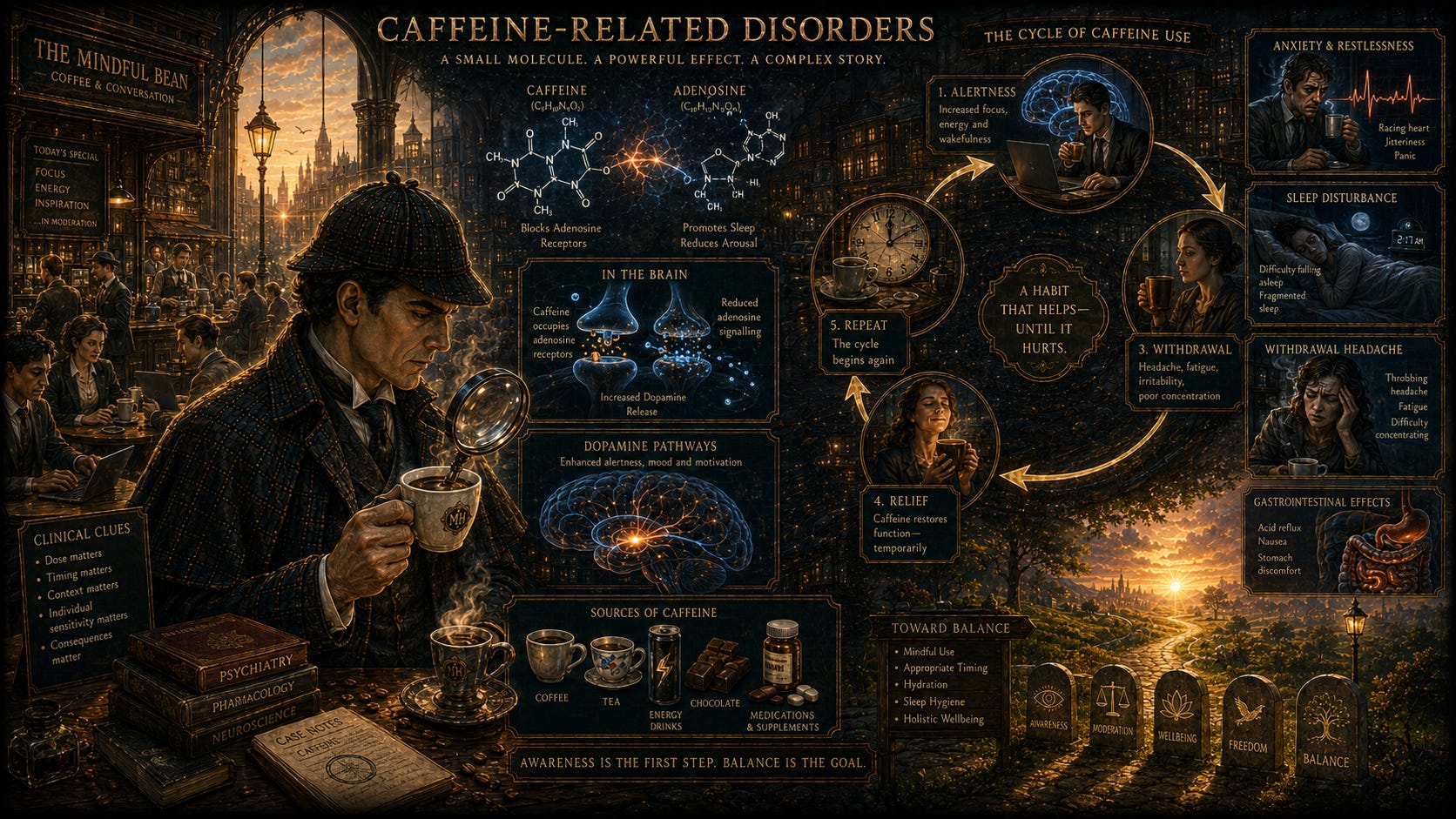
PSYCH 084: Caffeine-Related Disorders
Description
Every morning, before the city truly awakens, Medlock Holmes notices a remarkable ritual.
Office lights flicker on.
Coffee machines begin to hiss.
Kettles whistle.
Students cradle steaming mugs.
Doctors begin ward rounds with takeaway cups in hand.
Parents finally feel awake after the first sip.
Unlike the illicit drugs Holmes has investigated before, no one hides this substance.
It is celebrated.
Shared.
Offered to guests.
Embedded within culture itself.
Yet Holmes is puzzled.
How can the world’s most socially accepted psychoactive substance also be capable of intoxication, withdrawal, anxiety, insomnia, dependence, and addiction?
His newest investigation begins not in a crime scene-but in a café.
Holmes quickly discovers that caffeine is the most widely consumed psychoactive drug in the world, with around 90% of adults consuming it regularly. It is naturally present in coffee, tea, cocoa, yerba mate and many other plants, while manufacturers also add it to soft drinks, energy drinks, medications, dietary supplements and foods.
Unlike amphetamines or cocaine, caffeine works primarily by blocking adenosine receptors.
Adenosine normally acts like the brain’s biological brake pedal.
Throughout the day, adenosine gradually accumulates.
The more adenosine binds to its receptors, the sleepier we become.
Caffeine disguises itself as adenosine.
It occupies the receptor without activating it.
The brake disappears.
The brain becomes more alert.
Indirectly, dopamine signalling also increases, producing greater motivation, attention and reward.
Holmes smiles.
“The engine,” he says, “was never made stronger.”
“You merely disconnected the brakes.”
The chapter explores the remarkable pharmacology of caffeine.
After ingestion, caffeine is rapidly absorbed, reaching peak blood levels within approximately 30–60 minutes. Its average half-life is four to six hours, although this varies considerably depending on genetics, pregnancy, oral contraceptive use, smoking, liver disease and interacting medications. Slow metabolisers may experience caffeine’s effects for far longer than expected.
Holmes begins interviewing patients.
Each tells a different story.
A medical student drinks two coffees before an examination and feels focused.
A lawyer drinks six coffees and cannot stop pacing.
A teenager consumes multiple energy drinks before sport and develops palpitations.
A psychiatrist cannot function until the second cup each morning.
The same molecule.
Different brains.
Different outcomes.
Holmes learns that caffeine’s effects are strongly dose dependent.
Low to moderate doses (around 20–200 mg) typically improve alertness, energy, concentration, mood and motivation while reducing fatigue.
At higher doses (usually ≥400 mg), benefits begin to disappear.
Instead, anxiety, nervousness, tremor, jitteriness and restlessness emerge. Performance may actually worsen despite feeling more awake.
He remarks:
“The dose decides whether caffeine becomes an ally-or an adversary.”
His next investigation concerns caffeine intoxication.
Unlike alcohol intoxication, most people never intend to become intoxicated with caffeine.
Instead, it happens accidentally.
Extra coffees during deadlines.
Multiple energy drinks during examinations.
Workout supplements combined with coffee.
Weight-loss tablets.
Cold medications.
The total quietly accumulates.
DSM-5-TR suggests intoxication generally follows recent consumption well above 250 mg, although more severe presentations often involve much larger doses. Typical symptoms include:
* Restlessness
* Nervousness
* Excitement
* Insomnia
* Diuresis