Episode Details
Back to Episodes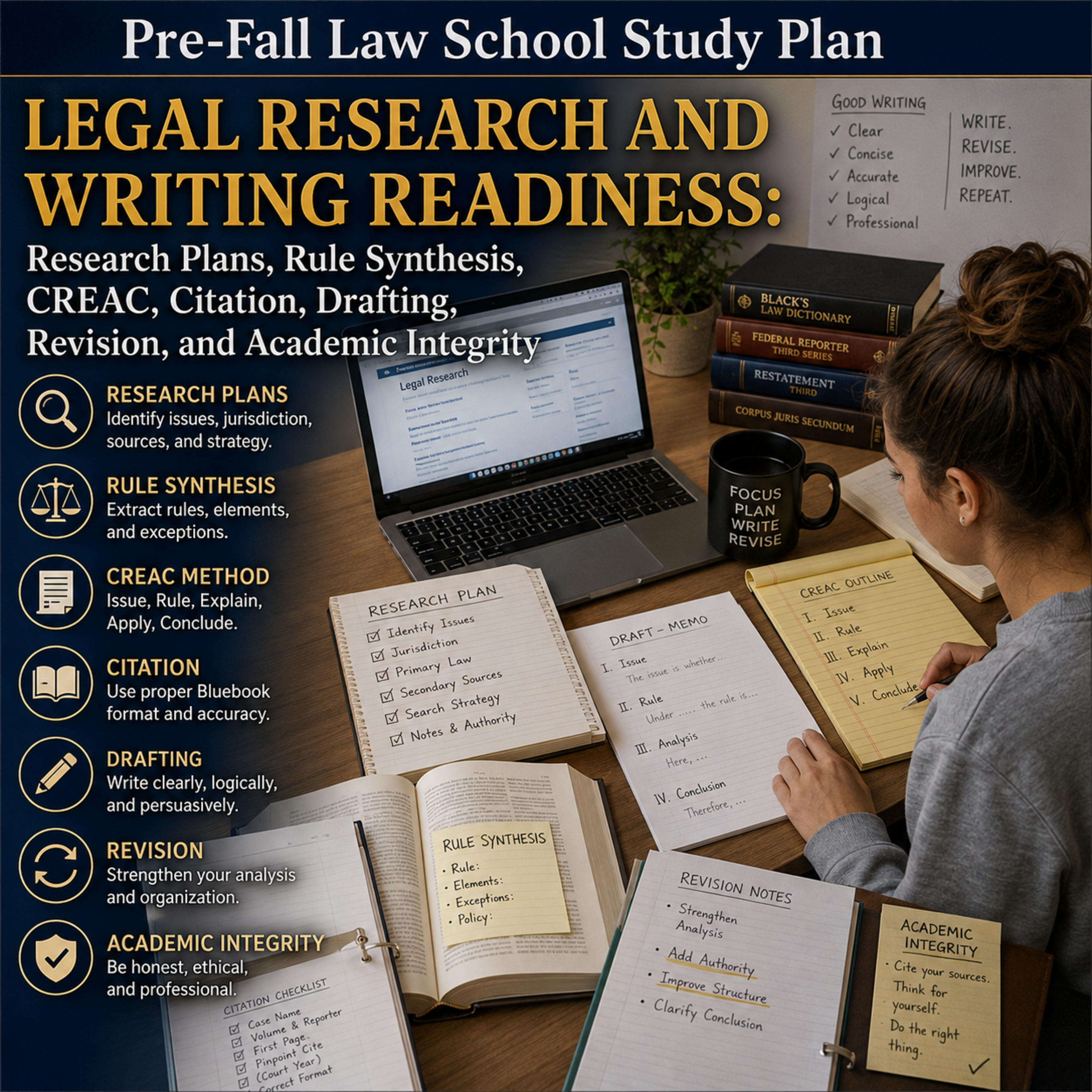
Pre-Fall Law School Study Plan: Legal Research and Writing Readiness: Research Plans, Rule Synthesis, CREAC, Citation, Drafting, Revision, and Academic Integrity
Description
📘 FREE COMPANION STUDY GUIDE 📘
👉 CLICK HERE TO OPEN YOUR FREE STUDY GUIDE 👈
Turn this episode into an exam-ready study plan.
🎧 EPISODE SUMMARY 🎧
Legal Research and Writing requires professional-quality work that is authority-based, rule-driven, reader-centered, fact-specific, and carefully organized.
Students must decode assignments by identifying the client, issue, jurisdiction, audience, document type, tone, deadline, length limit, citation system, permitted sources, and purpose before researching.
Objective writing predicts outcomes and addresses adverse authority or weaknesses. Persuasive writing advocates by framing rules favorably, emphasizing supportive facts, distinguishing adverse cases, using persuasive headings, and requesting specific relief. Both require accuracy and candor.
Research requires a plan identifying jurisdiction, court hierarchy, statutes, rules, regulations, key terms, claims, defenses, and secondary sources, supported by a research log.
Primary authority includes constitutions, statutes, regulations, court rules, judicial opinions, and administrative decisions. Secondary authority explains law and leads to primary sources but cannot replace controlling law.
Mandatory authority binds the court, while persuasive authority only influences it. Students must evaluate each authority's jurisdiction, court level, publication status, opinion type, factual relevance, and validity.
Every source must be updated for reversal, overruling, negative treatment, limitations, amendments, and jurisdictional changes.
Rule synthesis integrates multiple authorities into one framework by identifying common elements, factors, applications, exceptions, burdens, and policy explanations.
CREAC (Conclusion, Rule, Explanation, Application, Conclusion) provides a disciplined organizational structure for analysis.
The explanation section shows how courts apply rules using decisive facts, conduct, factor weighting, exceptions, analogies, and distinctions, avoiding disconnected quotations.
The application section compares specific case facts with precedent, explains similarities and differences, addresses adverse facts and counterarguments, and reaches a supported conclusion.
Each analytical paragraph must contain one controlling point, relevant authority, specific factual application, and a logical transition.
Citations support propositions and enable verification. Students must master case citations, short forms, signals, parentheticals, quotations, pinpoint citations, statutes, rules, and electronic sources.
Drafting follows a research outline and provisional rules, while revision proceeds from structure to rules, application, authority, sentences, and final proofreading.
Academic-integrity policies governing collaboration, artificial intelligence, research assistance, editing, citation, prior work, and unauthorized materials must be followed precisely.
Professional communication requires clear subjects, respectful greetings, concise explanations, specific requests, deadlines, and professional closings.
The central lesson is that precise legal writing...
ℹ️ INFORMATION, PRIVACY POLICY & TERMS OF USE ℹ️
The Podcast and Website Purpose
The Law School Podcast and 1L Study Aide webpage supplements law-school and Bar Exam study with strategies, condensed rules, quizzes, and flashcards.
Educational Disclaimer
Content is for educational and informational purposes only. It is not legal advice, creates no attorney-client relationship, and does not guarantee law-school or Bar Exam success.
Privacy Policy
- No account or login is required.
Listen Now
Love PodBriefly?
If you like Podbriefly.com, please consider donating to support the ongoing development.
Support Us