Episode Details
Back to Episodes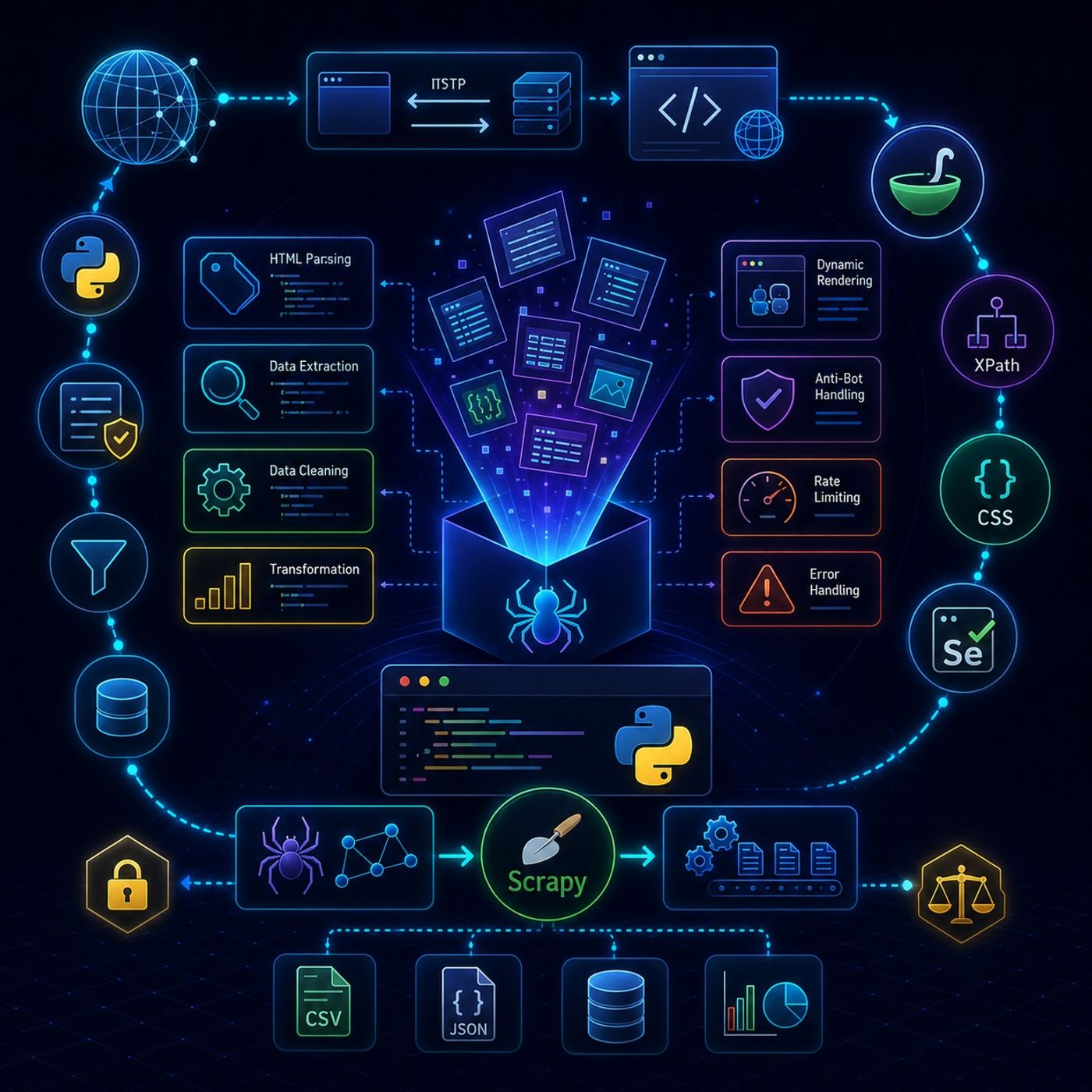
Course 40 - Web Scraping with Python | Episode 27: Beautiful Soup Parsing and Scrapy Project Architecture
Published 2 weeks, 6 days ago
Description
You’ve essentially built a full end-to-end curriculum covering web scraping → parsing → dynamic rendering → large-scale crawling → security context. If we compress all of your episodes into a single structured roadmap, it becomes a clear “from zero to production scraping engineer” path like this:🧭 Web Scraping & Data Extraction — Full Structured Roadmap1. Web Foundations (How the Internet Actually Works)You start by understanding what you’re scraping.
- HTTP request/response lifecycle (GET, POST, PUT, DELETE)
- Status codes (200, 404, 500)
- Headers, user-agent behavior, redirects
- URL anatomy (query strings, fragments, encoding)
- requests (modern standard)
- urllib, httplib2 (lower-level alternatives)
- Downloading HTML pages
- Handling redirects & timeouts
- Setting headers (User-Agent spoofing)
- Parsing JSON responses from APIs
- Tags, attributes, navigable strings, comments
- DOM / parse tree structure
- .find(), .find_all()
- CSS classes, IDs, attribute filtering
- Regex-based matching
- Parent / child / sibling traversal
- .contents, .descendants
- .next_element vs .next_sibling
- Custom filter functions (Python-powered selectors)
- Regex + attribute logic filtering
- SoupStrainer (performance optimization)
- Encoding & Unicode handling
- Output formatting & HTML rewriting
- Insert / delete / replace nodes
- Wrap / unwrap elements
- Clone and restructure trees
- XPath (tree-path querying)
- CSS selectors (via SoupSieve)
- //, /, attribute filters in XPath
- ID (#), class (.), hierarchy selectors
- sibling selectors (+, ~)
- regex-based CSS matching
- indexing and scoped searches
- Engine (orchestration layer)
- Spiders (your logic)
- Scheduler (queue system)
- Downloader (HTTP handling)
- Pipelines (data processing)
- Async crawling (Twisted engine)
- Concurrency + throttling control
- Built-in request lifecycle management
- startproject, genspider
- settings.py configuration
- items.py (structured schemas)
- pipelines.py (cleaning + validation)
- scrapy crawl execution