Episode Details
Back to Episodes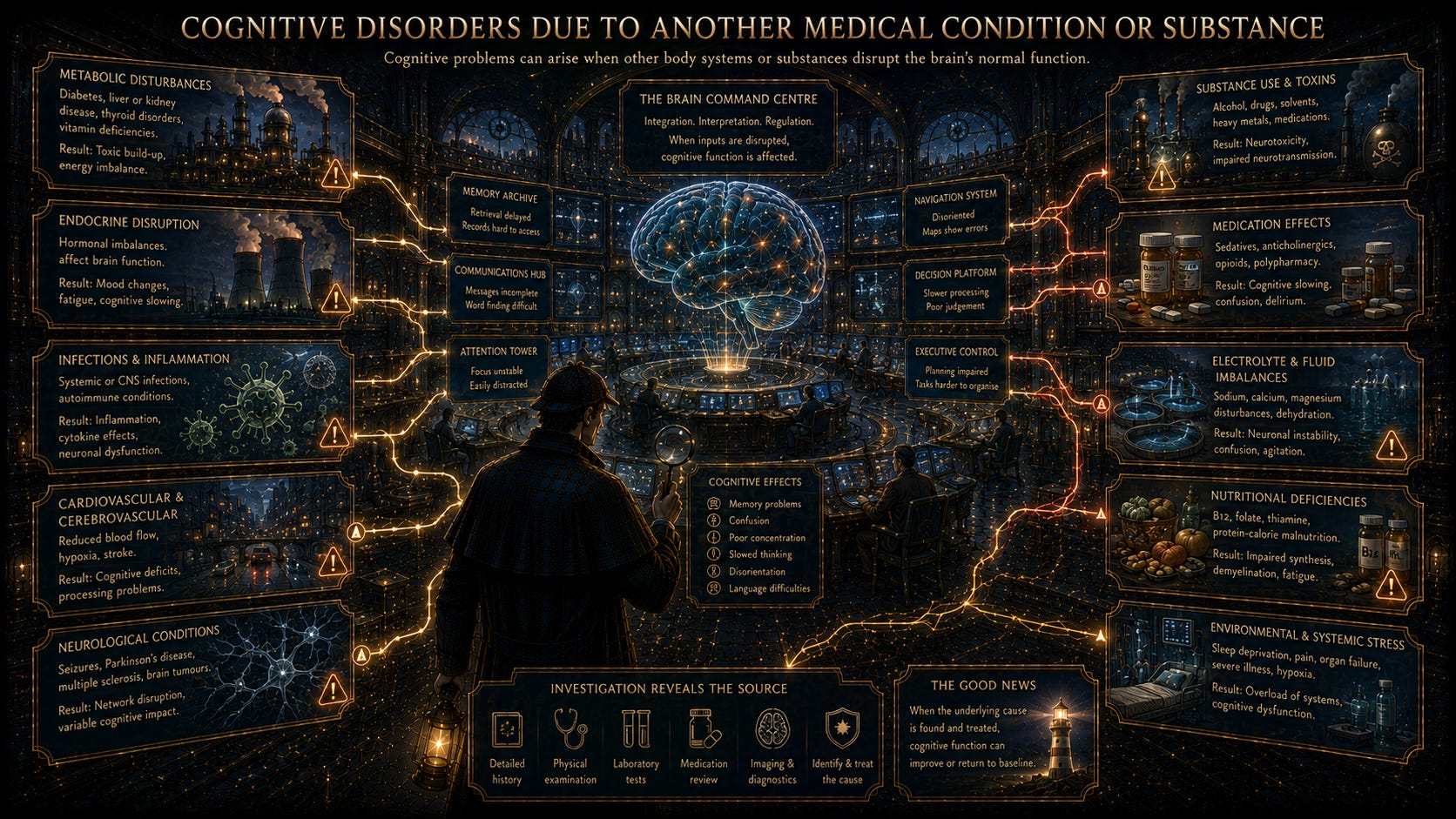
PSYCH 080: Cognitive Disorders Due to Another Medical Condition or Substance
Description
Imagine Medlock Holmes arriving at a grand command centre responsible for coordinating an entire city.
The command centre appears sophisticated and highly organised. It manages communication, planning, navigation, memory, and decision-making for every district.
One day, however, the operators begin making mistakes.
Messages are delayed.
Instructions become confused.
Important information is misplaced.
Decision-making becomes unreliable.
At first, observers assume the command centre itself is failing.
Yet Holmes notices something unusual.
The problems are not originating within the command centre.
Instead, disruptions are arriving from elsewhere.
A contaminated water supply.
A failing power station.
Toxic fumes entering the ventilation system.
Damaged communication cables.
The command centre is responding to problems occurring throughout the wider city.
The command centre represents the brain.
The wider city represents the body.
This chapter explores cognitive disorders that arise not from primary neurodegenerative disease, but from other medical conditions, substances, medications, toxins, or systemic illnesses affecting brain function.
A central lesson emerges immediately: cognition is extraordinarily dependent upon the health of the entire organism.
The brain requires oxygen, nutrients, hormonal regulation, immune stability, metabolic balance, and uninterrupted communication with the rest of the body. When these systems become disrupted, cognitive symptoms may be among the earliest and most prominent signs.
As Holmes investigates, he encounters a remarkable variety of causes.
Endocrine disorders alter cognition through hormonal imbalance.
Liver and kidney disease allow toxic substances to accumulate.
Nutritional deficiencies impair neural function.
Autoimmune diseases generate inflammatory disturbances.
Infections affect the brain directly or indirectly.
Sleep disorders compromise attention and memory.
Cardiovascular disease reduces cerebral blood flow.
Neurological conditions interfere with neural communication.
In every case, the cognitive symptoms are real, but their origin lies beyond the brain itself.
The chapter also explores the cognitive effects of substances.
Holmes enters another district where medications, alcohol, recreational drugs, environmental toxins, and withdrawal states influence the city’s functioning.
Some substances impair attention.
Others affect memory.
Some slow thinking.
Others create confusion, agitation, or altered awareness.
The pattern of impairment often provides clues regarding the underlying cause.
A key theme is reversibility.
Unlike many neurodegenerative disorders, cognitive impairment caused by medical conditions or substances may improve substantially when the underlying problem is identified and treated.
Correcting a vitamin deficiency.
Managing thyroid disease.
Treating infection.
Stopping a problematic medication.
Addressing substance misuse.
Restoring metabolic balance.
The earlier the cause is recognised, the greater the potential for recovery.
Holmes quickly learns that clinicians must resist premature conclusions.
Not every memory complaint represents dementia.
Not every concentration problem reflects psychiatric illness.
Not every episode of confusion indicates primary brain disease.
Sometimes the most important diagnostic question is not “What is happening in the brain?” but rather “What is happening elsewhere that is affecting the brain?”
The chapter highlights the importance of comprehensive assessment, including medical history, physical examination, laboratory testing, medication review, neuroimaging, and collateral information.
The brain cannot be assessed in