Episode Details
Back to Episodes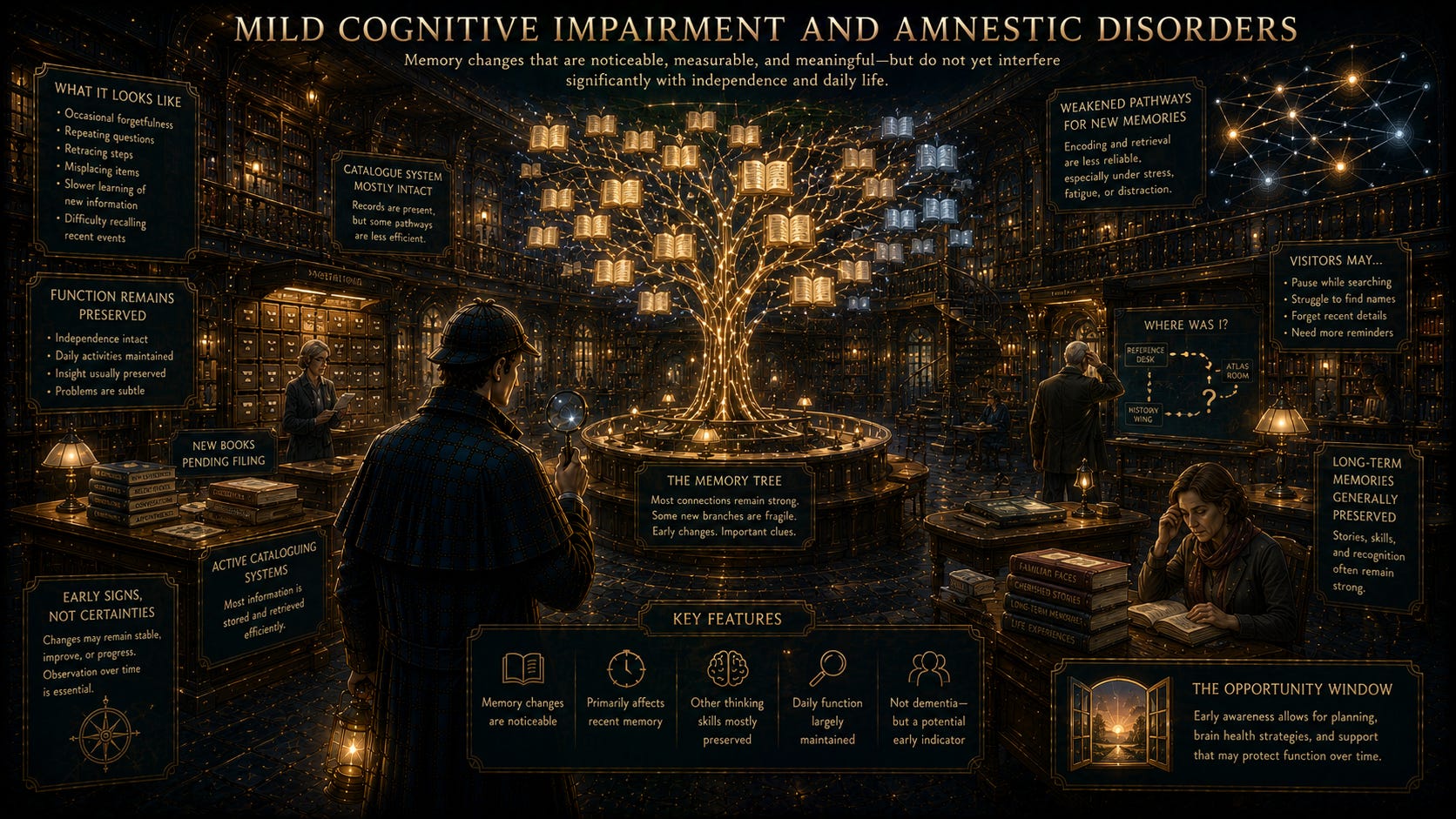
PSYCH 079: Mild Cognitive Impairment and Amnestic Disorders
Description
Imagine Medlock Holmes returning once more to the great library of the mind.
Unlike the previous chapter, the library is still functioning remarkably well.
The catalogue remains largely intact.
Visitors can still find most of the books they need.
The librarians continue their work.
The building remains operational.
Yet Holmes notices subtle signs that something has changed.
A librarian takes longer to locate a familiar volume.
A catalogue entry requires a second search.
A book is occasionally misplaced before being found again.
The library continues to function, but not with the effortless efficiency it once possessed.
This is the world of Mild Cognitive Impairment (MCI).
The chapter explores a state that occupies the space between normal cognitive ageing and major neurocognitive disorder. Individuals experience measurable cognitive decline, yet their overall independence remains largely preserved.
Holmes quickly learns that ageing itself is not a disease.
Many cognitive processes change over time. Names may take longer to retrieve. New information may require more repetition. Processing speed may slow slightly.
These changes are expected.
The challenge lies in determining when such changes exceed what would normally be anticipated.
As Holmes investigates, he discovers that Mild Cognitive Impairment represents an important transitional territory.
Objective evidence of cognitive decline exists, often confirmed through clinical assessment or neuropsychological testing. However, the individual continues to manage daily life with relative independence.
The library is functioning, but its systems are becoming less efficient.
The chapter pays particular attention to amnestic disorders.
Within one wing of the library, Holmes observes a specialised archive responsible for memory formation and retrieval.
The challenge is not simply forgetting where a book was placed.
Rather, the system responsible for recording new information struggles to create reliable entries in the catalogue.
Recent events become difficult to retain.
New learning becomes less efficient.
Questions may be repeated because the memory of asking them was never firmly stored.
Holmes discovers that amnestic disorders can arise from many causes.
Some result from neurological disease.
Others emerge following head injury, nutritional deficiencies, substance use, metabolic disturbances, infections, or damage to structures critical for memory processing.
Not all memory disorders are progressive.
Some remain stable.
Others improve if the underlying cause can be treated.
A central theme of the chapter is uncertainty.
Not everyone with Mild Cognitive Impairment develops dementia.
Some individuals remain stable for years.
Some improve.
Others progress to major neurocognitive disorders.
The clinician’s task is therefore not merely to identify impairment but to understand its pattern, severity, likely cause, and future implications.
As Holmes explores further, he notices something often overlooked.
People with Mild Cognitive Impairment are frequently aware of their difficulties.
Unlike advanced neurocognitive disorders, where insight may diminish, individuals often recognise changes in memory, concentration, or mental efficiency.
This awareness can generate anxiety, frustration, fear, and concern about the future.
The emotional impact of cognitive change becomes part of the story.
The chapter also highlights the importance of early assessment.
Recognising subtle cognitive changes allows clinicians to investigate reversible causes, monitor progression, implement risk reduction strategies, and support individuals and families before substantial functional decline occurs.
Standing within the library’s memory ar