Episode Details
Back to Episodes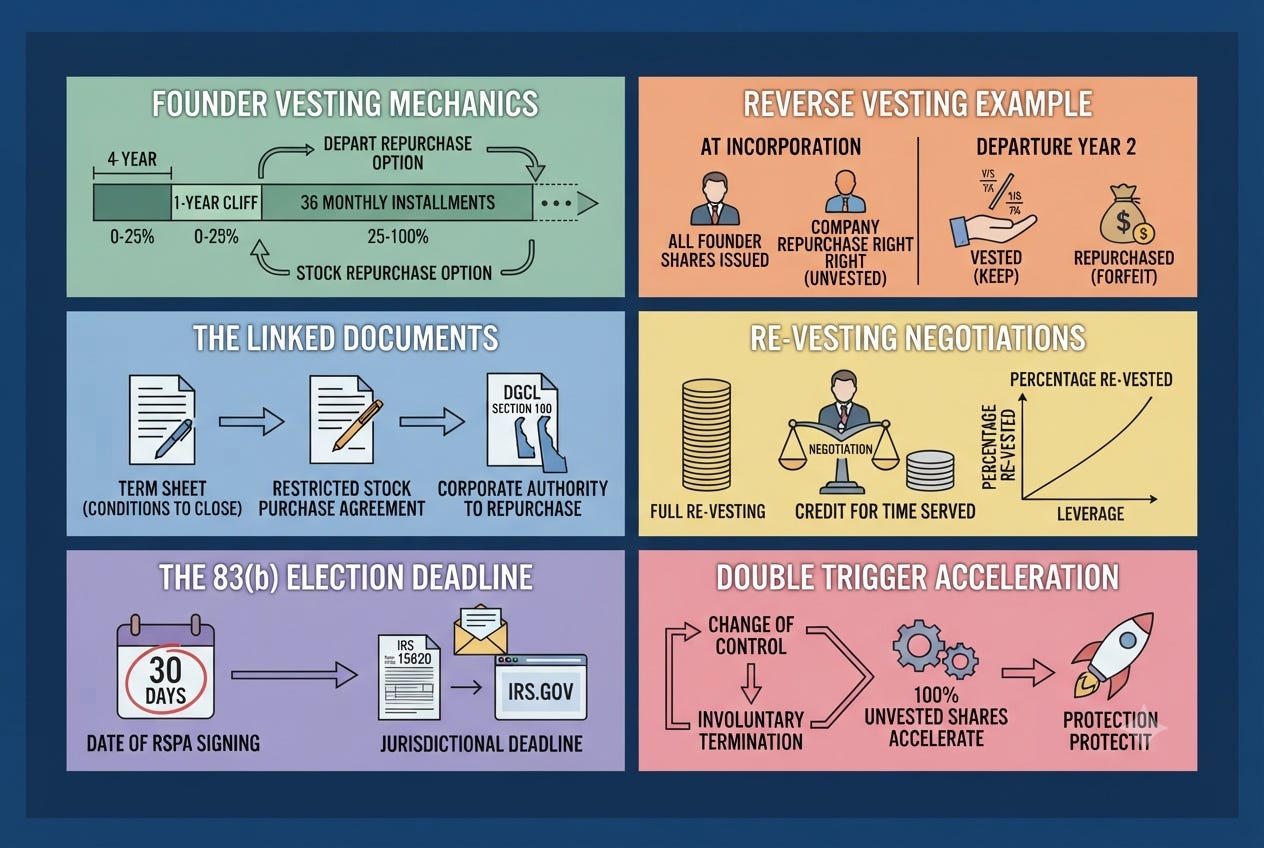
The Founder’s Guide to Reverse Vesting and Company Buybacks
Description
Institutional investors are treating a written founder vesting schedule with a one year cliff, tracking NVCA Investor Rights Agreement Section 5.3, as a condition to closing a priced round in 2026. A lead investor’s term sheet increasingly lists a signed restricted stock purchase agreement among the conditions to closing rather than as a side letter to negotiate after the wire lands. Founders who never documented vesting, or whose shares fully vested years before this round, are the ones asking what specific reverse vesting and company buyback language a term sheet will require before a lead investor signs.
The question surfaces at an inconvenient moment. By the time a term sheet reaches signature, the company has already negotiated valuation, board composition, and protective provisions. Vesting shows up in the conditions to closing section almost as an afterthought, yet it is often the single item standing between a signed term sheet and a closed round, because the lead investor’s counsel will not release funds until every founder has executed the restricted stock purchase agreement the term sheet references.
How the standard schedule works
NVCA Investor Rights Agreement Section 5.3 supplies the template most lead investors hand to portfolio companies: vesting over forty eight months, with nothing vesting during the first twelve. Twenty five percent vests on the cliff date, and the remaining seventy five percent vests monthly over the following three years. When a founder incorporated without documenting a vesting schedule, this is the schedule the round will impose retroactively, dated to a vesting commencement date the parties negotiate, often the company’s original incorporation date or the date the founder began working full time.
What the repurchase right actually says
Reverse vesting issues a founder’s full share grant up front and then gives the company a contractual right, not an automatic forfeiture, to repurchase the unvested portion if the founder departs before the shares vest. Delaware General Corporation Law Section 160 supplies the corporate authority for that repurchase, subject to the rule that a company cannot buy back its own stock if doing so impairs capital. The 2023 amendments to Section 160 clarified how the resulting treasury shares may later be resold under Section 153, a detail that matters when a company wants to reissue repurchased founder shares to a replacement executive rather than retire them. The restricted stock purchase agreement itself fixes the repurchase price, commonly the lower of original issue price or fair market value, and a repurchase window, commonly ninety days from termination, during which the board must act or the option lapses.
Does the cliff apply to shares already earned
This is the specific ambiguity founders are running into. Where a founder already vested shares under an earlier grant and is only placing new or unvested shares onto a schedule at the priced round, a fresh one year cliff is hard to justify on the merits: the founder has already demonstrated the staying power a cliff exists to test. SaaStr founder Jason Lemkin has taken exactly this position in practitioner commentary, arguing that reverse vesting at a financing generally should not carry a new cliff for founders who are already committed. Some lead investors propose the NVCA cliff language anyway, as a matter of drafting convenience rather than a considered position on a founder who already has three years of history behind the company. That gap between boilerplate and rationale is precisely where a founder’s counsel should redline.
Credit for time served, and what happens without it
When a term sheet requires revesting, it typically places some or all of a founder’s previously vested shares back onto a new schedule as of closing. Founders routinely negotiate credit for time already served, so that only a portion, often twenty five to fifty percent