Episode Details
Back to Episodes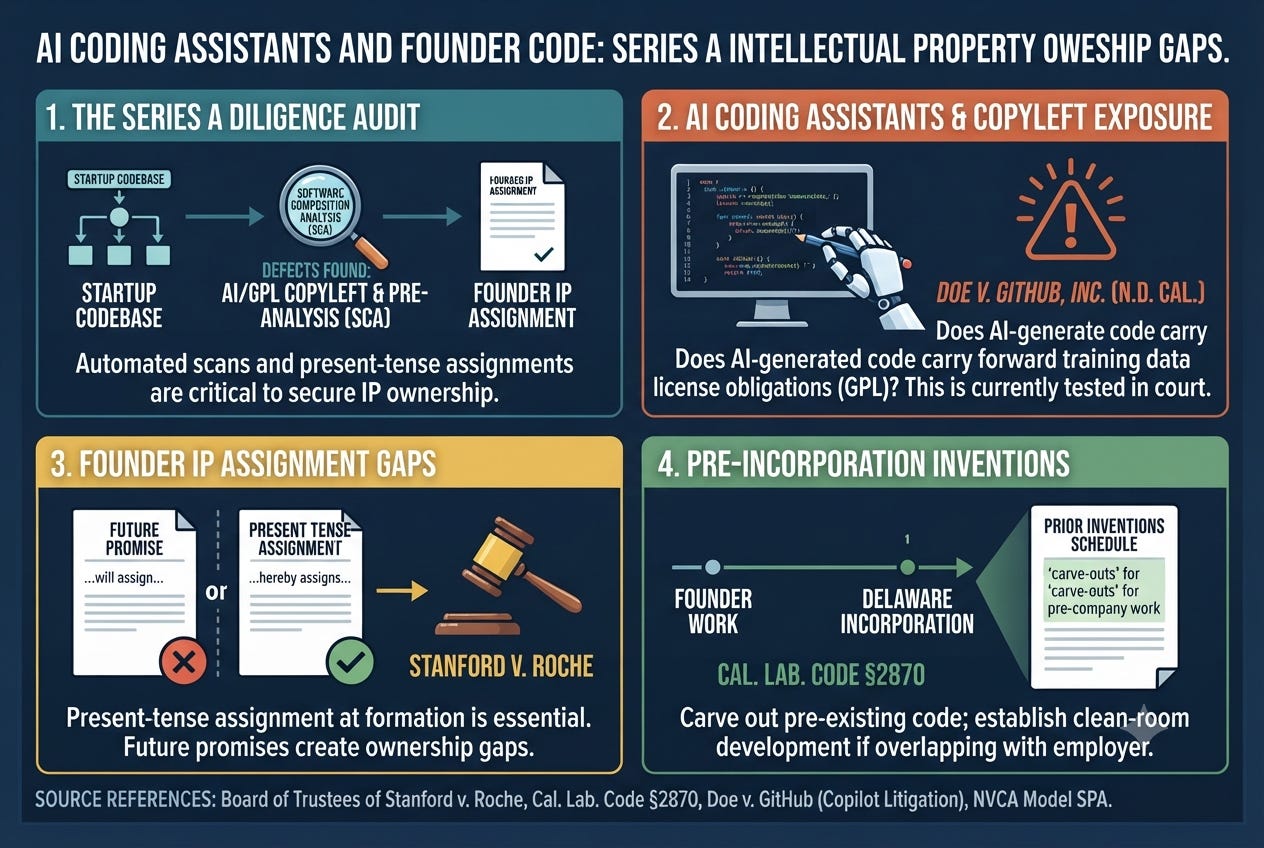
Closing the Series A IP Gap: Founder Code, AI Assistants, and Chain of Title
Description
A Series A term sheet stalls when diligence counsel finds GPL code an AI assistant pulled from public repositories central to the nine billion dollar Doe v. GitHub copyright suit. The same clause that decides code provenance also decides who owns the invention: a present tense assignment signed at incorporation controls, a promise to assign later does not. Both defects are curable before the term sheet is signed. Neither is curable after.
Two failure patterns account for nearly every intellectual property defect found in a Series A closing. The first involves code an AI coding assistant wrote, where the model’s training corpus included repositories carrying the General Public License or another copyleft term. The second involves code a founder wrote before the Delaware corporation existed, where the assignment agreement uses the wrong verb tense or never gets executed at all. Neither defect requires bad intent. Both require the founder to run the audit before the investor’s counsel does.
What Triggers A GPL Disclosure Obligation In AI Generated Code
An open source license attaches its disclosure obligation at the moment the code is distributed, not at the moment it is written. The General Public License, Version 3, triggers its disclosure obligation only at distribution; the Affero variant extends that obligation to network accessible software, which describes almost every software as a service product built today.
Doe v. GitHub, Inc., filed in the Northern District of California on November 3, 2022, tests whether an AI coding assistant’s output can carry the license terms of its training data forward into a new codebase without the author ever knowing the terms exist. The presiding judge dismissed twenty of twenty two claims, including the claim under the Digital Millennium Copyright Act’s copyright management information provision, but the open source license violation and breach of contract claims survived and moved to the Ninth Circuit on an interlocutory appeal filed September 27, 2024, with nine billion dollars in statutory damages at stake. A dependency scan run today, using a tool such as FOSSA, Black Duck, or Snyk, catches the same copyleft fingerprint the Ninth Circuit is being asked to rule on, months or years before a court says what the rule actually is.
Why The Wording Of An Assignment Clause Decides Who Owns Pre Incorporation Code
Copyright law assumes an independent author owns the code that author writes, and a founder who built a product before the company existed was, as a matter of law, an independent author. Under 17 U.S.C. Section 101, an independent contractor’s work qualifies as a work made for hire only if it falls into one of nine enumerated categories, and software is not one of them. The code stays the founder’s personal property until a written assignment moves it, and the certificate of incorporation filed under Delaware General Corporation Law Section 102 does not perform that transfer by itself.
The verb tense in that assignment then decides the outcome if a dispute ever reaches a court. Board of Trustees of the Leland Stanford Junior University v. Roche Molecular Systems, Inc., 563 U.S. 776 (2011), holds that a present tense assignment defeats an earlier promise to assign, because title vests first in the inventor and moves only when an actual assignment, not a promise, takes effect. A founder who once signed an employer’s invention assignment agreement carries a second risk: California Labor Code Section 2870, and the six other state statutes built on the same model, protect an employee’s invention only when it was built entirely on personal time, without the employer’s equipment, and unrelated to the employer’s actual or reasonably anticipated business, a protection that narrows sharply the moment the startup’s product resembles the former employer’s own line of business.
What A Founder Should Do Before Opening A Data Room
Three steps c