Episode Details
Back to Episodes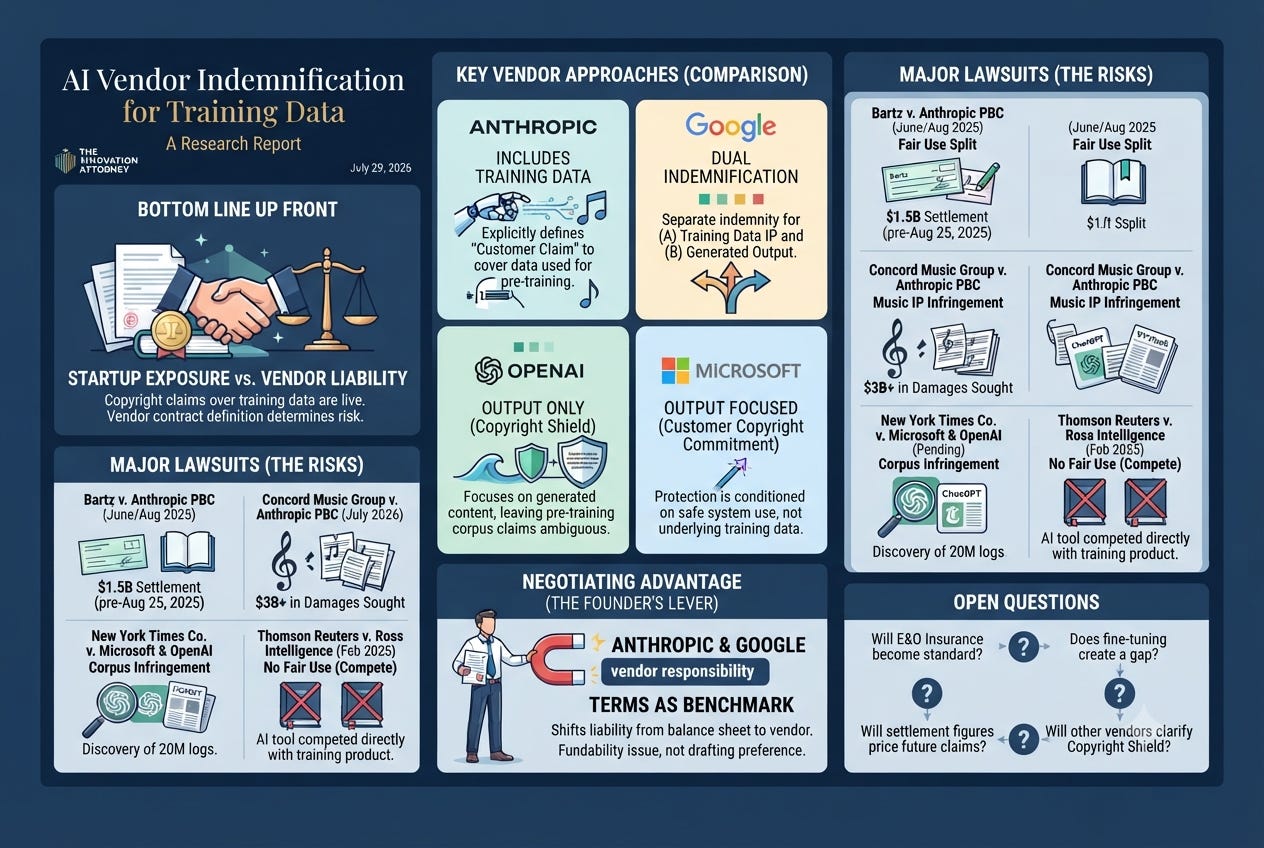
Shifting the Burden: AI Vendor Indemnification for Training Data
Description
Indemnification clauses covering training data, not just model output, are the specific language shifting AI copyright liability to vendors, a shift exposed by the $1.5 billion Bartz v. Anthropic settlement of August 2025. Anthropic’s commercial terms define a covered Customer Claim to include the data Anthropic used to train the model, not merely the output the model produces. Google’s Generative AI Indemnified Services terms take the same two pronged approach, indemnifying both the training data and the output. OpenAI’s Copyright Shield and Microsoft’s Customer Copyright Commitment, by contrast, are written to reach only the output a customer generates, leaving open who bears a claim aimed at the underlying training corpus itself.
Three cases decided or advanced in the past twelve months turned training data indemnification from a boilerplate footnote into the line item that can determine whether a seed stage company survives a copyright claim it did not create. Anthropic agreed to pay $1.5 billion to settle Bartz v. Anthropic in August 2025, covering the piracy based downloading of copyrighted books before August 25, 2025, but that settlement does not touch claims arising from Anthropic’s later conduct or from Claude’s generated output. Music publishers led by Concord Music Group filed a second amended complaint against Anthropic in the Northern District of California on July 22, 2026, covering more than 20,000 songs and seeking over $3 billion, with BMG filing its own suit in March 2026 over 493 compositions. The New York Times’ case against Microsoft and OpenAI remains pending before Judge Sidney Stein in the Southern District of New York, with the court ordering the production of 20 million anonymized ChatGPT logs in 2026.
In redlining commercial AI licensing agreements this year, the fastest movement from a vendor’s legal team has not come from asking for a higher indemnification cap. It has come from inserting the word training into the defined term Claim. A vendor’s outside counsel will negotiate over dollar figures for a week and concede that single word in an afternoon, because the word costs the vendor nothing until a rights holder actually sues, at which point it decides who pays.
what specific language shifts training data liability to the vendor
The operative shift happens inside the definition of the covered claim, not in the marketing name attached to the indemnification program. Anthropic’s commercial terms define a Customer Claim as a third party claim alleging that the customer’s use of the Services, including data Anthropic used to train a model that is part of the Services, or Outputs generated through authorized use, violates a third party’s patent, trade secret, trademark, or copyright. Google’s Generative AI Indemnified Services terms indemnify separately against an allegation that Google’s use of data to train the underlying model infringes intellectual property rights and against a claim that the generated output infringes those rights. OpenAI’s enterprise terms indemnify claims arising from the Services but explicitly exclude customer content, customer applications, and combinations with third party products, leaving open whether a claim aimed squarely at the pretraining corpus falls inside or outside that promise. Microsoft’s Customer Copyright Commitment, extended to Copilot Studio as of June 1, 2025, protects the output of Copilot products and the Azure OpenAI Service, conditioned on the customer not tampering with safety systems and implementing required mitigations, but the commitment is written around what the model produces, not what data built it.
Only Anthropic and Google currently write training data into the indemnified claim itself, a distinction that separates two of the four major foundation model vendors from OpenAI and Microsoft on the single clause most likely to decide a copyright suit.
why the liability cap decides what the indemnity is actua