Episode Details
Back to Episodes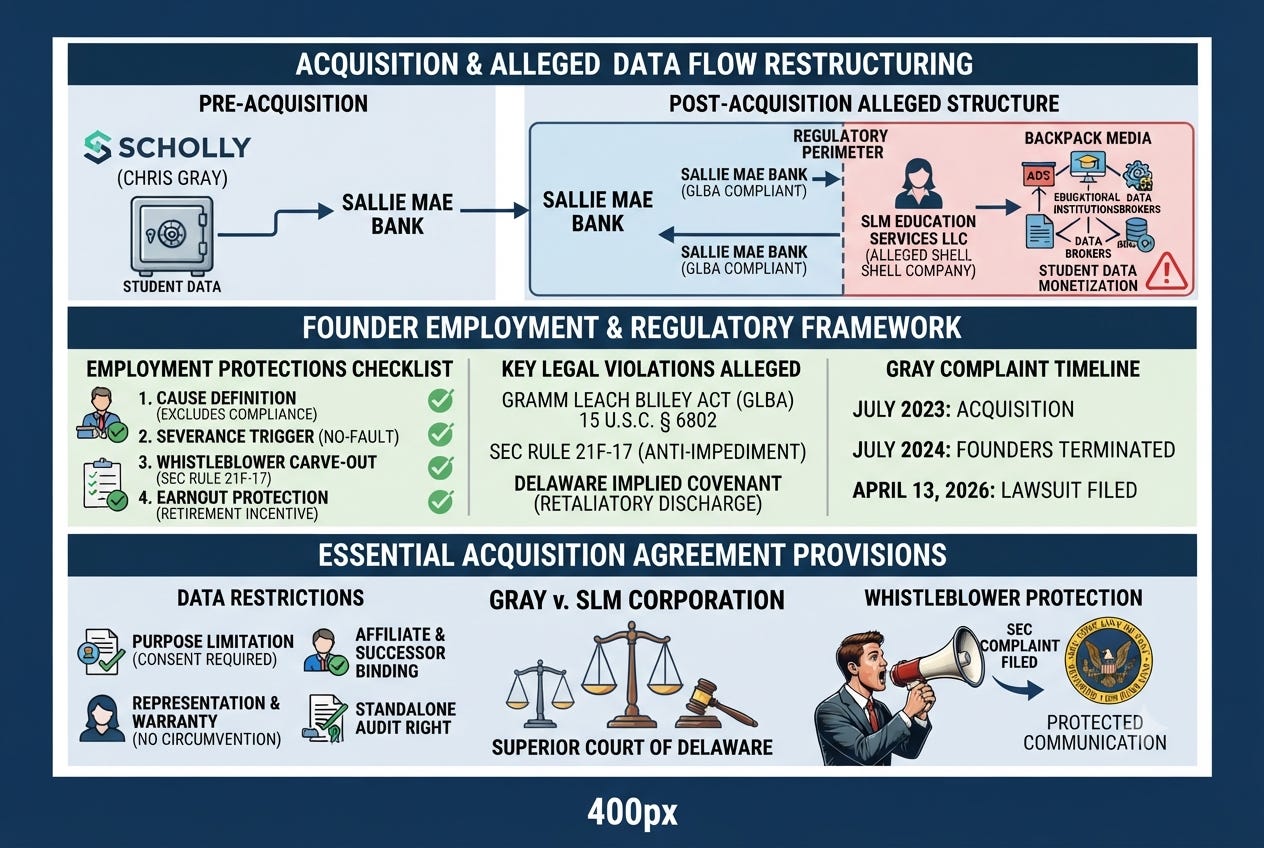
Earnouts, Post Closing Data Restrictions and Founder Protections
Description
Christopher Gray’s April 13, 2026, complaint against SLM Corporation in Delaware Superior Court accuses Sallie Mae of building a non bank subsidiary to sell student data the bank could not lawfully sell on its own, and it names Gray’s own termination as the response that followed his objection. Gray sold his scholarship search company, Scholly, to Sallie Mae in July 2023. He alleges that a year later, after he raised internal concerns about a subsidiary called SLM Education Services, he was fired ahead of a scheduled meeting with the company’s chief executive on that same subject. He has also filed a whistleblower complaint with the Securities and Exchange Commission covering the same facts. Sallie Mae denies the allegations and says it will contest the suit.
Scholly began as a scholarship search tool that helped Gray fund his own education, and it grew into a Shark Tank backed company before Sallie Mae acquired its app, its scholarship administration technology, and its Scholly Offers matching platform. Gray and his cofounders joined as employees, with Gray named a vice president of product management. A year after closing, the company eliminated the Scholly founding team, including Gray’s cofounders. Gray remained until his own termination, which he says followed directly from raising the data concerns described in his complaint.
The complaint’s legal theory rests on the separation between two entities. Salliemae.com operates under Sallie Mae Bank, a federally insured bank bound by the Gramm Leach Bliley Act’s restriction on disclosing nonpublic personal financial information to nonaffiliated third parties, a rule codified at 15 U.S.C. section 6802 and carried out through the Consumer Financial Protection Bureau’s Regulation P. Sallie.com, carrying the same logo and colors, is operated instead by SLM Education Services, a non bank affiliate. On March 4, 2026, that affiliate launched Backpack Media, an advertising network marketed as reaching 8.5 million students, families, and young professionals, a population Gray’s complaint says includes minors. Gramm Leach Bliley permits sharing between affiliates without the notice and opt out requirement that governs nonaffiliated third parties, but that exception covers movement between affiliates. It does not plainly authorize an affiliate’s own resale to ad networks, brands, and data companies outside the corporate family. Whether SLM Education Services functions as a genuine affiliate for that purpose, and whether its onward sales fall inside or outside the exception, is what a Delaware court will now have to decide.
None of this is proven, and Sallie Mae is entitled to contest every allegation. What the dispute does establish, regardless of outcome, is a gap that shows up repeatedly in technology acquisitions: a definitive agreement written to govern the acquirer as it exists at signing rarely reaches an affiliate the acquirer forms two years later. Scholly’s 2023 purchase agreement was negotiated before SLM Education Services existed in its current form and before Backpack Media had a name. A covenant that binds only the signing entity, not its future affiliates and successors, leaves exactly the room this complaint alleges Sallie Mae used.
A founder negotiating a live term sheet has more leverage before signing than at any point afterward, and four specific terms belong in the document while that leverage still exists. The data use covenant needs a purpose limitation tied to what users were told at collection, and it needs to expressly bind the acquirer’s affiliates, any entity the acquirer later forms or acquires, and any successor by merger or asset sale. Without that reach, the covenant only ever governs the entity as it looked on the day of closing. The representations and warranties should include a statement that the acquirer will not use a non bank or otherwise uncovered affiliate to accomplish a data use the acquirer itself could not lawfully p