Episode Details
Back to Episodes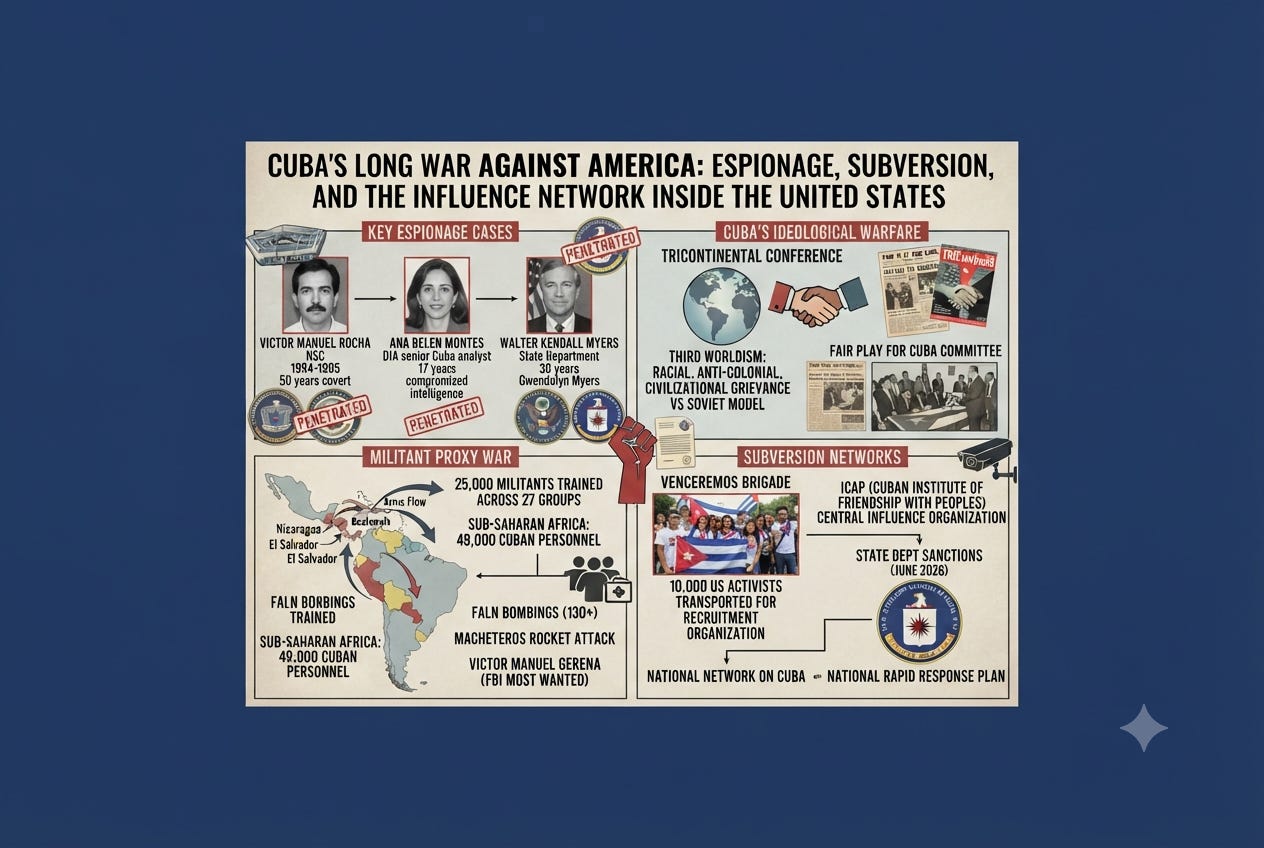
Espionage, Subversion, and the Influence Network Inside the United States
Description
Cuba’s Long War: How Ideological Recruitment Defeated U.S. Counterintelligence for Six Decades
The longest confirmed foreign spy placement in U.S. history did not end with a dramatic arrest at a dead drop. It ended when Victor Manuel Rocha, a former National Security Council official and U.S. Southern Command adviser, was taken into custody in December 2023, approximately 50 years after the Direccion de Inteligencia recruited him in Chile.
The U.S. government has confirmed penetrations of the National Security Council, the Defense Intelligence Agency, the State Department, and U.S. Southern Command by Cuban intelligence assets working simultaneously. How those penetrations were built and sustained across six presidential administrations without triggering financial detection comes down to one factor: Cuba recruited by conviction rather than compensation, and that decision defeated the central assumption of U.S. counterintelligence doctrine for decades.
Ana Belen Montes was recruited in 1984 as a Johns Hopkins graduate student. She became the Defense Intelligence Agency’s senior Cuba analyst, briefed the Joint Chiefs of Staff on Cuban military capabilities, passed a DIA polygraph in 1994 while actively spying, and was arrested in September 2001 because officials feared she would transfer U.S. war plans for Afghanistan to the Taliban. No unusual financial activity preceded her arrest. Walter Kendall Myers spent 30 years in the State Department’s Bureau of Intelligence and Research, met privately with Castro in 1995, and was not arrested until 2009 at age 72. None of these agents left the financial markers counterintelligence programs are designed to detect.
Cuba did not limit its model to recruited government officials. Beginning in 1969, the Venceremos Brigade transported approximately 10,000 American activists to Cuba; a 1975 U.S. Senate report found that the DI’s deputy director personally supervised the Brigade’s creation and that virtually every Cuban national assigned to the camps was a DI agent. ICAP, which coordinated more than 2,000 affiliated organizations across 150 countries, was designated for sanctions under Executive Order 14404 in June 2026. That month, ICAP’s U.S. counterpart distributed a National Rapid Response Plan directing coordinated action against federal buildings, military bases, and ICE detention centers.
Cuba rebuilt its intelligence-sharing arrangements with China, Russia, Iran, and North Korea after the Soviet Union dissolved in 1991. The access networks built over six decades inside American universities, labor unions, and activist organizations remain intact. James Olson, former CIA Chief of Counterintelligence, stated in 2020 that confirmed cases represent only the tip of the iceberg. That statement preceded Rocha’s arrest by three years, and the damage assessment from his 50-year penetration is expected to take additional years to complete.
Read my full analysis here: https://theinnovationattorney.com/blog/
This is a public episode. If you'd like to discuss this with other subscribers or get access to bonus episodes, visit theinnovationattorney.substack.com/subscribe