Episode Details
Back to Episodes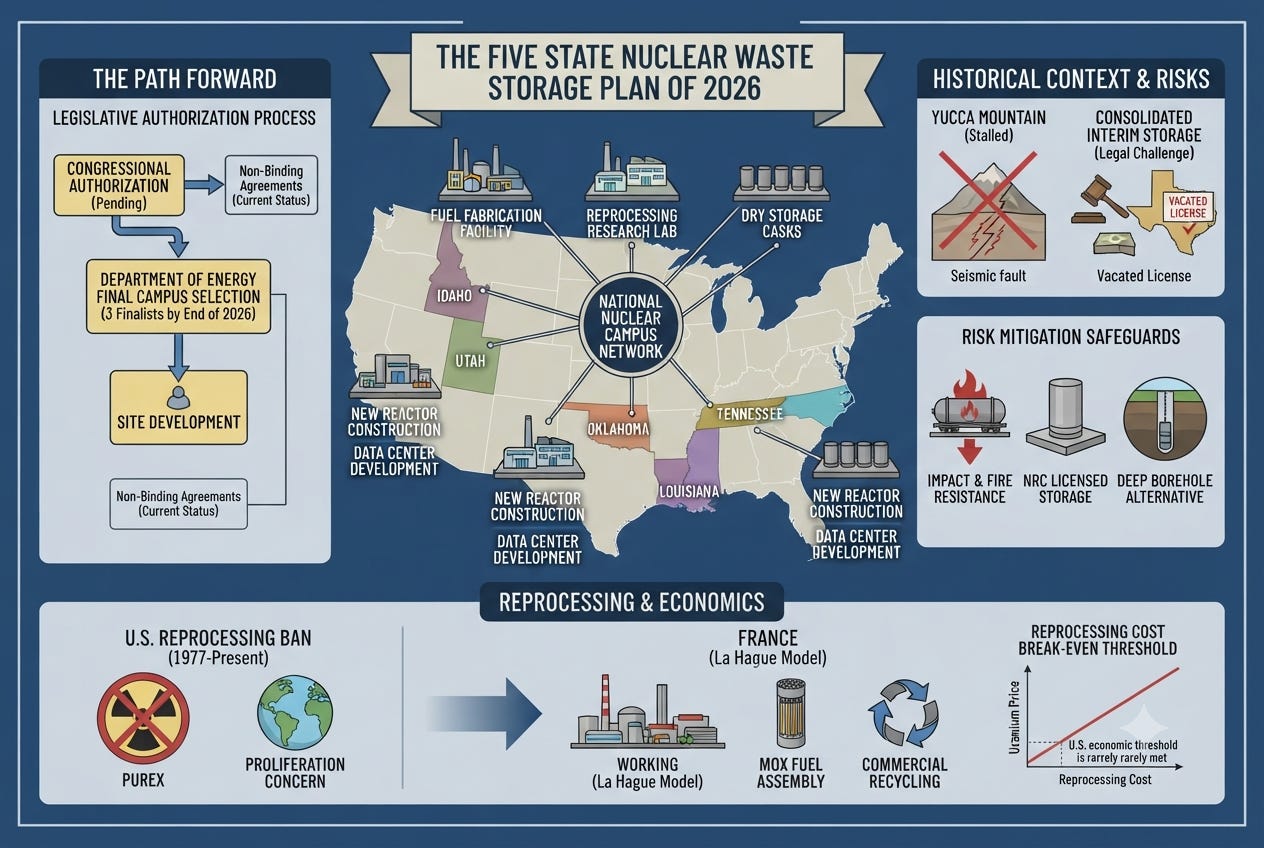
Restarting the Nuclear Fuel Cycle
Description
Tennessee, Utah, Oklahoma, Louisiana, and Idaho have each signed a non binding agreement with the Department of Energy to host a Nuclear Lifecycle Innovation Campus, a facility combining uranium enrichment, fuel fabrication, spent fuel research, and waste storage on one site. The Department expects to narrow the five contenders to three finalists before the end of 2026. Utilities that have spent nearly three decades collecting Judgment Fund damages for spent fuel the federal government was contractually obligated to remove starting in 1998 are watching closely, because the plan asks Congress to grant authority two federal appeals court rulings already said the Nuclear Regulatory Commission does not have.
The spent fuel problem is older than most of the reactors producing it today. Congress passed the Nuclear Waste Policy Act in 1982, funded by a fee of one mill per kilowatt hour on every unit of nuclear electricity generated, and directed the Department of Energy to open a permanent repository by 1998. In 1987, Congress narrowed the search to a single site, Yucca Mountain, Nevada, and in 2002 it overrode Nevada’s formal objection to complete the designation. The site never opened. Funding for its licensing process ended in 2011, and roughly one hundred thousand metric tons of spent commercial fuel now sit in pools and dry casks at more than seventy reactor locations across the country, growing by about two thousand metric tons a year.
Distributing the function across five willing states is a reasonable departure from four decades of trying to force a single site through litigation. Oak Ridge, Tennessee, and Idaho National Laboratory each carry existing federal nuclear infrastructure and a trained workforce that a green field site would lack, and the Department’s new Center for Spent Fuel Research at Idaho National Laboratory, announced in January 2026, gives the plan a research foundation rather than a blank page. The remaining obstacle is not geology or willingness. It is statutory authority. In 2024, the Fifth Circuit Court of Appeals vacated Nuclear Regulatory Commission licenses for consolidated interim storage facilities in Texas and in Lea County, New Mexico, ruling that neither the Atomic Energy Act nor the Nuclear Waste Policy Act gives the Commission power to license privately owned storage away from a reactor or a federal repository. Holtec International, the New Mexico licensee, withdrew its project in 2025 after the Supreme Court resolved a related challenge on procedural grounds without reaching that statutory question. Every state agreement signed this year is non binding until Congress supplies the authority those courts said the agency lacks.
Three environmental risks apply to consolidated storage: transportation accidents, cask or container failure, and handling errors, and most already have a demonstrated safeguard elsewhere in the federal system. Transport casks must survive a thirty foot drop, a thirty minute fire, and submersion under Nuclear Regulatory Commission rules at 10 CFR Part 71, and the agency’s own risk studies rate the probability of a radiological release during shipment as very low. Storage has one clear cautionary tale. On February 14, 2014, a drum of transuranic waste at the Waste Isolation Pilot Plant near Carlsbad, New Mexico, ruptured after technicians packed it with an organic absorbent instead of the mineral based material its chemical profile required, producing a reaction that blew off the lid and contaminated about thirty five percent of the underground disposal area. The facility closed for nearly three years, and direct cleanup ran to roughly five hundred million dollars. Investigators traced the rupture to a packaging procedure rather than to any flaw in the salt formation, which performed as designed, and it produced a permanent fix: the Environmental Protection Agency and the New Mexico Environment Department now require overhauled waste characterization at