Episode Details
Back to Episodes
Episode 495 The Koao
Description
Further reading:
Gauguin’s Magical Mystery Koao
Show transcript:
Welcome to Strange Animals Podcast. I’m your host, Kate Shaw.
The French painter Paul Gauguin moved to the island of Hiva Oa in 1901, less than two years before he died. Hiva Oa is the second largest island in the Marquesas, a volcanic archipelago in Polynesia in the South Pacific. It’s extremely remote, only slightly closer to Mexico than it is to New Zealand, although Hawaii is even closer.
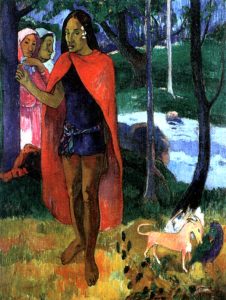
During his short time on Hiva Oa, Gauguin produced quite a few paintings, including a famous one whose title translates to “The Sorcerer of Hiva Oa.” It depicts a dancer and magician named Haapuani and represents the fast-vanishing local culture. One of the details of the painting is a bird on the ground next to a small dog. But no one can identify the bird in the painting.
The bird is mostly blue but with green face and wings, and the small dog appears to be biting its wing or back. It’s about the size of a chicken, although details aren’t especially clear due to Gauguin’s painting style. The bill is a brownish-red and is thick and pointed. The eye is the same brown-red.
No one paid much attention to the bird in the painting until a man named Thor Heyerdahl published a book about the Marquesas in 1974. He was most well known for his adventures sailing a balsawood boat, the Kon-Tiki, from South America to the Polynesian islands in 1947. In 1937, though, the most notable thing Heyerdahl did was see an unusual bird that he mentioned in his book.
He wrote that the bird had no wings and ran extremely fast when he startled it. It vanished into a thick bank of ferns and although he tried to catch another glimpse of it, it was gone. He later said it was about the size of a long-legged gull.
A French explorer also wrote about this bird in 1957, although he didn’t see it himself. He said the people who lived on the island called the bird koao, which meant “burrow bird” since it was supposed to hide in burrows. It was about the size of a rooster, purplish in color with a yellow bill, and while it only had little wings, its legs were long and it was a fast runner.
By 1979, researchers investigating the koao were told that it had gone extinct from overhunting, specifically by the French colonizers of Hiva Oa. Other researchers learned that the bird was supposed to have red eyes and was the size of a duck.
The ornithologist Jean-Jacques Barloy thought the bird sounded like a type of rail. Rails are relatively small birds that mostly stay on the ground. Even rail species that can fly are weak flyers, while many species are flightless. The family is a large one and includes birds like the American coot, the takahē of New Zealand, the common moorhen that lives throughout much of western Europe, South Asia, and parts of Africa, and the spotless crake that’s common throughout much of the South Pacific. Barloy suggested in 1979 that the koao might be a spotless crake.
The spotless crake is bluish-gray with reddish-brown back and wings, a black bill, red eyes, and pale orangey legs that are long for its size. It’s shy and mostly crepuscular, but when it’s out in daylight it never goes far from vegetation where it can hide. It prefers freshwater wetlands but will also live in for