Episode Details
Back to Episodes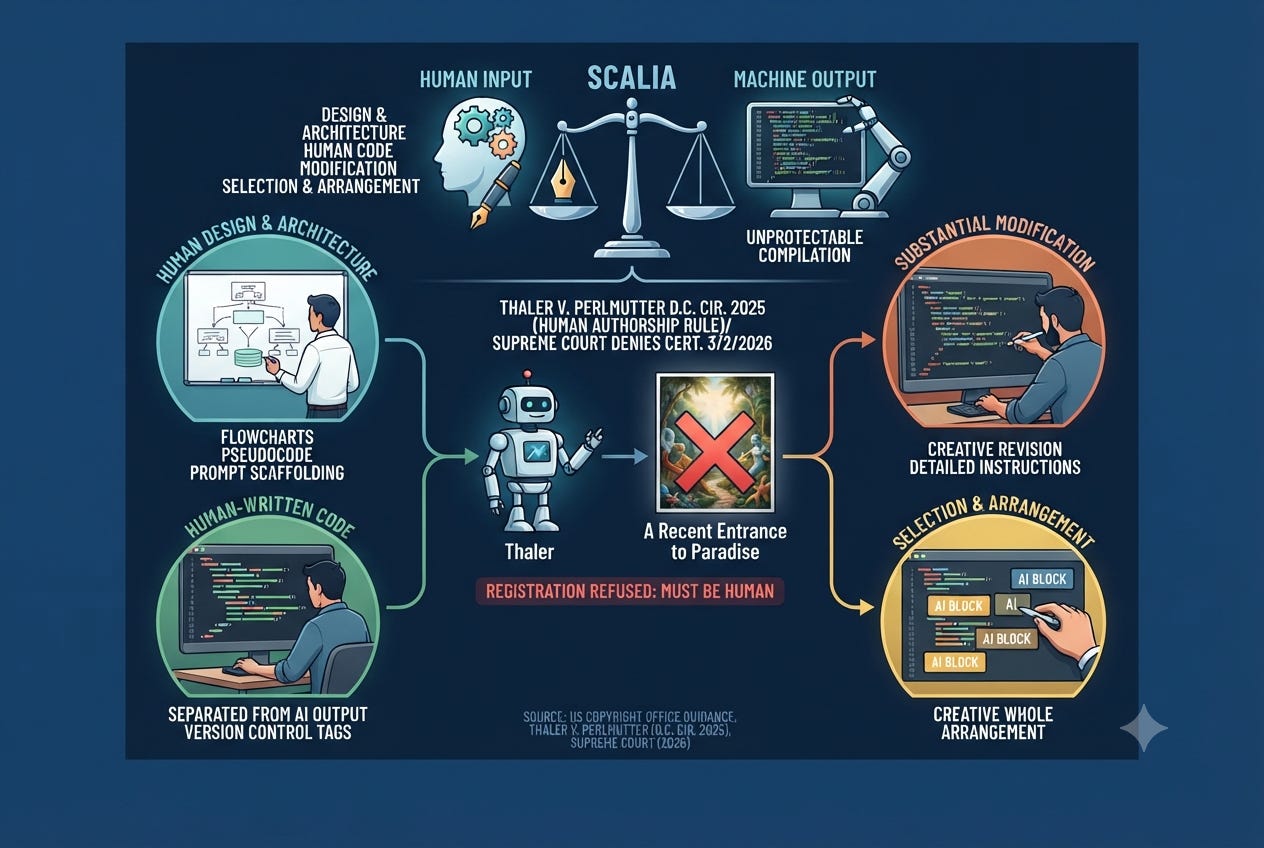
Beyond Copyright: The New AI Vendor Contract Architecture
Description
A startup owns AI generated outputs and blocks vendor training on its data only through explicit contract clauses, since Thaler v. Perlmutter held copyright does not cover machine generated content. Ownership of an AI output is a function of contract, not copyright: the operative protection is an unconditional assignment clause that survives termination, paired with a training prohibition that reaches the vendor’s own definition of aggregated or deidentified data. Most enterprise AI tiers already promise a version of both protections. The gap between the promise and the actual definition is where founders keep losing negotiating leverage they did not know was available.
This issue is showing up in nearly every enterprise AI procurement conversation this year because the underlying legal exposure changed twice in twelve months. In March 2025, the D.C. Circuit decided Thaler v. Perlmutter, and in March 2026 the Supreme Court declined to review it, closing off, for now, any argument that a wholly machine generated work qualifies for copyright protection on its own. At the same time, California’s Generative Artificial Intelligence Training Data Transparency Act took effect January 1, 2026, requiring large AI developers to publish a high level summary of the data used to train their models. Neither development directly rewrites a vendor contract. Both changed what a careful founder now asks for inside one.
Why does Thaler v. Perlmutter matter for a founder who never plans to register a copyright
Thaler v. Perlmutter began with an inventor named Stephen Thaler, who told the Copyright Office that his own system, the Creativity Machine, was the sole author of an image and asked to register it that way. The Copyright Office refused, the district court affirmed the refusal, and on March 18, 2025 the D.C. Circuit agreed: copyright protection requires a human author, and a system with no human control over the expression produced cannot be that author. The ruling does not say AI assisted work is never copyrightable. It says the human contribution has to be real enough to count, and it leaves the line between meaningful human control and a rubber stamp prompt for a later case to draw. For a startup generating marketing copy, code, or a data model with an enterprise AI tool, that ambiguity means the company cannot assume copyright automatically protects the output the way it would protect a document an employee typed by hand. The assignment clause in the vendor contract becomes the primary legal mechanism securing the startup’s position, not a backstop to copyright.
What do OpenAI, Microsoft, and Anthropic actually promise about training data
The major platforms have converged on a similar structure for enterprise and application programming interface tiers. OpenAI’s Business Terms state that OpenAI will not use Customer Content to develop or improve its services unless the customer explicitly agrees, a reversal of the default reuse permitted on individual ChatGPT accounts. Microsoft states that Azure OpenAI Service does not use customer prompts, completions, embeddings, or fine tuning data to train or retrain the underlying foundation models without permission. Anthropic’s Commercial Terms of Service assign output ownership to the customer and keep commercial and application programming interface customer content out of model training by default. Each of these commitments is real, and each is also narrower than the marketing language suggests. The protections generally attach to Customer Data or Customer Content as those terms are defined in the agreement, and the definition is where the negotiation actually happens.
What is the aggregation carveout and why does it undo the training prohibition
Vendor paper frequently excludes aggregated or deidentified data from the definition of protected Customer Data, then permits unrestricted use of that excluded category. Once data is aggregated or strippe