Episode Details
Back to Episodes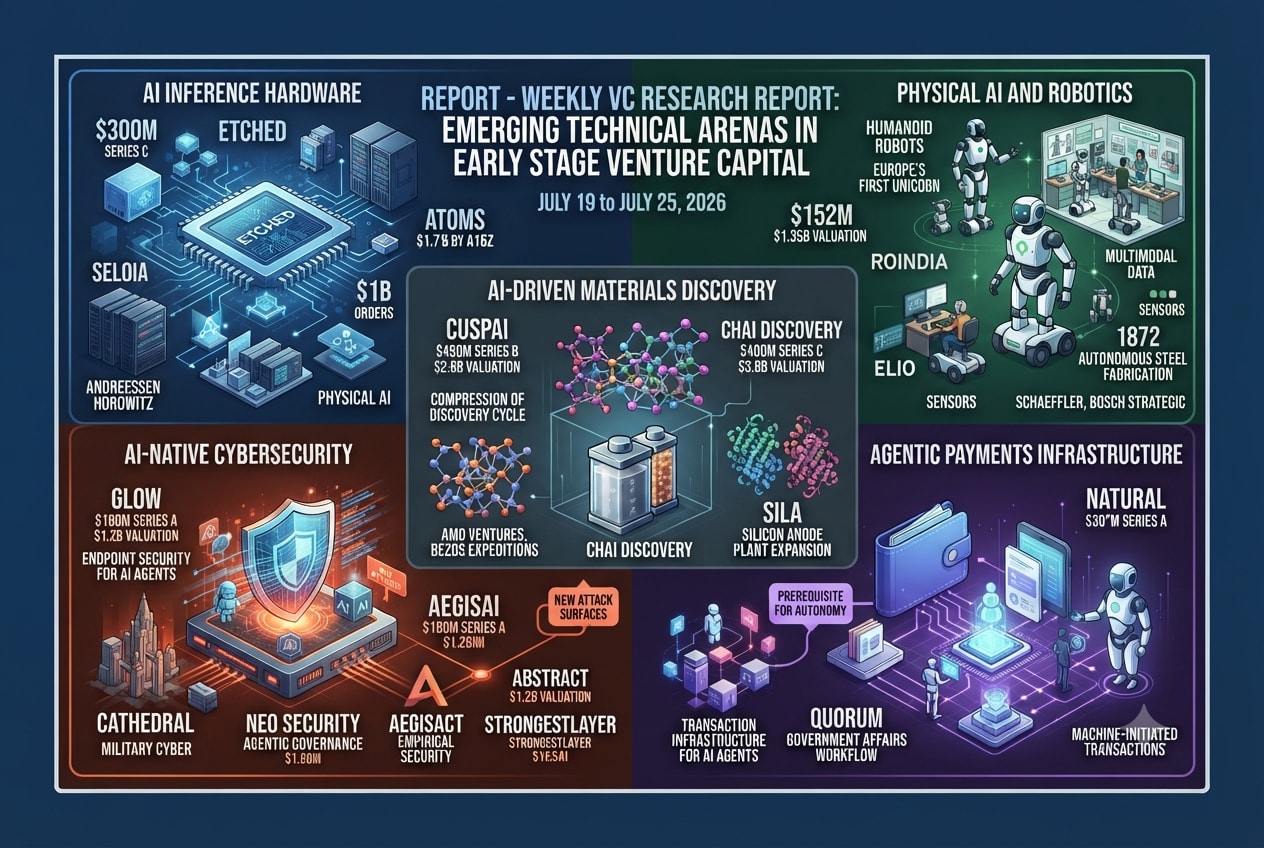
Capital Concentration in Production-Scale AI
Description
Venture capital in the week of July 19 to July 25, 2026, deployed more than $4 billion across five technical arenas: AI inference hardware, physical AI and robotics, materials discovery powered by AI, AI-native cybersecurity, and agentic payments infrastructure, with Atoms receiving $1.7 billion and Etched receiving $300 million marking the clearest statement yet about where production-scale AI economics will be decided.
There are weeks when the funding tape is a random collection of unrelated bets. This was not one of them. Every major round funded something that sits between the AI model and the customer outcome: the hardware that runs the model efficiently, the robots that carry decisions into physical environments, the materials that make chips and batteries work, the security that keeps autonomous software from becoming a liability, the payment rails that allow software to complete transactions. Capital is not buying AI capability. It is buying the stack that makes AI capability usable at production scale.
How Does AI Inference Hardware Change the Economics of Deployment?
Etched raised $300 million at a $10.3 billion pre-money valuation on July 23, 2026, led by Sequoia Capital. The company reported $1 billion in existing orders and first silicon manufactured. Etched co-designs chips, memory, interconnects, racks, and manufacturing around inference workloads, not around the general-purpose flexibility that NVIDIA GPUs provide for training. Training and inference have fundamentally different optimization targets. Training requires flexibility to adjust model weights across iterations. Inference requires throughput, low latency, and energy efficiency per token on a fixed model. A chip architecture optimized for one performs suboptimally on the other.
Atoms, founded by Travis Kalanick, raised $1.7 billion led by Andreessen Horowitz in the same week, framing the company as a bet on the complete digitization of large industrial economic sectors through AI-powered physical systems. The two rounds together argue that the next cost reduction in AI comes not from model architecture improvements but from purpose-built hardware and purpose-built deployment infrastructure. NVIDIA generated approximately $130 billion in revenue in fiscal year 2026, with the majority from data center GPUs designed for training flexibility. Etched and companies like it are betting that a portion of that revenue is available to hardware alternatives offering better inference economics per token, and that $1 billion in purchase orders constitutes early evidence that buyers agree.
Why Is Physical AI Attracting Capital Across Five Distinct Problems?
Humanoid raised $152 million Series A at a $1.35 billion post-money valuation led by Prime Movers Lab with Schaeffler and Bosch as strategic investors. The wheeled robot form factor choice is commercially revealing: capital is going to whatever can be deployed fastest, not whatever looks most impressive in a demonstration video. Ropedia raised $30 million for a multimodal human interaction data platform capturing synchronized video, audio, depth, gaze, motion, and pose, producing a repository of 10 million interaction episodes. Elio raised $21 million for machine-native sensors that capture information optimized for AI processing rather than human perception. 1872 raised $15 million seed to build autonomous steel fabrication in Cincinnati, coordinating procurement, robotics, and production for heavy industrial work.
Each round addresses a different layer in the physical AI supply chain. Humanoid is the deployment vehicle. Ropedia is the training data. Elio is the sensor that feeds accurate real-world information into the model. 1872 is the application in a specific industrial category. None of these companies competes with the others. They are co-dependent layers in a value chain that has not yet reached commercial scale. Investors across these four rounds are buying p