Episode Details
Back to Episodes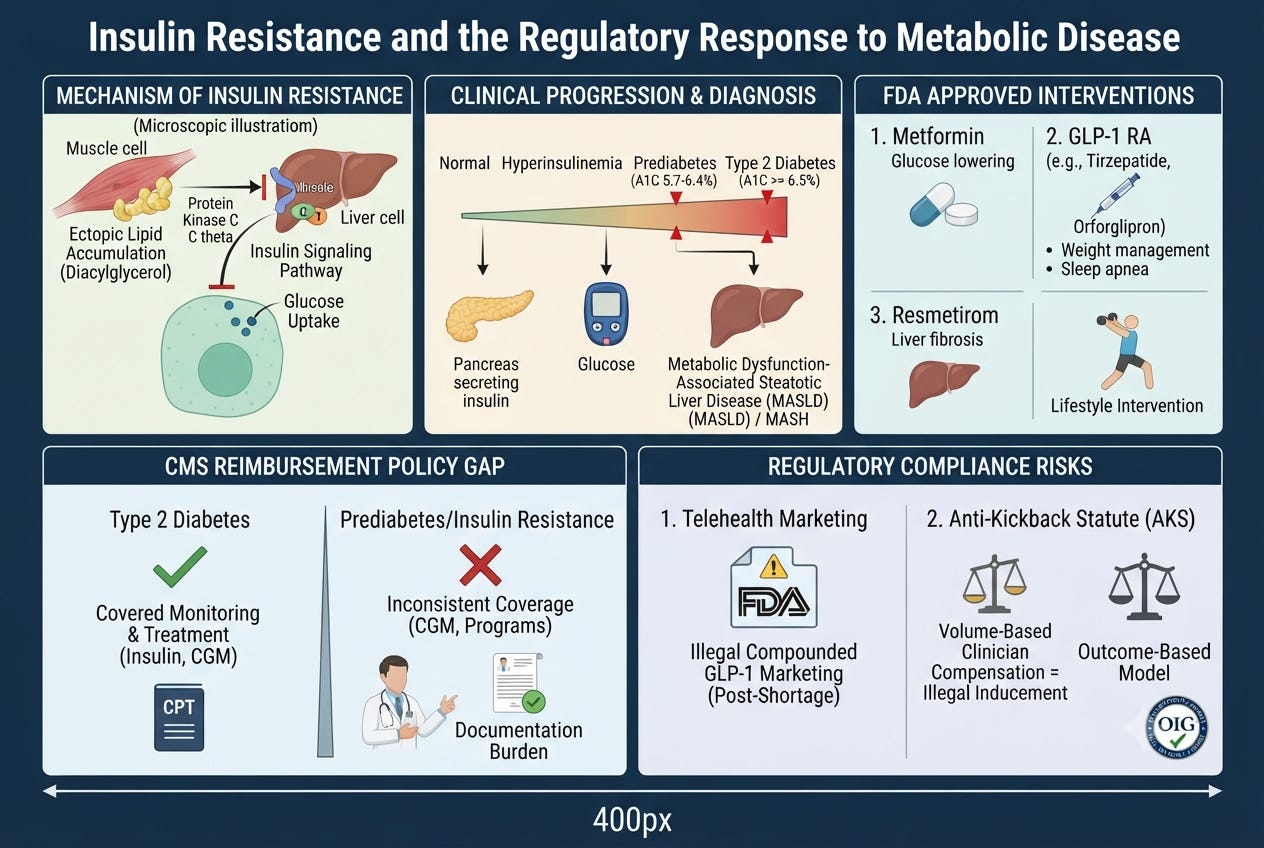
The Metabolic Health and Insulin Resistance Regulatory Paradox
Description
CDC Data Show Insulin Resistance Precedes Diabetes by Years
what is insulin resistance and how is it treated
A patient can carry the same insulin resistant biology on two consecutive lab reports and land in two entirely different medical and financial categories, depending on which side of a single decimal point their hemoglobin A1C falls. At 6.4 percent, the American Diabetes Association’s Standards of Care in Diabetes, 2026 edition, calls that patient prediabetic and recommends monitoring. At 6.5 percent, the same patient has type 2 diabetes, a different set of covered drugs, and a different conversation with a claims adjuster. The insulin resistance underneath both numbers, according to the Centers for Disease Control and Prevention’s 2024 National Diabetes Statistics Report, already affects an estimated 97.6 million American adults, 38 percent of the adult population, most of whom have never heard the term.
Stanford endocrinologist Gerald Reaven gave the condition its first formal description in his 1988 Banting Lecture to the American Diabetes Association, published that year in the journal Diabetes. Reaven noticed that heart attack patients tended to share a cluster of abnormalities: high triglycerides, low HDL cholesterol, elevated blood pressure, and a resistance to insulin’s normal effect on glucose uptake, whether or not the patient was obese. He called the cluster Syndrome X. The field later renamed it metabolic syndrome, but Reaven’s core finding held up: insulin resistance can be present in roughly a quarter of nonobese adults with entirely normal glucose tolerance, meaning the defect precedes any visible weight change, often by years.
Yale endocrinologist Gerald Shulman supplied the mechanism twenty six years later, in a 2014 New England Journal of Medicine paper that remains the clearest account of how the defect actually works. When a person takes in more energy than their subcutaneous fat can safely store, the overflow does not disappear. It accumulates inside muscle cells and liver cells, where a lipid byproduct called diacylglycerol activates an enzyme, protein kinase C theta, that interrupts the signaling pathway insulin normally uses to move glucose into the cell. The muscle stops responding first. The pancreas compensates by secreting more insulin, a state called hyperinsulinemia, and blood glucose stays normal for a while longer, right up until the pancreas itself tires and fasting glucose begins to climb. By the time a hemoglobin A1C test catches the rise, the underlying defect has usually been present for years.
FDA’s approval record traces the same progression from the treatment side. Metformin remains approved only for type 2 diabetes, but the 2002 Diabetes Prevention Program, a National Institutes of Health trial of 3,234 adults with prediabetes published in the New England Journal of Medicine, found that metformin cut progression to diabetes by 31 percent while intensive lifestyle intervention, exercise and modest calorie reduction, cut it by 58 percent, a larger effect that persisted through 21 years of follow up in the Diabetes Prevention Program Outcomes Study. The glucagon like peptide 1 receptor agonist class arrived later and moved faster. FDA approved tirzepatide as Mounjaro for type 2 diabetes in 2022 and as Zepbound for chronic weight management in November 2023, then cleared orforglipron, the first oral GLP-1 agent without food or water restrictions, under the brand Foundayo on April 1, 2026. FDA approved resmetirom, brand name Rezdiffra, in March 2024 for the liver fibrosis that develops once fat spillover from muscle reaches the liver, a condition now called MASH that affects roughly 65 percent of people with type 2 diabetes.
None of these approvals names insulin resistance as the condition being treated, because FDA’s approval pathway requires a defined disease endpoint: diabetes, obesity, obstructive sleep apnea, liver fibrosis. Insulin resistanc