Episode Details
Back to Episodes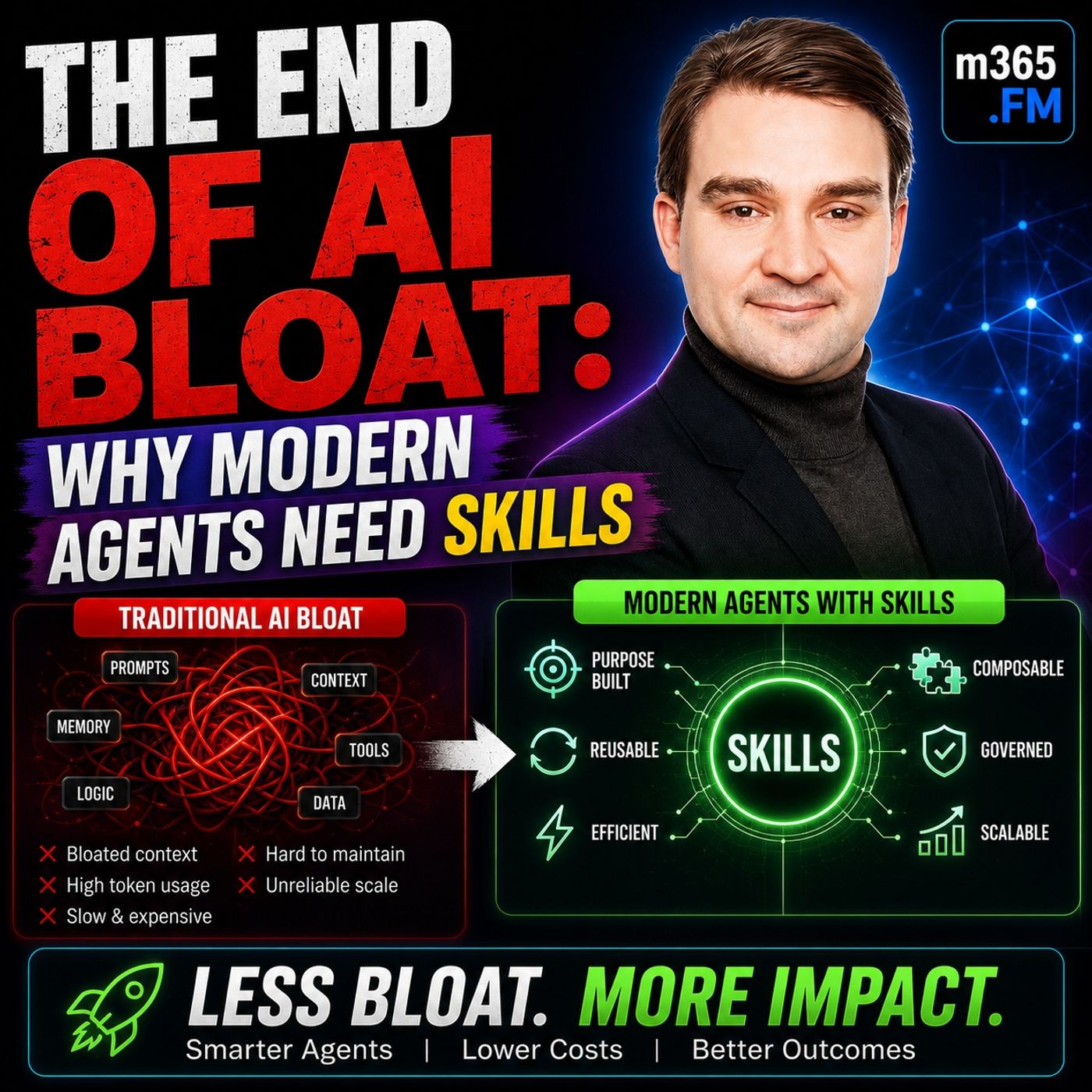
The End of AI Bloat: Why Modern Agents Need Skills
Season 2
Published 1 week, 6 days ago
Description
Many AI agents start out fast, responsive, and surprisingly intelligent. But after a few months of real-world use, something changes. Response times increase, costs rise, prompts become enormous, and accuracy begins to decline. Organizations often respond by upgrading to larger models, expanding prompts, or adding more orchestration—but the underlying problem remains. The issue isn't the model. It's the architecture. This episode explains why monolithic prompts create what is known as the Context Tax, how modular Skills solve the problem through progressive disclosure, and why Skills are becoming the architectural foundation of modern AI agents across Microsoft Copilot Studio, GitHub Copilot, Claude Code, and the broader enterprise AI ecosystem.
THE CONTEXT TAX
Every enterprise AI project eventually faces the same challenge. At first, an agent contains a relatively small system prompt describing its role, tone, business rules, and guardrails. As the organization grows, more instructions are added:
WHY AGENTS DEGRADE OVER TIME
Agent degradation is remarkably predictable. Organizations usually begin with one comprehensive instruction document that contains everything the AI should know. Initially this works well. Then new departments request additional functionality. Policies evolve. Compliance requirements expand. New workflows are added. Instead of restructuring the architecture, teams simply keep extending the same prompt. The result is context saturation. The model spends increasing amounts of effort searching through irrelevant guidance before finding the instructions that actually matter. This produces several side effects:
ALWAYS-ON GUIDANCE VS SITUATIONAL EXPERTISE
One of the most important architectural distinctions introduced in this session is separating always-on guidance from situational expertise. Always-on guidance includes information that applies to every conversation:
WHAT IS A SKILL?
A Skill is much more than a prompt. It is a reusable package containing:
THE CONTEXT TAX
Every enterprise AI project eventually faces the same challenge. At first, an agent contains a relatively small system prompt describing its role, tone, business rules, and guardrails. As the organization grows, more instructions are added:
- Policies
- Compliance rules
- Business procedures
- Examples
- Edge cases
- Department-specific workflows
WHY AGENTS DEGRADE OVER TIME
Agent degradation is remarkably predictable. Organizations usually begin with one comprehensive instruction document that contains everything the AI should know. Initially this works well. Then new departments request additional functionality. Policies evolve. Compliance requirements expand. New workflows are added. Instead of restructuring the architecture, teams simply keep extending the same prompt. The result is context saturation. The model spends increasing amounts of effort searching through irrelevant guidance before finding the instructions that actually matter. This produces several side effects:
- Higher token consumption
- Slower responses
- Increased hallucinations
- More inconsistent reasoning
- Higher operational costs
ALWAYS-ON GUIDANCE VS SITUATIONAL EXPERTISE
One of the most important architectural distinctions introduced in this session is separating always-on guidance from situational expertise. Always-on guidance includes information that applies to every conversation:
- Agent identity
- Tone of voice
- Universal compliance rules
- Security requirements
- Core behavioral instructions
- Vendor onboarding
- Leave eligibility
- Tax regulations
- Refund workflows
- Regional compliance
- Incident response procedures
WHAT IS A SKILL?
A Skill is much more than a prompt. It is a reusable package containing:
- Structured instructions
- Metadata
- Trigger descriptions
- Optional scripts
- Reference documents
- Templates
- Supporting assets