Episode Details
Back to Episodes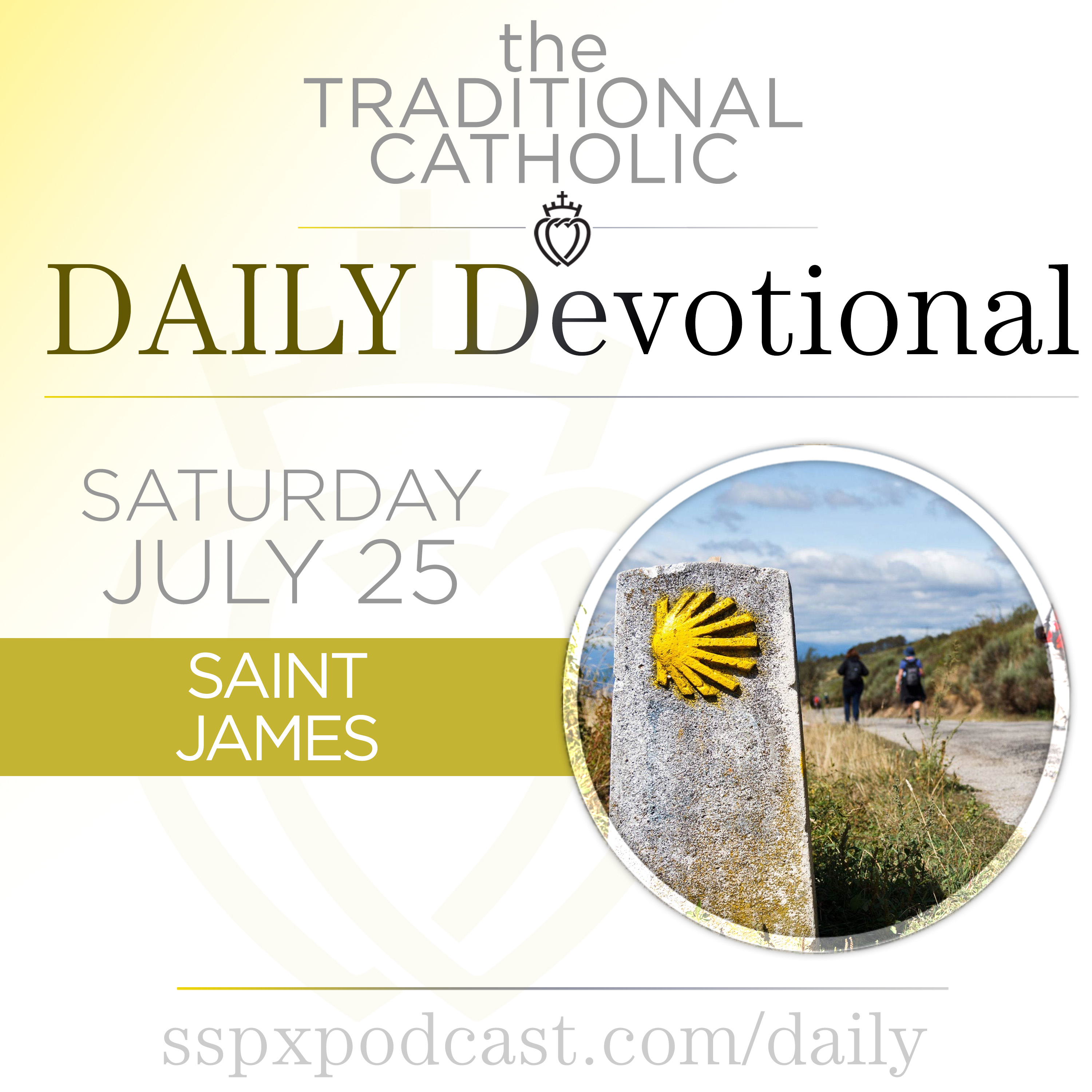
Jul 25 – St James
Description
Sources Used Today:
- "Rendering an Account" — From Trinity Sunday to the Assumption
- "1974-1983-2026: Semper Idem" (FSSPX.news)
- The Spiritual Life — Archbishop Marcel Lefebvre (Angelus Press)
Please support our new project, the Archbishop Lefebvre Biography Audiobook!
- Learn more:https://www.youtube.com/watch?v=Y-Wp4MQdK2o
- Donate:https://sspx.gifts/audiobook
Saint James the Greater is one of the Twelve Apostles, the brother of Saint John and one of Christ's closest companions. The Gospels tell us that he was present at some of the most important moments of Our Lord's earthly life, including the Transfiguration and the Agony in the Garden. He was also the first of the Apostles to give his life for Christ, martyred by order of King Herod around the year 44. But while his earthly life was relatively brief, his influence after his death has been extraordinary.
According to one of Christianity's oldest traditions, after preaching the Gospel in Spain, James's disciples carried his body back across the sea after his martyrdom and buried him in what is now Santiago de Compostela in northwestern Spain. Whether every detail of that tradition can be historically verified has long been discussed, but for well over a thousand years Christians have believed that his tomb rests there, making it one of the greatest pilgrimage destinations in the world.
Beginning in the Middle Ages, pilgrims from every corner of Europe set out on what became known as the Camino de Santiago, the Way of Saint James. There wasn't just one route. A network of ancient roads stretched across France, Spain, Germany, Italy, and beyond, all gradually converging on the cathedral that housed the Apostle's shrine. Some pilgrims walked for weeks. Others for months. A few traveled more than a thousand miles, carrying little more than a walking staff, a cloak, and the famous scallop shell that became the symbol of Saint James.
The Camino became so popular that entire towns grew up to serve pilgrims. Monasteries, hospitals, bridges, and hostels were built along the routes, many of which still exist today. Even now, hundreds of thousands of people walk the Camino each year. Some come for religious reasons, others for history or personal reflection, but nearly all discover that pilgrimage has a way of slowing life down and making room for God.
July 25,