Episode Details
Back to Episodes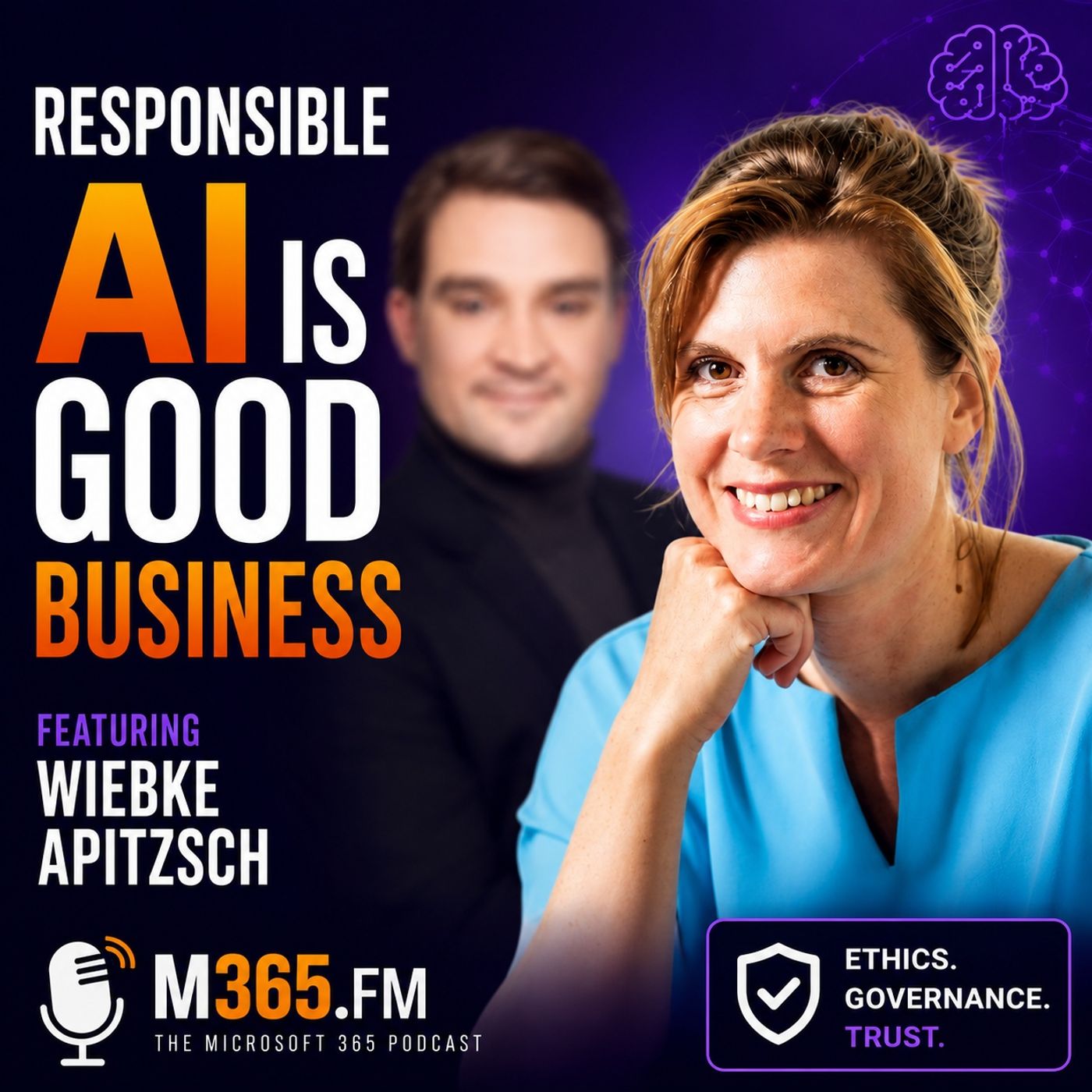
Responsible AI Is Good Business — Featuring Wiebke Apitzsch
Season 2
Published 2 weeks, 1 day ago
Description
Artificial intelligence is transforming every industry, but successful AI adoption requires far more than deploying the latest models or building autonomous agents. In this episode of M365.fm, Mirko Peters is joined by Wiebke Apitzsch, founder of AI Impact, AI strategy advisor, executive coach, and keynote speaker, for a deep conversation about why responsible AI is not just an ethical requirement—it is a competitive business advantage. Drawing from her background in technology, business strategy, consulting, and philosophy, Wiebke explains why organizations must first decide who they want to become with AI before selecting technologies or implementing solutions.
FROM AI HYPE TO REAL BUSINESS IMPACT
Many organizations rush into AI projects because of market pressure, only to discover that implementation is far more challenging than expected. Wiebke explains why AI adoption often stalls after the initial excitement and why leaders should focus on solving real business problems instead of chasing the newest models. Rather than asking, "Where can we use AI?" companies should first identify their strategic challenges and then determine whether AI is actually the right solution. Sometimes the best answer is not using AI at all. This practical mindset helps organizations avoid costly mistakes while maximizing long-term business value.
THE ROLE OF PHILOSOPHY IN ARTIFICIAL INTELLIGENCE
One of the most fascinating parts of the discussion explores how philosophy can guide AI strategy. Inspired by thinkers such as Immanuel Kant, Wiebke discusses concepts like dignity, human value, and responsibility, explaining why certain activities should always remain human-centered regardless of how capable AI becomes. The conversation explores what separates humans from intelligent systems, why trust matters in every business relationship, and why organizations should carefully define where AI supports people instead of replacing them. These philosophical foundations become surprisingly practical when designing enterprise AI solutions.
BUILDING TRUSTWORTHY AI FOR THE ENTERPRISE
Trust cannot simply be added to an AI solution—it must be earned through consistent, reliable behavior. Wiebke explains how organizations can design AI systems that employees and customers actually trust by keeping humans involved at the right decision points, validating AI-generated outputs, and building processes that acknowledge the probabilistic nature of large language models. Instead of striving for impossible perfection, companies should create workflows where AI accelerates work while experienced professionals remain accountable for the final outcome. This balanced approach enables organizations to benefit from AI without sacrificing quality or confidence.
AI AGENTS, AUTONOMY, AND HUMAN DECISION MAKING
The conversation also explores autonomous AI agents and where they truly deliver value. While AI can automate repetitive tasks, summarize information, generate content, and optimize workflows, completely autonomous decision-making introduces significant risks. Wiebke explains why humans should continue making strategic decisions, maintaining customer relationships, driving innovation, and taking responsibility for business outcomes. AI works best as an intelligent assistant—not as an unchecked replacement for leadership, judgment, or accountability.
BIAS, HALLUCINATIONS, SECURITY, AND RESPONSIBILITY
Modern AI systems raise important questions about hallucinations, algorithmic bias, data privacy, and enterprise security. Rather than treating hallucinations as unexpected failures, Wiebke explains how organizations should build processes that anticipate them through human review and validation. The discussion also covers recruitment bias, predictive policing, confidential enterprise data, local AI models, governance, and why companies—not AI vendors—rem
FROM AI HYPE TO REAL BUSINESS IMPACT
Many organizations rush into AI projects because of market pressure, only to discover that implementation is far more challenging than expected. Wiebke explains why AI adoption often stalls after the initial excitement and why leaders should focus on solving real business problems instead of chasing the newest models. Rather than asking, "Where can we use AI?" companies should first identify their strategic challenges and then determine whether AI is actually the right solution. Sometimes the best answer is not using AI at all. This practical mindset helps organizations avoid costly mistakes while maximizing long-term business value.
THE ROLE OF PHILOSOPHY IN ARTIFICIAL INTELLIGENCE
One of the most fascinating parts of the discussion explores how philosophy can guide AI strategy. Inspired by thinkers such as Immanuel Kant, Wiebke discusses concepts like dignity, human value, and responsibility, explaining why certain activities should always remain human-centered regardless of how capable AI becomes. The conversation explores what separates humans from intelligent systems, why trust matters in every business relationship, and why organizations should carefully define where AI supports people instead of replacing them. These philosophical foundations become surprisingly practical when designing enterprise AI solutions.
BUILDING TRUSTWORTHY AI FOR THE ENTERPRISE
Trust cannot simply be added to an AI solution—it must be earned through consistent, reliable behavior. Wiebke explains how organizations can design AI systems that employees and customers actually trust by keeping humans involved at the right decision points, validating AI-generated outputs, and building processes that acknowledge the probabilistic nature of large language models. Instead of striving for impossible perfection, companies should create workflows where AI accelerates work while experienced professionals remain accountable for the final outcome. This balanced approach enables organizations to benefit from AI without sacrificing quality or confidence.
AI AGENTS, AUTONOMY, AND HUMAN DECISION MAKING
The conversation also explores autonomous AI agents and where they truly deliver value. While AI can automate repetitive tasks, summarize information, generate content, and optimize workflows, completely autonomous decision-making introduces significant risks. Wiebke explains why humans should continue making strategic decisions, maintaining customer relationships, driving innovation, and taking responsibility for business outcomes. AI works best as an intelligent assistant—not as an unchecked replacement for leadership, judgment, or accountability.
BIAS, HALLUCINATIONS, SECURITY, AND RESPONSIBILITY
Modern AI systems raise important questions about hallucinations, algorithmic bias, data privacy, and enterprise security. Rather than treating hallucinations as unexpected failures, Wiebke explains how organizations should build processes that anticipate them through human review and validation. The discussion also covers recruitment bias, predictive policing, confidential enterprise data, local AI models, governance, and why companies—not AI vendors—rem