Episode Details
Back to Episodes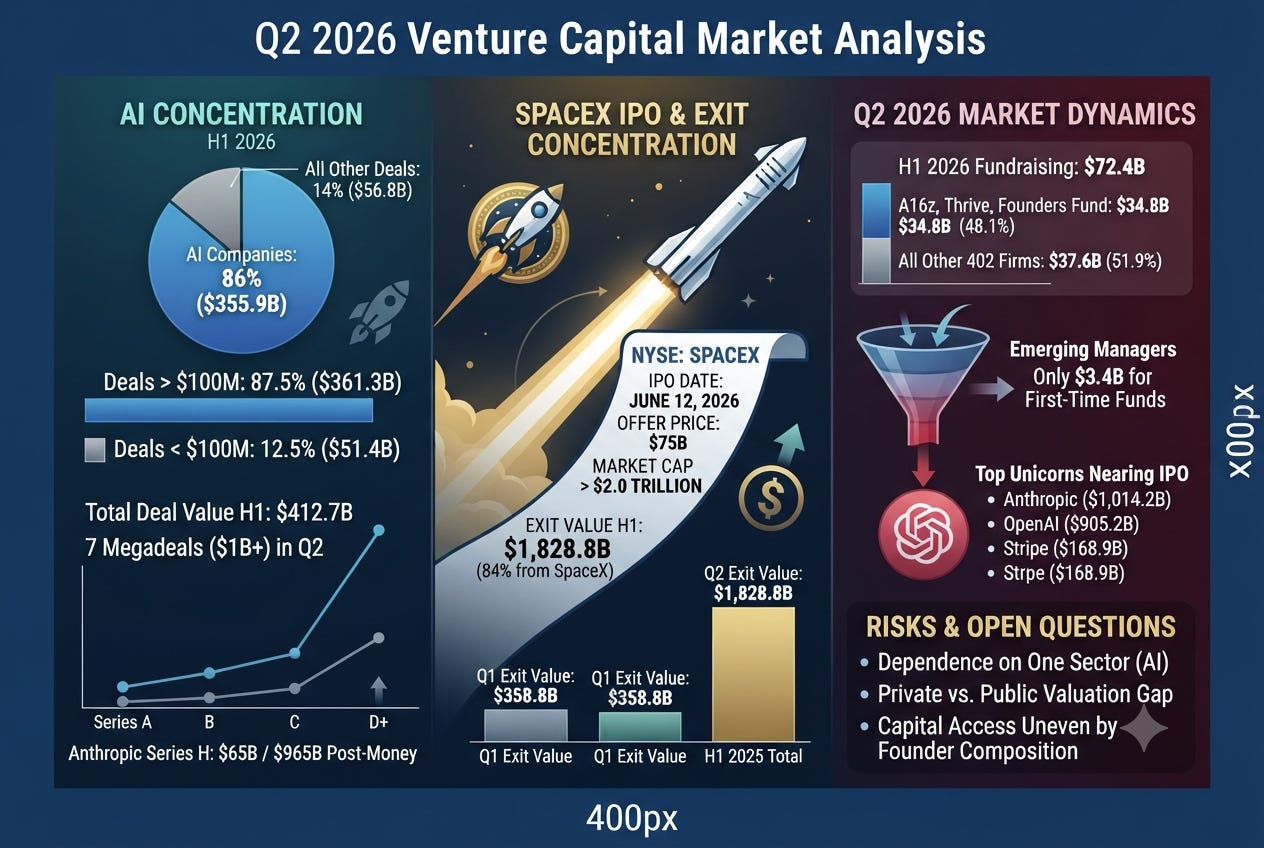
Anatomy of a Narrow Boom: Q2 2026 Venture Capital Realities
Description
SpaceX’s $1.7 Trillion IPO Defines Venture Capital in 2026
why is venture capital so concentrated in ai companies in 2026
The venture capital market did not have a good first half of 2026. It had a great one for a small number of funds and companies, and a difficult one for nearly everyone else raising capital in the United States. SpaceX completed a $1.7 trillion initial public offering on June 12, 2026, the largest IPO in history, raising approximately $75 billion and pushing its market capitalization above $2 trillion on its first trading day. That single event generated more exit value than the entire prior decade of US venture backed exits combined, and it illustrates a pattern running through every part of the 2026 data: record totals at the top, and contraction almost everywhere beneath it.
US venture capital deal value reached $412.7 billion in the first half of 2026, a total that already exceeds all of 2025. Megadeals of $100 million or more captured 87.5 percent of that figure. Deals under $100 million, the rounds that seed companies founded by first time entrepreneurs, drew just 12.5 percent of deployed capital, down from 33.1 percent in 2025 and 43.8 percent in 2024. The compression has been sharp and consistent for three straight years.
Artificial intelligence absorbed $355.9 billion of the first half total, 86 percent of all venture dollars deployed nationally. Anthropic’s Series H round shows how those totals get built. The company raised $65 billion in May 2026, but $15 billion of that figure reflected capital already committed in earlier tranches, including $5 billion from Amazon.com, Inc. The round pushed Anthropic’s post money valuation to $965 billion, ahead of OpenAI’s estimated $905.2 billion mark, and both companies have since filed confidentially for public listings. A post money valuation is not a price every investor in the round paid. It is the highest mark struck, usually by the last dollar in, and headline coverage of these rounds routinely treats it as if it were the average.
Founders raising Series B and C rounds this year are running into a specific consequence of that dynamic. Investors who cannot get into Anthropic or OpenAI are asking for contractual protection instead: pay to play provisions, participation rights, and in a few cases full ratchet anti dilution language that had all but disappeared from West Coast term sheets between 2021 and 2024. I have negotiated that exact language out of three term sheets in the past two quarters. It is not a sign that any one deal is distressed. It is a sign that investors are pricing in the possibility that a company priced against 2026 AI comparables will need a down round to get there.
The median pre money valuation for AI companies at Series D and later reached $4.25 billion in year to date 2026 data, against $644 million for non AI companies at the same stage. Every stage has pushed past its 2021 highs, but the driver differs. In 2021, low interest rates and abundant liquidity lifted valuations broadly. In 2026, expectations of fast AI revenue growth and market capture are pushing the largest valuations higher and resetting comparables across every stage beneath them. A correction in AI growth assumptions would not stay contained to AI.
Washington is moving on two fronts that matter directly to how this capital gets deployed and reported. The Securities and Exchange Commission and the Commodity Futures Trading Commission jointly proposed amendments to Form PF on April 20, 2026, that would raise the general private fund reporting threshold from $150 million to $1 billion in assets under management, and the large hedge fund adviser threshold from $1.5 billion to $10 billion. Comments closed June 23, 2026. Separately, a bipartisan pair of House members released a discussion draft of the Great American Artificial Intelligence Act on June 4, 2026, which would preempt state laws that specifically regulate AI mo