Episode Details
Back to Episodes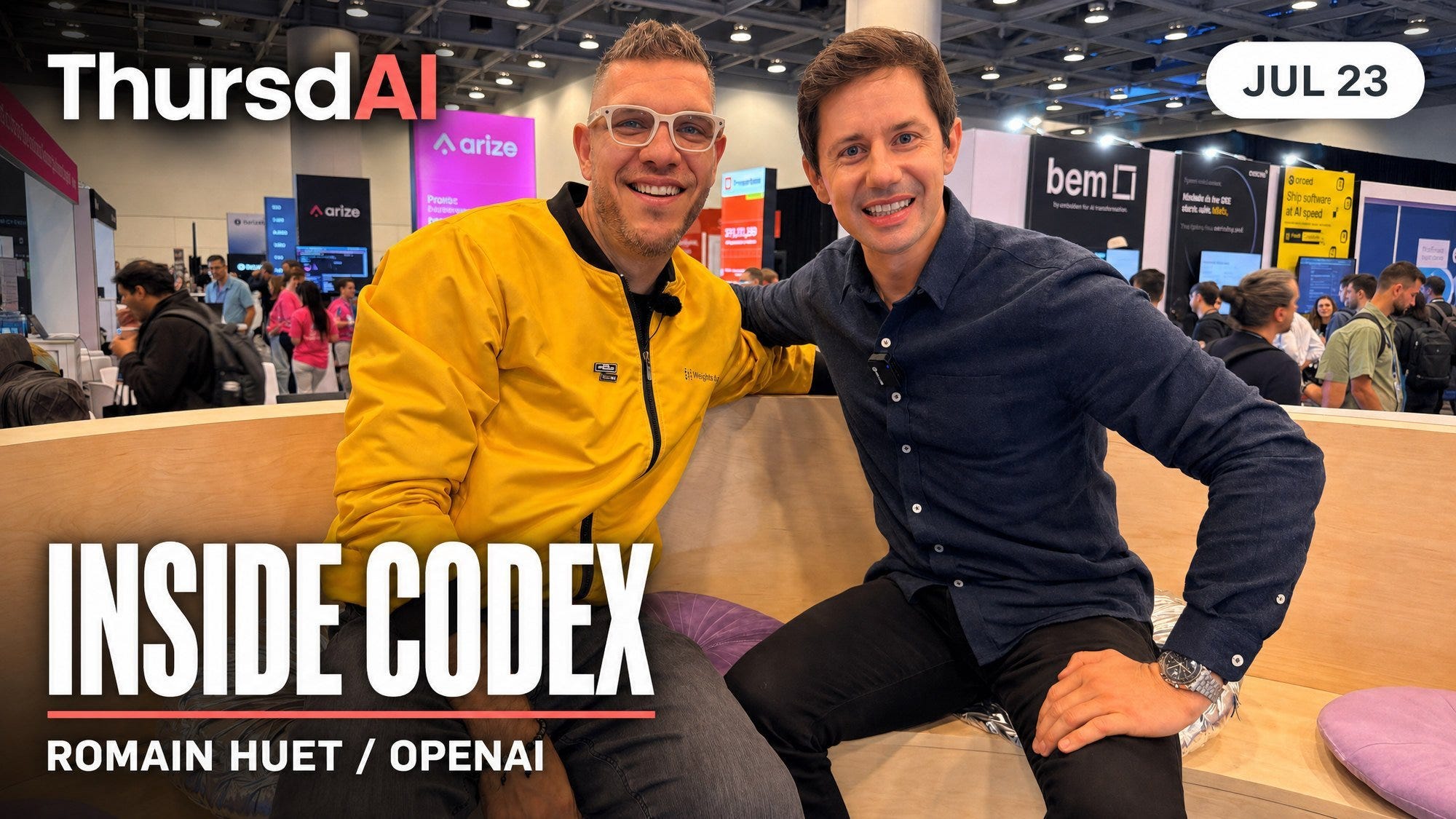
ThursdAI Special - OpenAI's Romain Huet on Codex's 5M users, GPT-5.6 & the Golden Age of AI Engineering
Description
Hey everyone, Alex here 👋
This week’s episode is a little different. As you’re reading this, I’m flying back from my 40th birthday trip with the family, and while the guys did end up having a great live stream (Huge thanks to Yam for hosting!), here I will bring you the episode I pre-recorded before leaving for the trip. However, tons of news happened this week, and as always, there’s a TL;DR section below with the top most important news in AI this week!
⏰ CHAPTERS:
0:00 — Cold open: this week is a special one
2:50 — How I use Sol & Fable: papercut-fixing with Computer Use
8:43 — Fable Max: trip site, kids' newspapers & the perfect packing list
12:06 — Rebuilding ThursdAI's openers with HyperFrames
15:53 — Romain Huet (OpenAI): the golden age of AI engineering
17:49 — Codex's inflection point: 5M weekly users & company-wide adoption
20:36 — /goal, AppShots & Codex managing its own threads
23:59 — GPT-5.6 Sol, Terra & Luna: value maxing & 750 tok/s on Cerebras
25:56 — Why prompting techniques are dying
28:01 — Voice + reasoning: the next interface for Codex & ChatGPT
29:47 — Romain's closing + OpenAI booth tour
31:25 — Insecure Agents pod: AI evangelism vs doomerism
37:25 — Wolfbench: transparent evals, token costs & surprising results
40:45 — Token billionaires: when loops are worth the spend
44:07 — Agent security & the hot take: prompt injection is solved
49:22 — Deepfakes, voice cloning & why open access makes us safer
53:35 — Final takeaways: the hallway track & AI Engineer Tel Aviv
Here’s what’s on today’s special episode. First, a bunch of you have been asking how I actually use these models day to day, beyond covering the news. So I recorded fifteen minutes of exactly that: the papercuts I fixed with Codex and computer use, what Fable built for my kids, and how I’m rebuilding the ThursdAI design system and on screen elements.
Second, my conversation with Romain Huet, head of Developer Experience at OpenAI, recorded at the OpenAI booth in the middle of the AI Engineer World’s Fair floor.
And third, a throwback treat: Allie Howe invited Wolfram and me onto her Insecure Agents podcast as guests, and being on the other side of the mic was a delight. Let’s get into it.
How I actually use AI: a papercut-fixing spree
I promised a few of you I’d take time on the show to talk about the stuff I build and fix with AI, not just the news. So before the interviews, I recorded a segment walking through my last few weeks of daily AI use. Use the chapters if you want to skip ahead, but why would you?
Codex with computer use fixed every Mac annoyance I had
Once OpenAI launched GPT 5.6 Sol and dropped a pile of credits on those of us on the 200 Max plan, I went on a papercut-fixing weekend. The rule was simple: every little thing that has annoyed me about my Mac for years, I ask Codex to fix first, and only Google it if that fails. I never got to the Google step.
Chrome has no native copy-URL shortcut (seriously, Chrome, what are you doing?), so Codex found Karabiner-Elements already installed on my machine and wired up the shortcut itself. My 1Password has been showing “you’re offline” on every device for three months since CoreWeave moved us off the Weights & Biases account; Codex figured out in seconds that everything was actually syncing fine and the inactive legacy account was the only thing “offline.” Removing it fixed the whole thing. That is not an answer you find in a help center.
It kept going. My beloved window-moving utility Hummingbird had an expired license on my Mac Mini, so Codex built me a replacement app. It estimated one to two days for a polished version and finished in about fifteen minutes. It cleaned roughly 75GB of leftover model weights and junk off my Mac (I had it build