Episode Details
Back to Episodes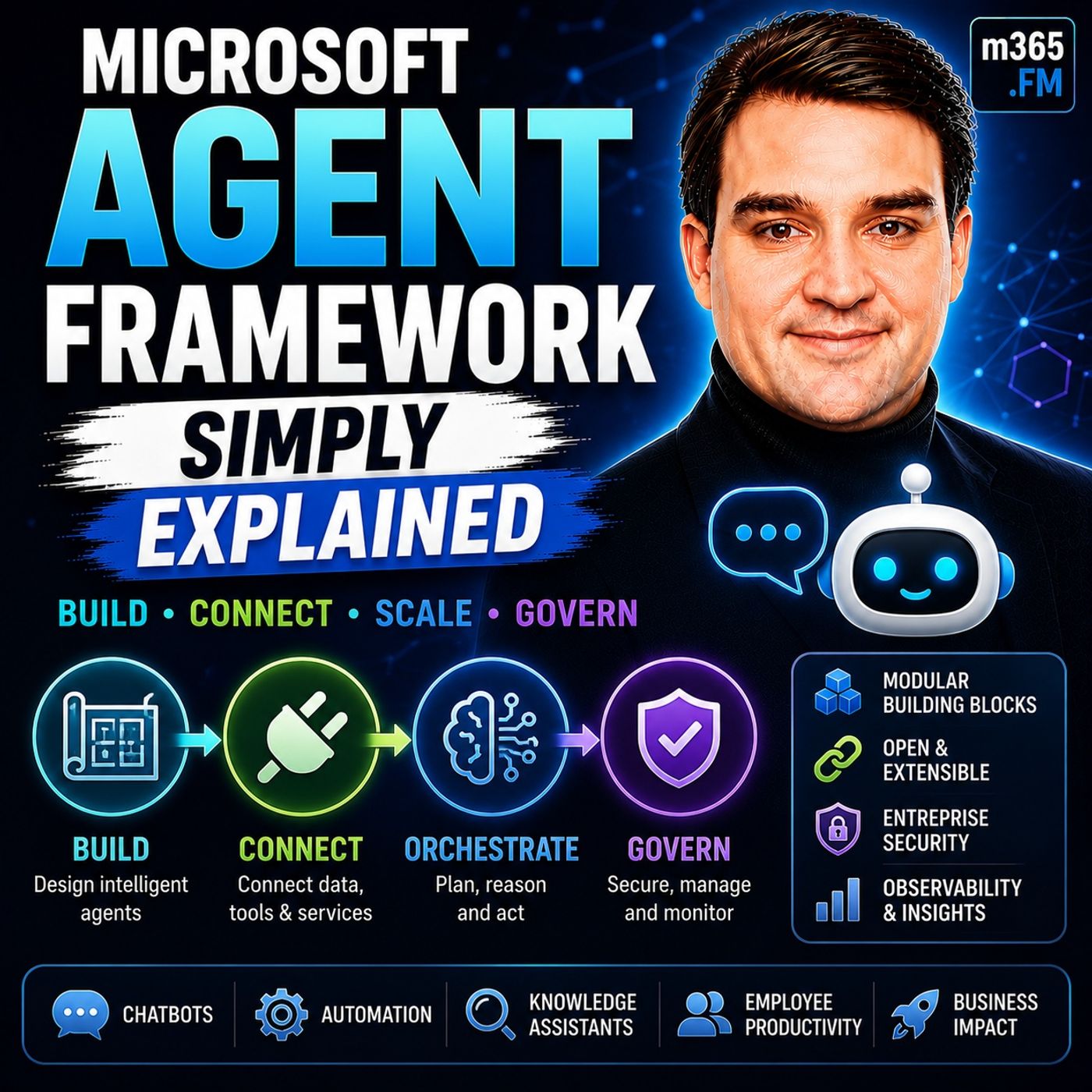
Microsoft Agent Framework - Simply Explained
Season 3
Published 2 weeks, 3 days ago
Description
Welcome to another episode of Knowledge Nuggets with Mirko Peters. Today we're exploring the Microsoft Agent Framework, Microsoft's unified development framework for building enterprise-ready AI agents. If you've been following AI over the last year, you've almost certainly heard the word agent. It's everywhere. Blog posts, conference sessions, LinkedIn discussions, Microsoft announcements, and product launches all seem to revolve around AI agents. But ask ten people what an agent actually is, and you'll probably receive ten different answers. Many people assume an agent is simply a chatbot with a more impressive name. In reality, they're fundamentally different. Microsoft created the Agent Framework to solve another growing problem. Developers were forced to choose between multiple AI frameworks, each with different capabilities, APIs, and programming models. Rather than continuing this fragmented approach, Microsoft combined its best technologies into one production-ready framework that makes building intelligent, secure, and enterprise-scale AI agents significantly easier. In this episode, we'll explain what an AI agent really is, why Microsoft built the Agent Framework, how it works, and why it will likely become one of the most important development platforms for the future of enterprise AI.
WHAT IS AN AI AGENT?
Before discussing the framework itself, it's important to understand what actually makes something an AI agent. A traditional chatbot is reactive. You ask a question, it generates an answer, and then waits for the next prompt. Every interaction is largely independent, with the user guiding every step of the conversation. An AI agent works very differently. Instead of simply responding, an agent receives a goal. It reasons about what needs to happen, creates a plan, chooses the appropriate tools, performs the required actions, and only returns once the work has been completed or additional information is required. A useful way to think about the difference is comparing a library receptionist with a personal assistant. A receptionist tells you where a book is located. A personal assistant finds the information, organizes it, prepares a summary, and hands you exactly what you need. Three capabilities separate an AI agent from a chatbot: reasoning, tools, and memory. The language model provides reasoning, tools allow the agent to interact with external systems, and memory enables it to remember previous conversations, preferences, and ongoing work. Together, these capabilities allow agents to complete tasks instead of merely answering questions.
WHY MICROSOFT CREATED THE AGENT FRAMEWORK
Building intelligent agents wasn't always straightforward. Microsoft originally provided Semantic Kernel, which offered enterprise-grade AI integration capabilities, and AutoGen, an experimental framework developed by Microsoft Research for coordinating multiple collaborating agents. Both frameworks were powerful, but they solved different problems. Semantic Kernel focused on stability and enterprise development, while AutoGen explored advanced orchestration and multi-agent collaboration. Developers often had to choose between them while also evaluating numerous third-party frameworks such as LangChain and CrewAI. This fragmented landscape created unnecessary complexity. Every framework introduced different concepts, APIs, programming models, and communities. Microsoft's answer was simple. Rather than maintaining separate frameworks, the company merged Semantic Kernel and AutoGen into one unified development platform known as the Microsoft Agent Framework, providing developers with one consistent way to build production-ready AI agents. This dramatically simplifies learning while giving organizations confidence that they're building upon Microsoft's long-term strategic platform.
WHAT IS THE MICROSOFT AGENT FRAMEWORK?
The Microsoft Agent Framework is an open-sourc
WHAT IS AN AI AGENT?
Before discussing the framework itself, it's important to understand what actually makes something an AI agent. A traditional chatbot is reactive. You ask a question, it generates an answer, and then waits for the next prompt. Every interaction is largely independent, with the user guiding every step of the conversation. An AI agent works very differently. Instead of simply responding, an agent receives a goal. It reasons about what needs to happen, creates a plan, chooses the appropriate tools, performs the required actions, and only returns once the work has been completed or additional information is required. A useful way to think about the difference is comparing a library receptionist with a personal assistant. A receptionist tells you where a book is located. A personal assistant finds the information, organizes it, prepares a summary, and hands you exactly what you need. Three capabilities separate an AI agent from a chatbot: reasoning, tools, and memory. The language model provides reasoning, tools allow the agent to interact with external systems, and memory enables it to remember previous conversations, preferences, and ongoing work. Together, these capabilities allow agents to complete tasks instead of merely answering questions.
WHY MICROSOFT CREATED THE AGENT FRAMEWORK
Building intelligent agents wasn't always straightforward. Microsoft originally provided Semantic Kernel, which offered enterprise-grade AI integration capabilities, and AutoGen, an experimental framework developed by Microsoft Research for coordinating multiple collaborating agents. Both frameworks were powerful, but they solved different problems. Semantic Kernel focused on stability and enterprise development, while AutoGen explored advanced orchestration and multi-agent collaboration. Developers often had to choose between them while also evaluating numerous third-party frameworks such as LangChain and CrewAI. This fragmented landscape created unnecessary complexity. Every framework introduced different concepts, APIs, programming models, and communities. Microsoft's answer was simple. Rather than maintaining separate frameworks, the company merged Semantic Kernel and AutoGen into one unified development platform known as the Microsoft Agent Framework, providing developers with one consistent way to build production-ready AI agents. This dramatically simplifies learning while giving organizations confidence that they're building upon Microsoft's long-term strategic platform.
WHAT IS THE MICROSOFT AGENT FRAMEWORK?
The Microsoft Agent Framework is an open-sourc