Episode Details
Back to Episodes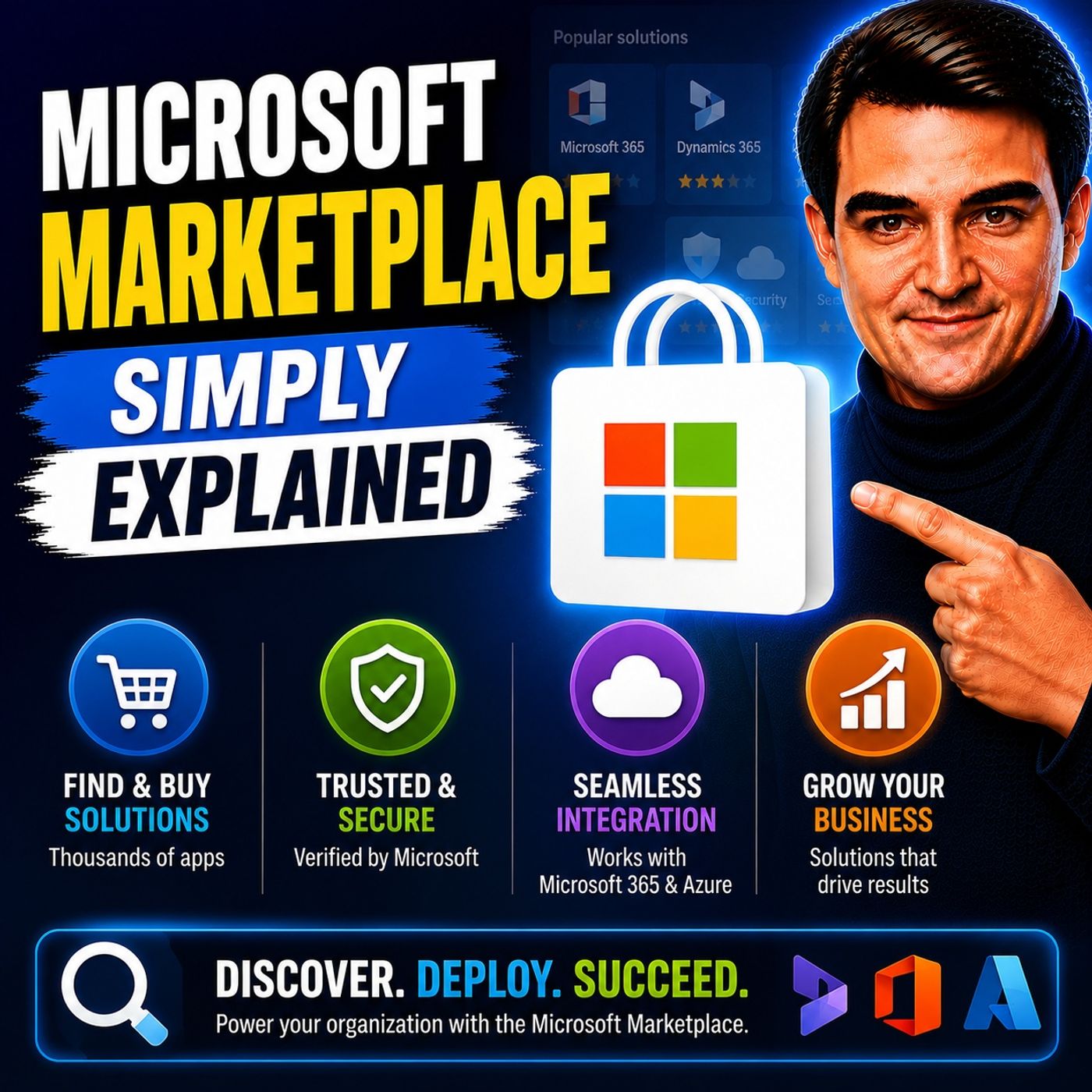
Microsoft Marketplace - Simply Explained
Season 3
Published 2 weeks, 4 days ago
Description
Welcome to another episode of Knowledge Nuggets with Mirko Peters. Today we're exploring Microsoft Marketplace, one of the most important platforms in the Microsoft ecosystem—and one that's often misunderstood. When most people hear the word Marketplace, they imagine something similar to an app store where you browse a few applications, click Buy, and you're done. While that's certainly part of the story, Microsoft Marketplace has evolved into something much bigger. Today it's a global commerce platform that connects customers, software vendors, consultants, AI solutions, and cloud services through a single purchasing experience. Whether you're an IT administrator looking for infrastructure, a business leader searching for a Power Platform solution, or a software vendor trying to reach millions of Microsoft customers, Marketplace plays a central role. By the end of this episode, you'll understand what Microsoft Marketplace actually is, why it exists, how it simplifies software procurement, and why it's becoming one of Microsoft's most important growth platforms.
WHY MICROSOFT CREATED MARKETPLACE
Before cloud marketplaces existed, buying enterprise software was surprisingly complicated. Every vendor had its own website, its own pricing model, its own contract, and its own billing process. If an organization wanted a security platform from one company, a reporting solution from another, and an AI tool from a third, procurement quickly became a project of its own. IT departments spent weeks evaluating vendors, finance teams had to process multiple invoices every month, and legal departments reviewed countless contracts that often covered very similar services. Even after the software had been purchased, deployment could still involve manual licensing, configuration, and user provisioning. Microsoft recognized that the buying experience itself had become a problem. Organizations didn't necessarily need fewer software vendors—they needed a simpler way to discover, evaluate, purchase, and manage them. That's exactly what Microsoft Marketplace delivers. Instead of maintaining dozens of independent vendor relationships, organizations can purchase solutions through the same Microsoft relationship they already use for Azure and Microsoft 365. The result is a procurement process that's dramatically simpler, faster, and easier to manage.
WHAT IS MICROSOFT MARKETPLACE?
At its core, Microsoft Marketplace is Microsoft's unified commercial platform for cloud solutions. Rather than being limited to applications, Marketplace offers an enormous range of commercial products including SaaS solutions, Azure infrastructure, virtual machines, managed applications, AI agents, consulting services, business applications, and Power Platform extensions. Every solution published on the platform has gone through Microsoft's validation process before becoming available to customers. A useful way to think about Marketplace is as a digital shopping mall. Instead of every software company building its own storefront, Microsoft provides the building. Customers enter through a single front door, compare products, read documentation, start free trials, purchase subscriptions, and deploy solutions without ever leaving the Microsoft ecosystem. Because everything integrates with Microsoft accounts, Azure subscriptions, and Microsoft 365 tenants, customers spend less time managing vendors and more time deploying technology that actually solves business problems.
TWO STOREFRONTS, ONE PLATFORM
One area that often causes confusion is the relationship between Azure Marketplace and AppSource. Although Microsoft now presents one unified Marketplace experience, the platform still serves two different audiences. Azure Marketplace is primarily designed for technical buyers. Cloud architects, developers, infrastructure engineers, and Azure administrators typically visit Azure Marketplace when searching fo
WHY MICROSOFT CREATED MARKETPLACE
Before cloud marketplaces existed, buying enterprise software was surprisingly complicated. Every vendor had its own website, its own pricing model, its own contract, and its own billing process. If an organization wanted a security platform from one company, a reporting solution from another, and an AI tool from a third, procurement quickly became a project of its own. IT departments spent weeks evaluating vendors, finance teams had to process multiple invoices every month, and legal departments reviewed countless contracts that often covered very similar services. Even after the software had been purchased, deployment could still involve manual licensing, configuration, and user provisioning. Microsoft recognized that the buying experience itself had become a problem. Organizations didn't necessarily need fewer software vendors—they needed a simpler way to discover, evaluate, purchase, and manage them. That's exactly what Microsoft Marketplace delivers. Instead of maintaining dozens of independent vendor relationships, organizations can purchase solutions through the same Microsoft relationship they already use for Azure and Microsoft 365. The result is a procurement process that's dramatically simpler, faster, and easier to manage.
WHAT IS MICROSOFT MARKETPLACE?
At its core, Microsoft Marketplace is Microsoft's unified commercial platform for cloud solutions. Rather than being limited to applications, Marketplace offers an enormous range of commercial products including SaaS solutions, Azure infrastructure, virtual machines, managed applications, AI agents, consulting services, business applications, and Power Platform extensions. Every solution published on the platform has gone through Microsoft's validation process before becoming available to customers. A useful way to think about Marketplace is as a digital shopping mall. Instead of every software company building its own storefront, Microsoft provides the building. Customers enter through a single front door, compare products, read documentation, start free trials, purchase subscriptions, and deploy solutions without ever leaving the Microsoft ecosystem. Because everything integrates with Microsoft accounts, Azure subscriptions, and Microsoft 365 tenants, customers spend less time managing vendors and more time deploying technology that actually solves business problems.
TWO STOREFRONTS, ONE PLATFORM
One area that often causes confusion is the relationship between Azure Marketplace and AppSource. Although Microsoft now presents one unified Marketplace experience, the platform still serves two different audiences. Azure Marketplace is primarily designed for technical buyers. Cloud architects, developers, infrastructure engineers, and Azure administrators typically visit Azure Marketplace when searching fo