Episode Details
Back to Episodes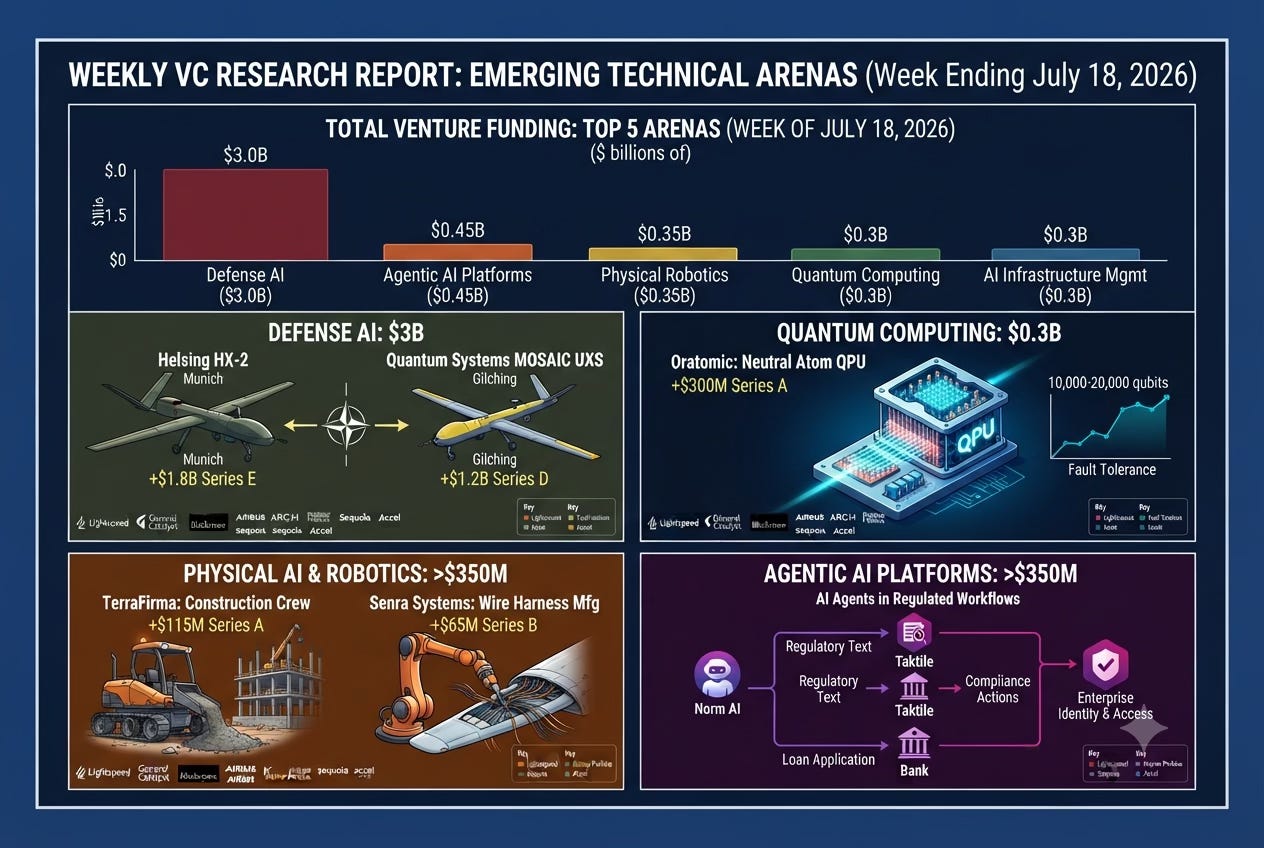
Weekly VC Research Report: Emerging Technical Arenas (July 18, 2026)
Description
Early-stage venture capital during the week ending July 18, 2026 directed more than five billion dollars toward defense AI, quantum computing hardware, and physical robotics deployed on live construction and industrial sites across twenty-two disclosed funding rounds.
This concentration of capital in three technical arenas has not been observed in a single reporting week since the first wave of generative AI infrastructure funding in late 2023. The largest individual round, a $1.8 billion Series E for a Munich-based defense AI company, set a record for European venture funding. A $300 million Series A for a London-based quantum hardware company set a record for quantum venture funding by round size. Physical robotics attracted five separate financing events totaling more than $350 million. Agentic AI platforms for regulated financial, legal, and and healthcare workflows drew five additional rounds totaling more than $350 million. Stablecoin infrastructure and AI-assisted drug discovery each contributed one transaction above $100 million to the week’s total. Every company in the top ten rounds was either deploying hardware in the field, operating with paying enterprise customers, or both.
How Much Capital Did Defense AI Attract During the Week Ending July 18, 2026?
Defense AI attracted $3 billion in disclosed venture capital during the week ending July 18, 2026, across two rounds for two German companies operating in the NATO supply chain. Helsing, a Munich-based company that builds AI software for autonomous weapons systems, closed a $1.8 billion Series E at a post-money valuation of $18 billion. The round was co-led by Lightspeed Venture Partners and General Catalyst, with participation from Accel, Greenoaks, and Prima Materia. Helsing sells the HX-2 strike drone system and the Altra command-and-control software platform to allied militaries. Total disclosed funding for the company now stands at approximately $3.5 billion.
Quantum Systems, a Gilching, Germany-based developer of autonomous aerial vehicles for defense applications, raised $1.2 billion in a Series D at a valuation of approximately $8 billion. Blackstone led the round alongside Airbus and Advent. Quantum Systems operates a multi-domain autonomy platform across air, land, and sea environments using a unified software stack called MOSAIC UXS. The company cited triple-digit revenue growth and a path to profitability as part of its investor materials, which is unusual in the defense category and likely contributed to the round size.
From my experience advising technology companies on government contracts and regulatory compliance, the increase in defense AI funding reflects a shift in how allied governments approach procurement. Several NATO member states have shortened technology adoption timelines since 2024, creating commercial pathways that did not exist previously. Three legal considerations accompany this capital flow. First, export control exposure for AI-enabled autonomous weapons is significant and varies across jurisdictions, with the International Traffic in Arms Regulations, 22 C.F.R. Parts 120-130, governing US-origin technology in these systems even when the company receiving funding is European. Second, the liability structure governing autonomous weapons decisions remains firmly disputed in international humanitarian law. Third, the concentration of defense AI funding in two German companies in a single week reflects both the strength of the European defense technology supply chain and the political urgency of European defense independence.
A third company operating in the defense sector, Singularity, a company developing air defense technology, emerged from stealth during the reporting period with $80 million in a Series A led by Khosla Ventures and Felicis, at a reported valuation of $400 million.
What Does the Oratomic $300 MM Series A Tell Us About Fault-Tolerant Quantum Computing?
Oratomic, a Lon