Episode Details
Back to Episodes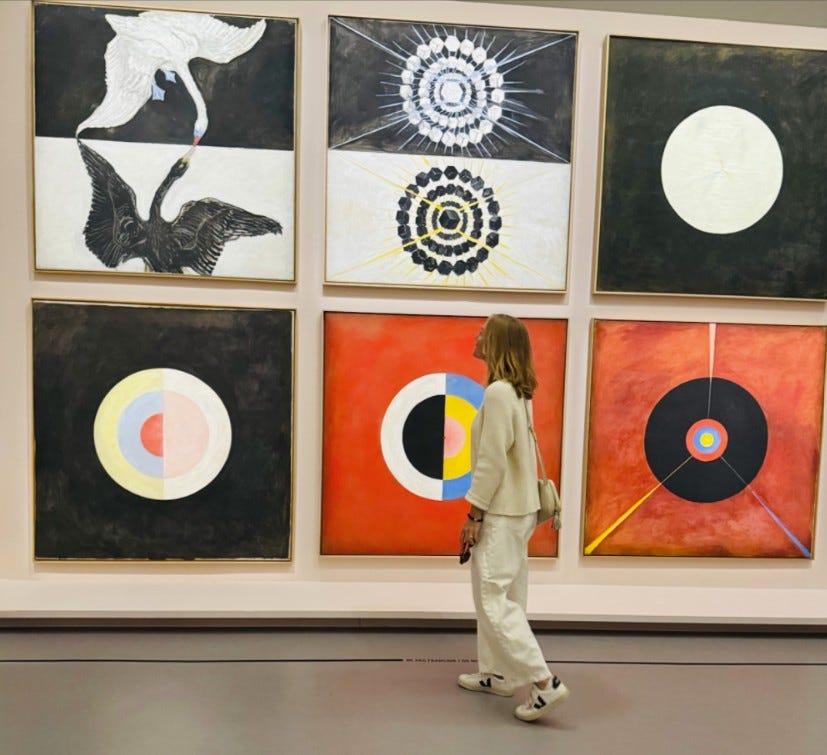
Narrated Essay: Pictures For The Future
Description
Registration will close this month for The Tender Harvest, a harvest yoga, meditation, and culinary retreat at world-class Ballymaloe House in County Cork, Ireland. Join this Sept 20-26, 2026, for a time of deep nourishment, learning, and inspiration. Just 2 rooms still available!
A dog’s retching yanks me from sleep. I’ve been floating between worlds all night, and suddenly I’m across the room before a thought can take shape. The dense atmosphere of a dream lingers as I kneel to wipe the floor, then thins as my mind reaches for it. I was in a foreign place, though the landscape felt familiar. I was with friends, though they were not themselves. There was a house. The house was a river. Its rooms were water.
With a sigh, the dog returns to bed. The house settles back into stillness. I move mutely to my meditation cushion. Incense lit, tea steeping, for a time, I watch tendrils of smoke and steam mingle in the dawning air.
Practice teaches us to notice what’s here. Gradually, our attention steadies and we begin to perceive what is real—the interplay of spirit and matter, psyche and body—through the tuning fork of our awareness. We grow quieter, more supple, more receptive—less beholden to neurosis and fixed assumptions. What we lose in certainty, we gain in texture and attunement.
As humans, especially now, our well-being depends on how honestly we inhabit the faculties of our aliveness. What do we know to be true, and by what inner or outer measure? How much doubt do we allow in the margins of confirmation? What may appear real, yet on closer examination, carries the subtle signature of an illusion? And, inversely: where have we developed trust in modes of knowing that defy rational explanation?
In classical yoga philosophy, pramana offers a basic epistemic map. It names three valid sources of knowledge: direct perception (pratyaksha), inference (anumana), and trusted testimony (sabda). I know the river is cold because I have placed my hand in it. I know the river is cold because it flows from glacial melt. I know the river is cold because someone I trust has told me so.
Of these, direct perception carries the weight of fact. Yet fact alone does not confer context. The elephant’s tail may still seem a pestle to a blind man, as the Buddhist parable goes. Here, the animal’s trumpet or a friend’s account can augment our own perception. Thus, these three sources of knowledge uphold one another.
But in Paris last month, standing beneath Hilma af Klint’s paintings at the Grand Palais, I sensed how this era of dissolving certainties is inviting us to loosen and refine our frameworks for human intelligence. Knowing is not the intellect’s final stamp of approval. It is a function of our embodied, psychic, and spiritual capacities—and it keeps calling us to widen what we recognize as real.
Born in 1862, af Klint painted vast, abstract diagrams of a reality folded within this one: swirls of color, spirals, botanical forms, and galaxies. Her pioneering abstract works, begun as early as 1906, were long kept hidden and revealed only, at her direction, decades after her death. Working with a circle of women known as The Five, she participated in séances where language and image moved through them. One presence, whom she called Ananda, instructed her to create a series of paintings “for the temple.” These “pictures for the future” were meant for the future, for an audience who could see beyond the pastoral and parlor depictions of her time.
Sta