Episode Details
Back to Episodes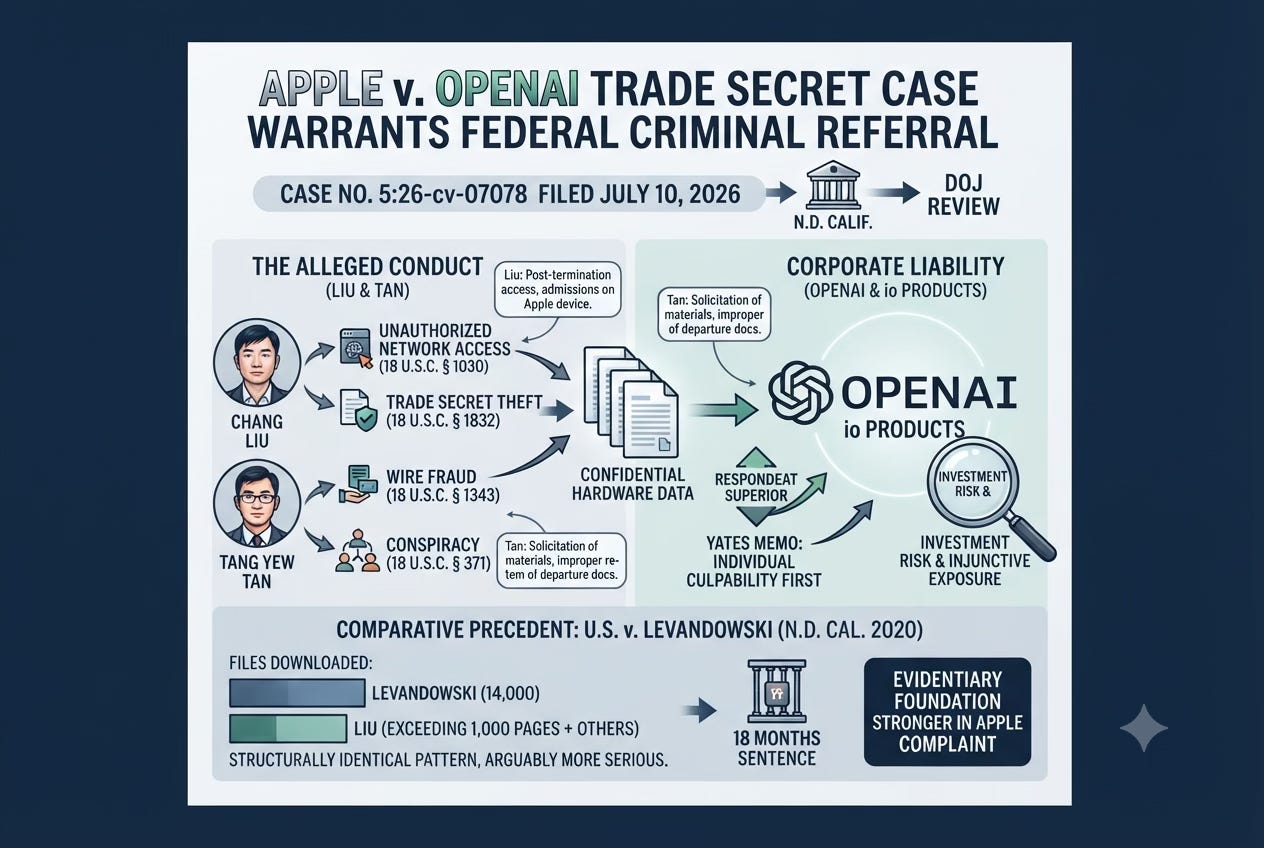
Apple v. OpenAI Trade Secret Case
Description
Apple’s complaint in Case No. 5:26-cv-07078, filed July 10, 2026 in the Northern District of California, alleges conduct by Chang Liu that satisfies every element of criminal trade secret theft under 18 U.S.C. Section 1832, and the Department of Justice has convicted a defendant on an identical fact pattern before. The question is not whether the conduct described warrants a criminal referral. It does. The question is whether federal prosecutors will act on it, and what the answer means for every venture-backed AI hardware company that has built its technical team by recruiting engineers away from Apple, Google, and Nvidia.
Why Does the Levandowski Conviction Matter for This Case?
The Levandowski conviction is the governing precedent. In 2020, the Northern District of California convicted Anthony Levandowski of a single count of criminal trade secret theft under 18 U.S.C. Section 1832 for downloading approximately 14,000 files from Google’s self-driving car project before leaving to found a competitor later acquired by Uber. He received eighteen months in federal prison. The factual structure of the Apple complaint is the same: a senior technical employee, a mass download of confidential materials, a move to a direct competitor, and evidence of deliberate concealment. On several dimensions, Apple’s factual record is stronger than what existed in Levandowski at the time of indictment.
Liu’s own communications, preserved on an Apple-issued device, establish knowledge of unauthorized access in his own words. The message quoted in the complaint describes his discovery that he could still access Apple’s network storage after his employment ended and his credentials should have been disabled. That is not circumstantial evidence. It is a written admission of the mental state Section 1832 requires: knowledge that the access was unauthorized. Liu also directed communications about the downloads to the LINE Messenger application, a choice the complaint frames as deliberate concealment, and he coached a current Apple employee on how to avoid Apple’s security team during the departure process.
What Is Tang Yew Tan’s Specific Criminal Exposure Under Section 1832?
Tang Yew Tan’s exposure is different in character but serious on its own terms. Twenty-four years at Apple is not a fact a prosecutor ignores. His alleged conduct centers on solicitation rather than direct computer intrusion: using internal Apple project codenames to probe job candidates for confidential information, directing candidates to physically remove Apple hardware from Apple premises, and distributing Apple’s internal departure security document to prospective hires before those individuals had given Apple any notice of their planned departure. Section 1832’s prohibition on obtaining trade secrets by fraud or deception covers structured deceptive interview practices. The dispositive open question is how Tan obtained the internal departure document after leaving Apple. If discovery answers that question unfavorably, his criminal exposure sharpens from a solicitation theory to a direct procurement theory, which is considerably easier to prosecute.
What Is the Basis for OpenAI Corporate Criminal Liability?
OpenAI’s corporate exposure turns on what its senior leadership directed and when. Apple’s complaint attributes the scheme not to rogue employees acting alone but to organizational conduct directed by the Chief Hardware Officer and reflected in structured interview protocols circulated across the organization. Corporate criminal liability under respondeat superior attaches when employees commit criminal acts within the scope of their employment and at least in part for the benefit of the corporation. The Yates Memorandum, issued by the Department of Justice in September 2015, requires federal prosecutors to identify culpable individuals before extending cooperation credit to the corporate entity. The content of OpenAI’s internal