Episode Details
Back to Episodes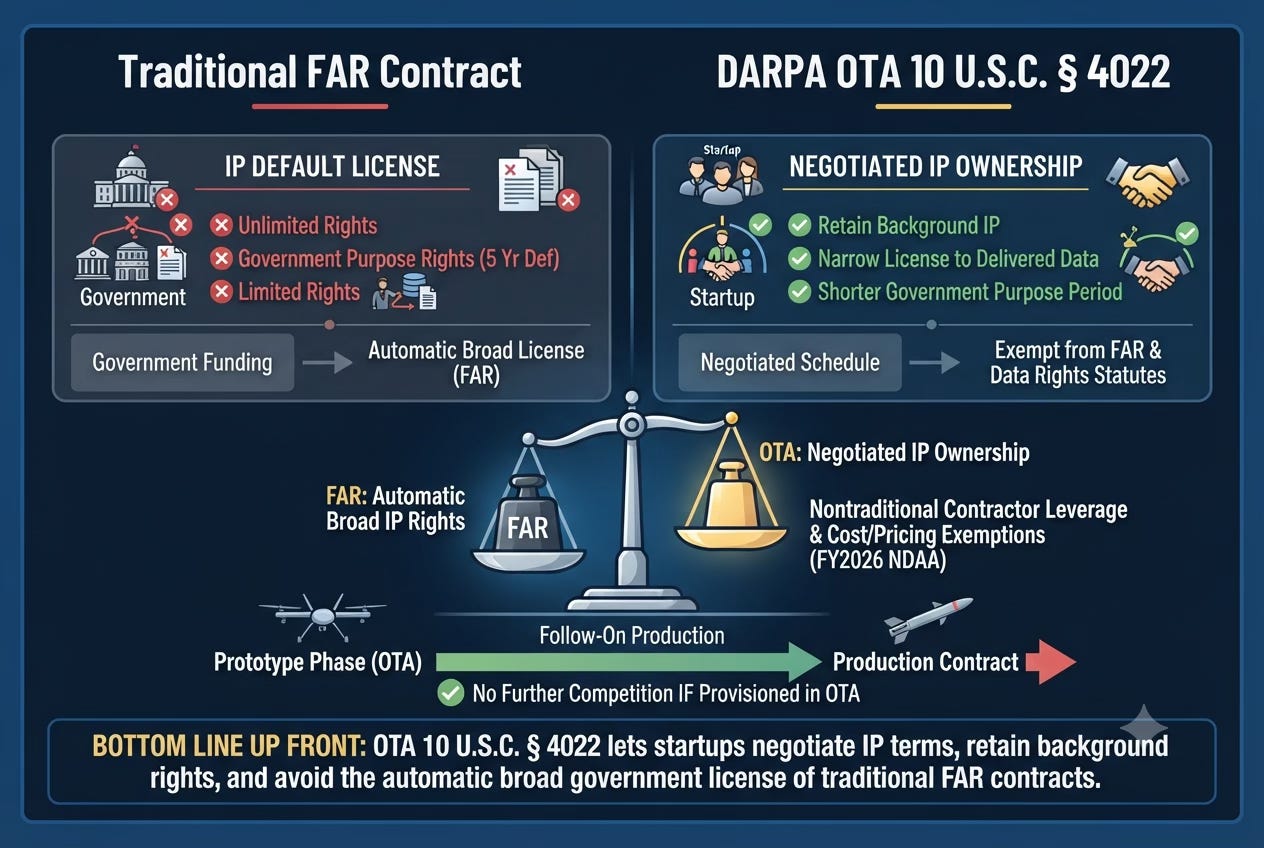
DARPA’s OTA Lets Startups Keep Their IP
Description
DARPA’s Other Transaction Authority under 10 U.S.C. Section 4022 lets defense technology startups negotiate IP ownership with the government and avoid the default government license the Federal Acquisition Regulation imposes. An Other Transaction Agreement for a prototype project sits entirely outside the Federal Acquisition Regulation and outside the statutory data rights scheme that automatically attaches Unlimited Rights, Government Purpose Rights, or Limited Rights to a standard defense contract. Because none of those default categories apply unless the parties write them into the agreement, a startup negotiates the intellectual property schedule from a blank page rather than from a government favorable template. The startups that benefit most treat that blank page as a drafting opportunity rather than paperwork to sign quickly so a program can start.
I spent three years as a submarine officer aboard USS William H. Bates before spending three decades advising technology companies, and one pattern has not changed in that time: the government’s leverage over intellectual property comes from a license structure most founders never read until a term sheet is already signed. Other Transaction Authority exists because Congress recognized, and expanded the authority repeatedly since, that a young company building autonomous flight software or a novel sensor has no reason to accept the same data rights scheme built for a shipyard constructing a destroyer under a fixed price contract spanning a decade.
What does 10 U.S.C. Section 4022 actually let the Pentagon do?
10 U.S.C. Section 4022 gives the Pentagon authority to enter into transactions other than contracts, grants, or cooperative agreements for prototype projects directly relevant to enhancing the mission effectiveness of military personnel or the equipment the armed forces use. The statute sits beside 10 U.S.C. Section 4021, which covers research transactions, but Section 4022 is the provision startups encounter most often because it governs the prototype stage, where a working demonstration, not a research paper, is the deliverable. To use the prototype authority at all, at least one of several conditions must be met: a nontraditional defense contractor or nonprofit research institution must participate to a significant extent, every significant participant must be a small business or nontraditional contractor, at least one third of the cost must come from non federal sources, or the agreement must have used competitive procedures with at least two competing proposals. Agreements between one hundred million and five hundred million dollars require a written determination from the head of the contracting activity or the relevant DARPA, Defense Innovation Unit, or Missile Defense Agency director, and anything above five hundred million dollars needs approval from the Under Secretary of Defense for Acquisition and Sustainment along with notice to Congress.
How does an Other Transaction Agreement change who owns the resulting technology?
An Other Transaction Agreement changes ownership outcomes because it removes the automatic license structure a Federal Acquisition Regulation contract imposes and replaces it with whatever the parties negotiate. Under a standard defense award, the government receives Unlimited Rights in technical data or software developed solely at government expense, Limited Rights in data developed solely at private expense that embodies a trade secret, and Government Purpose Rights, which convert to unlimited after a five year period, in anything developed with mixed funding. Because 10 U.S.C. Sections 3771 through 3775, the statutes that create this scheme, do not apply to a prototype Other Transaction Agreement unless the parties import them by reference, a startup can instead retain its background intellectual property outright, grant a license limited to the specific data delivered rather than everything created during p