Episode Details
Back to Episodes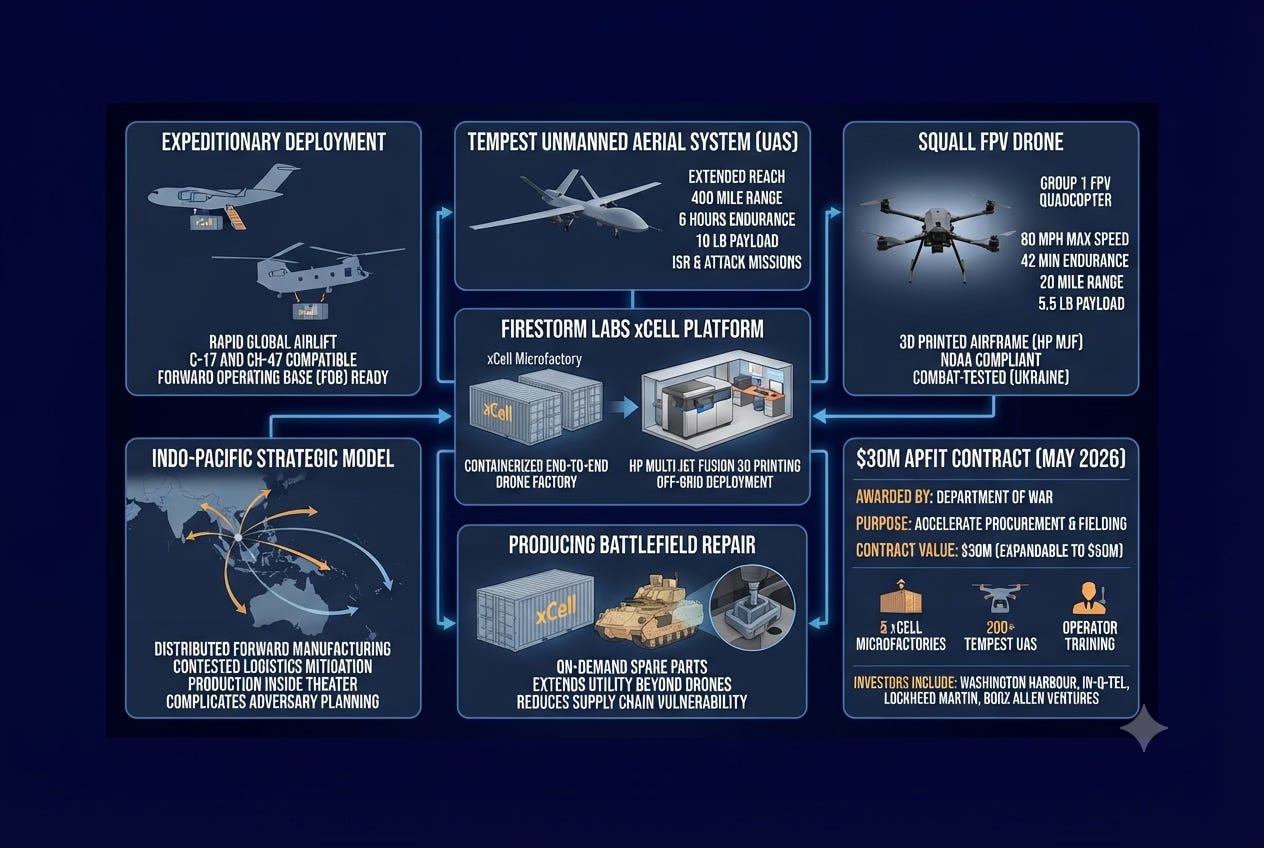
Firestorm Labs Wins $30 Million Contract for 3D Printed FPV Drones
Description
The Department of War awarded Firestorm Labs a $30 million APFIT contract on May 8, 2026, to deploy five containerized xCell drone microfactories and more than 200 Tempest unmanned aerial systems to the Indo-Pacific. The award was made under the Accelerate the Procurement and Fielding of Innovative Technologies program, a procurement mechanism established in Fiscal Year 2022 specifically for technologies ready to transition from development to operational units. Approximately $26 million has been obligated across five task orders and deliveries are underway, marking Firestorm’s first deployments outside the continental United States. This contract validates a production model first tested in Ukraine, where 3D-printed drones have become central to tactical operations and where the design cycle compresses from months to days.
What Did the Squall Prove in Ukraine?
Orqa FPV, the Croatian company that co-developed the Squall with Firestorm, has operated FPV drones in Ukraine since the early phase of the conflict. The Squall is a Group 1 FPV quadcopter: it reaches 80 mph, carries a 5.5-pound payload, flies for 42 minutes, and ranges 20 miles. Its airframe is produced by HP Multi Jet Fusion industrial 3D printing, not injection molding or traditional composites. All components are NDAA-compliant under the procurement restrictions established by Section 848 of the National Defense Authorization Act for Fiscal Year 2020, addressing Pentagon requirements and allied purchasing rules.
Ukraine established specific operational facts for defense planners. Approximately 50 to 70 percent of Ukrainian drones are 3D-printed, according to multiple assessments. Drone designs iterate at a pace measured in days, driven by rapid adversary adaptation in electronic warfare and kinetic countermeasures. Fixed manufacturing facilities are targets: Ukrainian factories have been struck repeatedly, demonstrating that centralized production creates single points of failure in a contested environment. Firestorm CEO Dan Magy cited this experience in the company’s April 2026 Series B announcement, noting that the design cycle has compressed dramatically and that fixed production sites cannot be taken for granted.
The Squall’s validation in Ukraine is the commercial foundation for the entire xCell model. A drone produced at the location of need, printed on-site rather than shipped from San Diego, changes how a commander manages attrition. The Squall demonstrated that HP Multi Jet Fusion airframes are not prototype curiosities. They are battlefield-ready platforms.
What Is the xCell System and How Does It Work?
The xCell is not a single 3D printer in a shipping container. It is a deployable industrial node built around HP Multi Jet Fusion printers, housed in two standard shipping containers, and designed to operate entirely off-grid. It can be airlifted inside a C-17 or C-130, sling-loaded beneath a CH-47 Chinook, or moved by sea. Firestorm holds a five-year global exclusive with HP for mobile deployment of Multi Jet Fusion technology, secured in July 2025. That exclusivity represents a commercially significant barrier: no competitor can replicate the manufacturing partnership in the near term.
HP Multi Jet Fusion deposits binding and fusing agents across successive layers of nylon polymer powder, then uses a fusing lamp to selectively solidify the material into structural parts. The parts are strong, accurate, and repeatable at production scale. The weapons added to the finished drone are not 3D-printed; they are attached separately. The airframe is the product. That distinction matters for International Traffic in Arms Regulations export control analysis and for battlefield logistics planning.
The Army used xCell to produce on-site replacement parts for a Bradley Fighting Vehicle, parts that would otherwise require months of conventional procurement. That application illustrates a capability extension beyond dro