Episode Details
Back to Episodes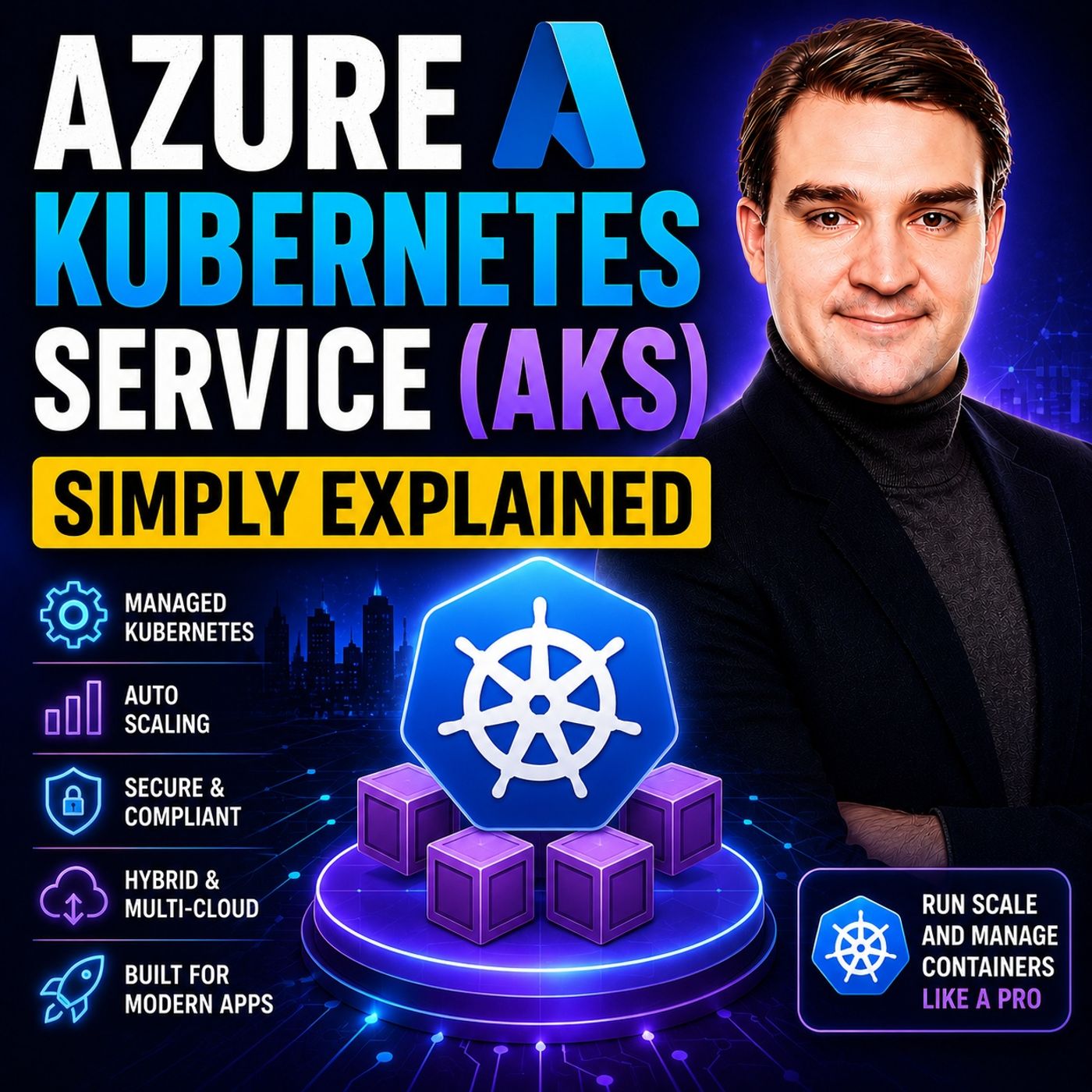
Azure Kubernetes Service (AKS) - Simply Explained
Season 3
Published 3 weeks, 2 days ago
Description
Azure Kubernetes Service (AKS) is Microsoft's fully managed Kubernetes platform that makes it easier to deploy, manage, and scale containerized applications in Azure. Instead of building and maintaining your own Kubernetes cluster, Microsoft operates the control plane while you focus on deploying your applications. AKS combines the power of open-source Kubernetes with deep Azure integrations, allowing organizations to build resilient, cloud-native applications without spending countless hours maintaining infrastructure. Whether you're running microservices, APIs, AI workloads, or enterprise applications, AKS provides a production-ready platform that automates many of the operational challenges of Kubernetes.
WHY KUBERNETES MATTERS FOR MODERN APPLICATIONS
Containers revolutionized software development by packaging applications together with their dependencies into portable, consistent units that run the same everywhere. While managing a handful of containers manually is simple, enterprise environments often require hundreds or even thousands of containers running across multiple servers. Kubernetes solves this challenge by automatically scheduling workloads, restarting failed applications, scaling resources during traffic spikes, and distributing workloads across available infrastructure. Azure Kubernetes Service removes the complexity of operating Kubernetes itself by managing the control plane, upgrades, backups, and patching, allowing development teams to focus on building software instead of maintaining clusters.
HOW AZURE KUBERNETES SERVICE WORKS AKS
consists of two primary components: the Microsoft-managed control plane and your worker nodes. The control plane acts as the brain of the cluster, making scheduling decisions, maintaining cluster health, and storing Kubernetes configuration. Microsoft manages these components automatically, ensuring high availability and regular updates. Your applications run on worker nodes, which are standard Azure Virtual Machines organized into node pools that can scale automatically based on workload demand. AKS also integrates seamlessly with Azure services like Microsoft Entra ID for authentication, Azure Monitor for observability, Azure Policy for governance, and Azure Container Registry for secure image storage, creating a complete cloud-native platform for enterprise applications.
NETWORKING, SECURITY, AND HIGH AVAILABILITY
Enterprise workloads require secure and reliable networking, and AKS provides multiple networking models to suit different deployment scenarios. Azure CNI enables secure communication between pods, services, and external resources while supporting both overlay and flat networking architectures. Applications can be exposed through Azure Load Balancer or Ingress Controllers, making it easy to publish APIs and web applications securely. On the security side, AKS integrates with Microsoft Entra ID for authentication, Kubernetes Role-Based Access Control (RBAC) for authorization, Azure Key Vault for secrets management, and Microsoft Defender for Containers to continuously monitor workloads for vulnerabilities and suspicious behavior. Together, these features help organizations build Zero Trust container platforms that meet modern security and compliance requirements.
COSTS, SCALING, AND PERFORMANCE
One of the biggest advantages of AKS is its flexibility. While the Kubernetes control plane is free in the Free tier, organizations primarily pay for the Azure Virtual Machines, storage, networking, and optional premium features that power their workloads. AKS supports automatic cluster scaling, allowing node pools to grow during peak demand and shrink during quieter periods to reduce costs. Businesses can further optimize expenses using Reserved Instances, Azure Savings Plans, or Spot Virtual Machines for non-critical workloads. Combined with rolling updates, automated health mon
WHY KUBERNETES MATTERS FOR MODERN APPLICATIONS
Containers revolutionized software development by packaging applications together with their dependencies into portable, consistent units that run the same everywhere. While managing a handful of containers manually is simple, enterprise environments often require hundreds or even thousands of containers running across multiple servers. Kubernetes solves this challenge by automatically scheduling workloads, restarting failed applications, scaling resources during traffic spikes, and distributing workloads across available infrastructure. Azure Kubernetes Service removes the complexity of operating Kubernetes itself by managing the control plane, upgrades, backups, and patching, allowing development teams to focus on building software instead of maintaining clusters.
HOW AZURE KUBERNETES SERVICE WORKS AKS
consists of two primary components: the Microsoft-managed control plane and your worker nodes. The control plane acts as the brain of the cluster, making scheduling decisions, maintaining cluster health, and storing Kubernetes configuration. Microsoft manages these components automatically, ensuring high availability and regular updates. Your applications run on worker nodes, which are standard Azure Virtual Machines organized into node pools that can scale automatically based on workload demand. AKS also integrates seamlessly with Azure services like Microsoft Entra ID for authentication, Azure Monitor for observability, Azure Policy for governance, and Azure Container Registry for secure image storage, creating a complete cloud-native platform for enterprise applications.
NETWORKING, SECURITY, AND HIGH AVAILABILITY
Enterprise workloads require secure and reliable networking, and AKS provides multiple networking models to suit different deployment scenarios. Azure CNI enables secure communication between pods, services, and external resources while supporting both overlay and flat networking architectures. Applications can be exposed through Azure Load Balancer or Ingress Controllers, making it easy to publish APIs and web applications securely. On the security side, AKS integrates with Microsoft Entra ID for authentication, Kubernetes Role-Based Access Control (RBAC) for authorization, Azure Key Vault for secrets management, and Microsoft Defender for Containers to continuously monitor workloads for vulnerabilities and suspicious behavior. Together, these features help organizations build Zero Trust container platforms that meet modern security and compliance requirements.
COSTS, SCALING, AND PERFORMANCE
One of the biggest advantages of AKS is its flexibility. While the Kubernetes control plane is free in the Free tier, organizations primarily pay for the Azure Virtual Machines, storage, networking, and optional premium features that power their workloads. AKS supports automatic cluster scaling, allowing node pools to grow during peak demand and shrink during quieter periods to reduce costs. Businesses can further optimize expenses using Reserved Instances, Azure Savings Plans, or Spot Virtual Machines for non-critical workloads. Combined with rolling updates, automated health mon