Episode Details
Back to Episodes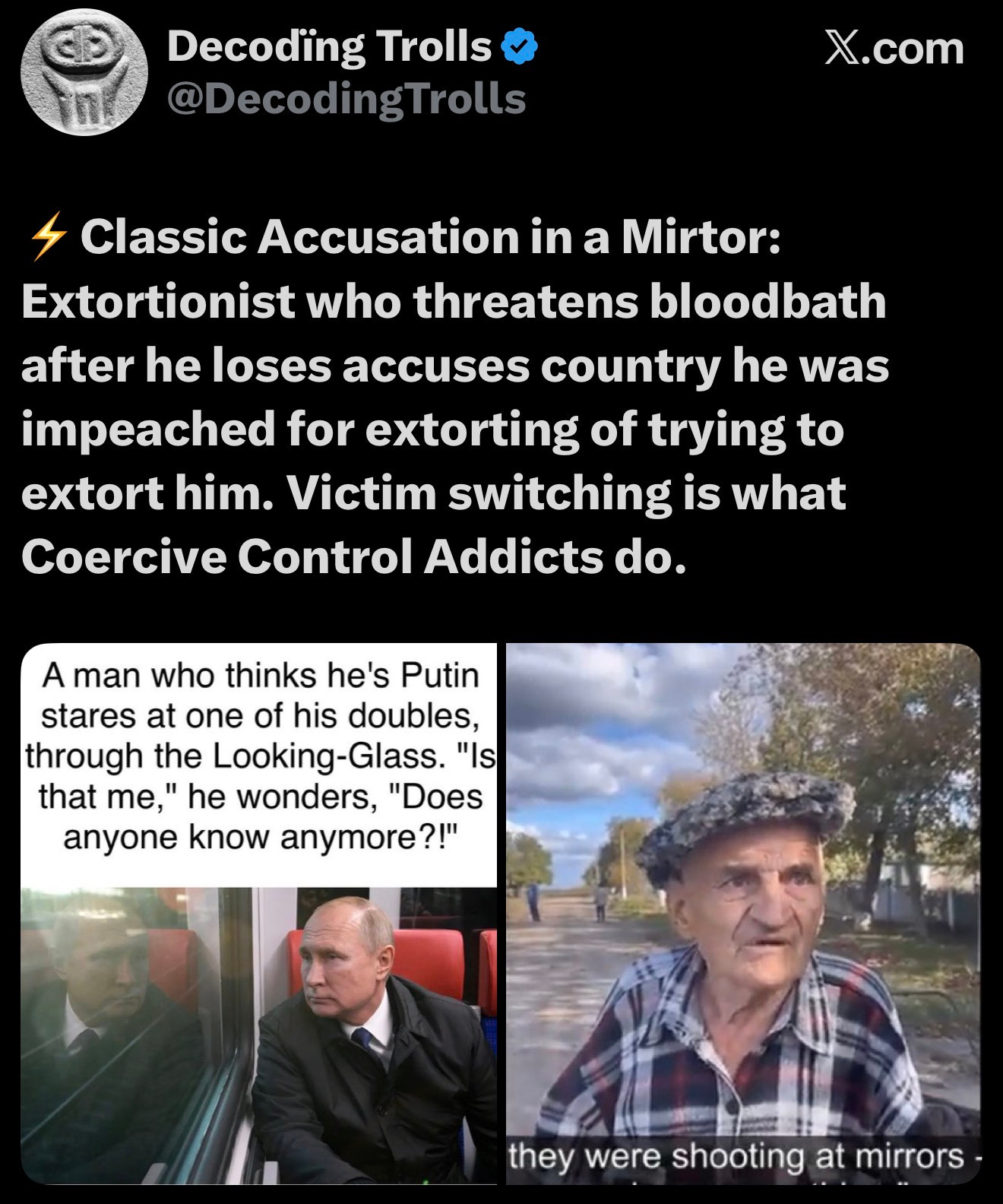
Podcast | Disinfolklore in Executive Orders and National Security Memos
Description
The United States government has published an Executive Order and a National Security Presidential Memorandum (NSPM-7) (h/t Ken Klippenstein) that use Disinfolklore about an entirely fictional character called ‘Antifa’ to justify entirely un-American activities by the Federal government. Both documents are premised on entirely fictional (Disinfolklore) accounts of so-called Anti-Fascist plans for violence against the Right.
Only evidence we have about plans for violence is from messages from Young Republicans (aged 18-40 years-old) that demonstrate they’re planning to exterminate Americans using gas chambers. Accusation in a Mirror (accusing the future victims of the crimes you’re planning to commit against them) is common to all genocides. It’s a pretext for murdering or displacing the scapegoats. A motivation. Reveals intentions.
The policy framework for oppressing anyone the Federal Government chooses to is now completely grounded on fictional events which never happened. For example, the U.S. President alleges falsely in NSPM-7 that the bullets used by the alleged murderer of his father’s Far Right hero, Charlie Kirk, were “engraved…with so-called ‘anti-fascist’ rhetoric.”
This entirely false and unfounded accusation in a formal document used by the US President as a policy basis for persecuting supposed members of an entirely fictional organisation called “Antifa” signposts the arrival of Disinfolklore into the heart of US government and society.
It’s precisely the pattern I watched the Russians use in Russia-occupied Ukraine (where I worked as a diplomat 2015-2018). It’s a new level of “Disinformation.” It’s why, as I argue in this podcast, we need a means - the analytical method I invented to parse Russian and MAGA - Disinfolklore to understand what is going on here.
In my work as a writer, what I try to do is provide the tools to analyse phenomena in real time. To find a way of looking at them, of cutting through the rhetoric.
If Both Sides, for instance, are saying, are Othering what they term disinformation. The political ‘Right’ is claiming that what Antifa is talking about is Disinformation. Antifa -not that it is anything anyway. It’s a set of inchoate individuals… If Antifa is saying what the Right is talking about is Disinformation.
Then we need what I call an ‘evaluative framework/dimension. An evaluative level/layer with which to define what is Disinformation. That’s where my Code of Positive Trolls came into my life in February 2020.
A set of six criteria, six elements that you can use to parse any meme, any linguistic or any piece of data and any informational unit. It’s an attempt to objectively define what is disinformation or non-disinformation, i.e. what is good, what is bad, what is positive, what is negative.
That’s what I use in terms rather than going for sinister/left and Right or writ or any such divisive wordings or self-declared labels.
So I just go for the positive, negative, neutral, which is also in the word neutral, neutral, no movement. That evaluative dimension, then that led me to, I was looking at, for the reasons I’ve spoken about before, that I was in eastern Ukraine on this bridge in this very folklore-like situation, which had structural elements like folklore. Also the whole setting was just folklore about the whole thing. That made me interested in folklore before I realized actually Russia was using stories to troll people into particular attitudes, moods, motivations, and intentions which suited to them.
We see today this horrific footage, which I would not recommend anyone watch. I certainly won’t be watching it. I can see a Disinfolklore without experiencing it of Russia hitting the World Food Programme convoy in Kherson.
I think it was our very first episode with the release of the UN Commission on Ukraine, which w