Episode Details
Back to Episodes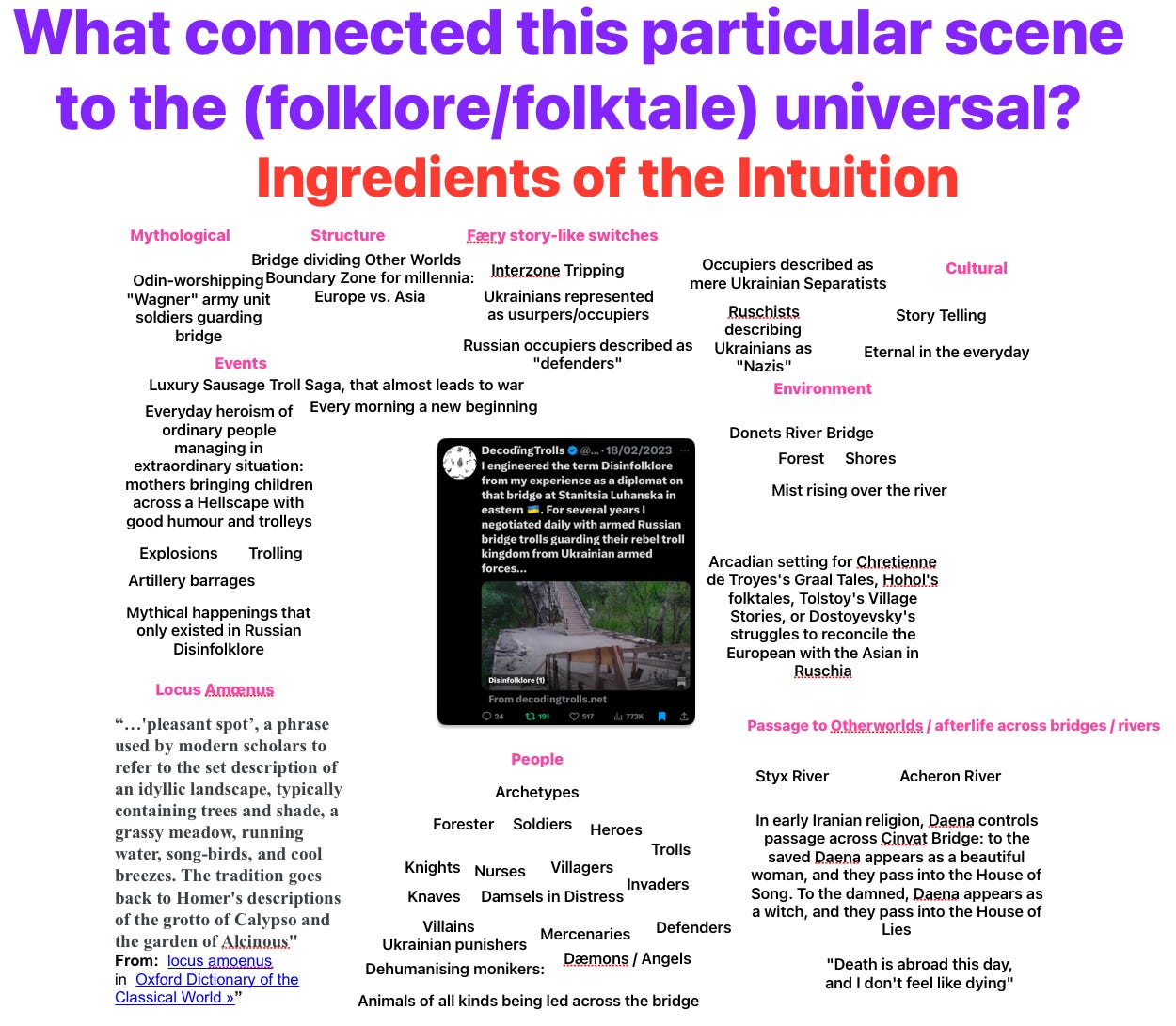
Podcast | What's 'Folklore' about Disinfolklore?
Description
Last week I was right back at the bridge at Stanytsia Luhanska and I went through the luxury sausage troll saga and the complicity between the activities which the Russians, and indeed the Ukrainians, create on the ground, but then the complicity between these actual activities and how the Russian Disinfolklore apparatus, the propaganda apparatus, then spins these actual events.
What I wanted to talk about today was the folkloric dimension of the bridge, because that’s obviously quite fundamental to Disinfolklore. I’m aware that most of us haven’t thought too much about folklore since we were children. I wanted to bring us through how I had this intuition — unwrapping that intuition that there was something folkloric about that situation — into what has now become the Disinfolklore analytical method.
The saga of me and my Russian colleague featured in a whole array of Disinfolklore stories spun by the Russians. But there’s another aspect of the bridge and that situation I was in that struck me almost the first moment I was there.
One thing I’ve noticed, by listening to Chuck Pfarrer since the Maria days, and Alan as well — I’ve actually learned quite a lot of how he thinks, how a Navy SEAL thinks and computes data. Every now and again, someone in my real life who doesn’t pay that much attention to Ukraine but is interested in what’s going on, I find myself speaking about what’s going on — like, for instance, about Pokrovsk in November — being able to channel what I was learning from Chuck Pfarrer and how he was looking at the battlefield. He didn’t think it would fall that easily. I realised I’ve actually learned quite a lot. A certain part of my mental architecture, the way I compute data, especially battlefield stuff, has really developed and evolved a great deal as a result of listening for three or four years to Chuck Pfarrer.
By analogy, that’s what I’m trying to do with the Disinfolklore analytical method. I’m grateful for these opportunities, these shows, which is just to give an idea of how I think about this kind of data and how I control it going into my mind.
But I didn’t start out that way. I forged the word Disinfolklore out of disinformation and folklore in February 2023. I established a folder on my computer in February 2020 called “Folklore.” That folder is where I was putting all these texts that I was reading to try and understand what trolls and trolling was about. Out of that initial attempt to look at how those terms were being used in the media, tracing them back — that led me on this massive journey, which I’m still on, into the origins of Indo-European languages, but also particularly through this data set I got from Factiva of tens of thousands of references to trolls and trolling.
I had that folder on my computer called Folklore, and then disinformation, obviously, was one of the words. It could be misinformation or disinformation. In February 2023, I was trying to think of a way of how I can archetype everything I have learned since being on the bridge. That was February 2023, a year into the war as well, where I realised — because of my experience on this bridge from February 2015 onwards, seeing and looking at patterns and data — that I had a particular way of perceiving the daily diet of information we were receiving through X and through Telegram. At the time I was on Telegram and looking at it for the full-scale invasion.
I spent the first month of the full-scale invasion collecting information for the OSCE’s Moscow Mechanism mission, which then in April 2022 produced the first report. It was charged by 44 countries, nation states, to inquire into Russia’s conduct of the war in Ukraine for the first month. That report was then cited in the definitive, historic, comprehensive 600-page judgment delivered by the European Court of Human Rights about three months ago on Russia’s violations of the European Convention on Human Rights.
I was collecting