Episode Details
Back to Episodes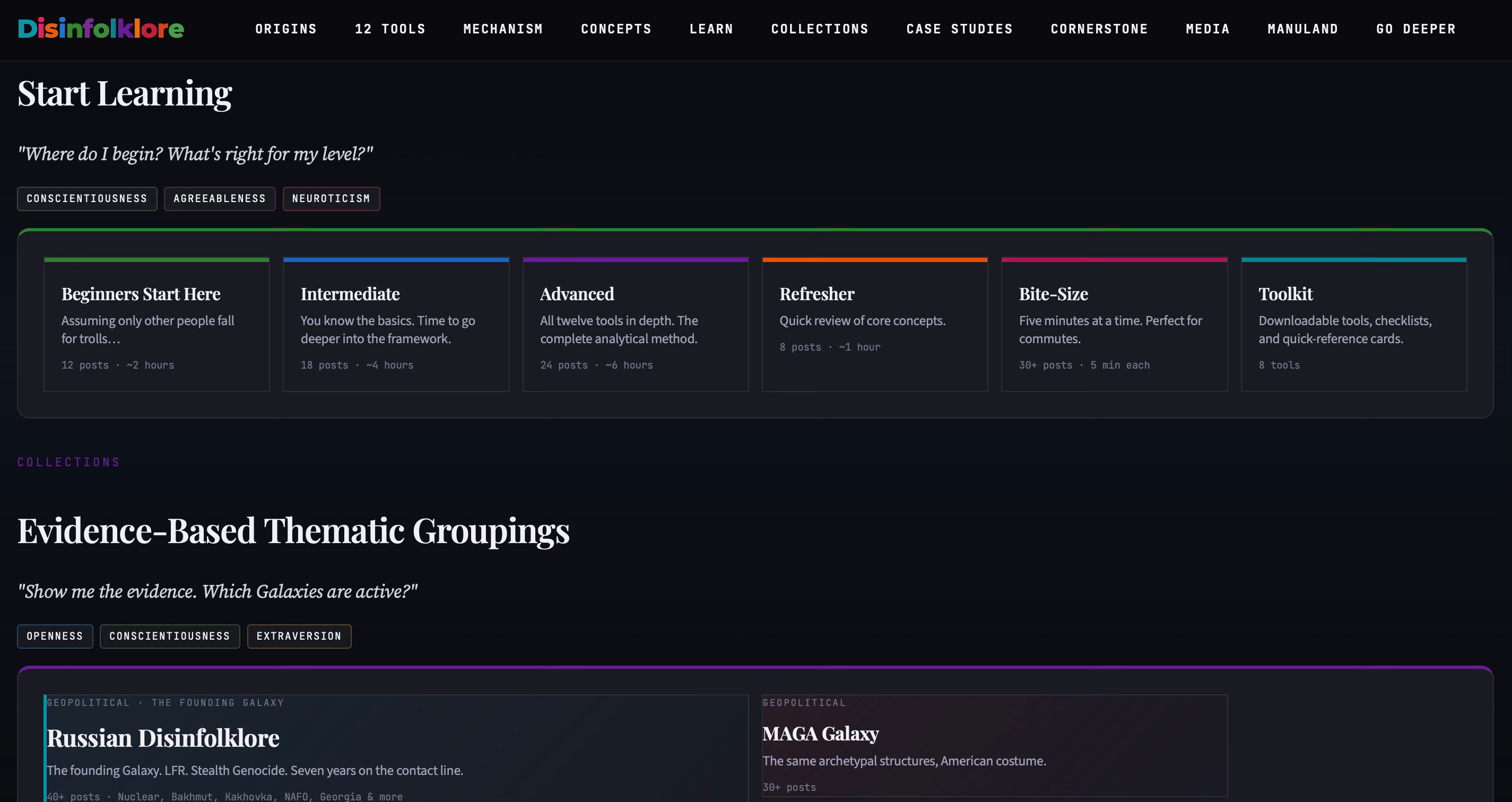
Podcast | Two Shaman Tricksters (Don & Putler) vs. The Comedian
Description
From Prime Ministers to Primary Schools: My Vision for Disinfolklore Literacy
My vision for the Disinfolklore Analytical Method took a giant leap forward towards realisation this week. My vision for Disinfolklore is to use its insights to teach universal communications literacy and to build up immunity to manipulating archetypal Disinfolklore. I visualise teams of teachers teaching in Prime Ministers’ offices and Primary Schools throughout Indo-European cultures globally.
With that in mind, this week was a huge moment for me in my development. Over the past while I discovered Claude Code, Anthropic's Claude Code. I have been working with it inside the Terminal. It differs from most of our encounters with Anthropic's AI in the sense that it's agentic. It actually executes. It doesn't just write the code for you and then you have to paste the code in. It actually implements the code, solves problems by writing multiple scripts in different computers language, recruits sub-agents to take on sub-tasks within a complex project such as that which I set to build my new platform. While the algorithm takes the initiative, it’s necessary to prompt it continually to ensure it stays on the right track. My new platform took around 600 prompts to bring it where it is now: a perfect representation of my artistic vision.https://www.disinfolklore.com will be my platform for the next few decades. I will continue publishing first here on Substack (https://www.disinfolklore.net). Then I will decant some highly distilled content to Disinfolklore.com periodically. Substack is optimised for email lists and has great potential for community building which I have not yet been prioritising but which I will in the future when I have the bandwidth.
Disinfolklore.com contains the million words I've written on disinfolklore since the full-scale invasion, divided into different sections and different passages, short passages rather than long essays. It's arranged according to certain structural divisions which should appeal to people who identify as being quite open and who will be quite interested in the origins of the concept — that's all there. Those of us who self-identify as being more high on the neurotic OCEAN dimension, who self-identify as feeling "I just need... I'm worried about the world. Just give me the tools." There's the Twelve Tools. Then there are certain tools which would be more useful to people than others.
I love the graphics. I designed all the graphics with Claude Code, but through about 600 different prompts. For me, I never thought in my lifetime I would be able to create something like this. This revolutionary technology is extraordinary.
This will be not only a platform to show what I've done and what I hope is going to be quite useful for decades to come — as a means of interpreting data and dealing with emotion-moving activity — it will also be a platform for teaching and for building more networks with people. It's also just an immersive resource for anyone to spend as much time as they're willing to give to it.It also has the Finding Manuland component, which is the 6,000-year context. Disinfolklore didn't come out of nowhere; it's an emanation of Indo-European culture and of deep history, as I'm talking about. The shaman-tricksters and these archetypes of Finding Manuland are also in there, which is also a very rich read, but these are very succinct, quick passages.
The entrance to the site is dark — the first homepage — but then everything underneath it is white and deliberately designed using the best optimised fonts and colours for making an easy reading experience.
No noise on the passage pages, just arrows bringing you to the next passage or to the previous passage. Breadcrumbs — which is an interesting use from folklore to describe the bit at the top of the page — show where you are in the site. Then for people who want to read all of the long-form material