Episode Details
Back to Episodes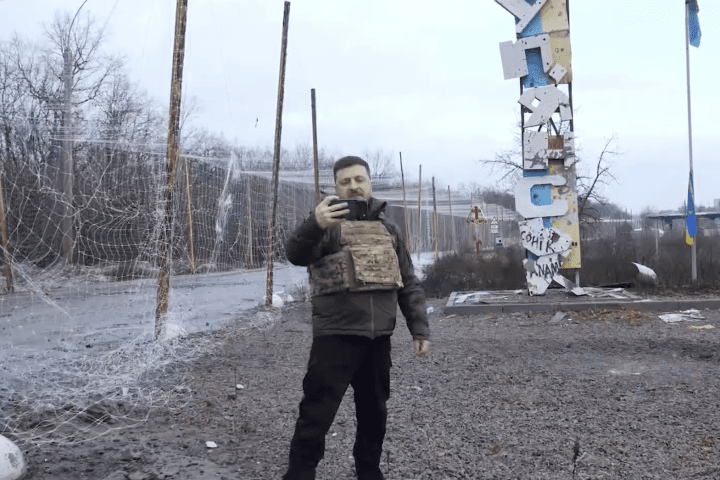
Podcast | The Three Moves of the Apparatus Campaign Elevation Doctrine
Description
Today I’m going to talk a bit about the Starobilsk incident, using the Disinfolklore Analytical Method, and I’m also going to talk about some examples from what I call the Luhansk Corpus, which I’ve been talking about for the last few weeks. We’re in the midst — not even one hundredth of a way through — what I have to talk about. This corpus is 10,000 propaganda items that I collected while I worked in Russia-occupied Ukraine, and between Russia-occupied Ukraine and government-controlled Ukraine, between 2015 and 2018 in Luhansk, and then afterwards in Dnipro.
Today’s Topic: The Starobilsk Incident
The first thing I’m going to talk about is the Starobilsk incident. Some of you probably didn’t hear about it, but it was a really interesting example for me to apply the Disinfolklore Analytical Method to. The moment I heard the President of the Rushist Federation mention a school in Starobilsk — which is a town I know very well, I used to go through it a lot when I lived in Severodonetsk, so it has that personal connection to me as well — and the moment I heard President Putin talk about it and talk about this, what I call the manufactured wound archetype, basically, it reeked of this, and I recognised the pattern. I thought, as the English might say, there was something rum about this. I tuned in.
Russia’s defence ministry announces in Putin’s name that international journalists are invited to come and see for themselves that Ukrainian forces are surrounded in Pokrovsk, Myrnohrad, and Kupyansk. The apparatus — which is how I refer to the entire collection of actors operating the Russian Federation — offers a five-to-six-hour ceasefire to enable the tour.
12th of December 2025: Putin claims at a press conference, based on a briefing from Gerasimov, that 15 Ukrainian Armed Forces battalions are blocked inside Kupyansk. Fifteen battalions. He invites journalists again to come and verify. On the same day, Volodymyr Zelensky turns up in Kupyansk himself, records a video address on his iPhone at the entrance stele, 1.15 kilometres from Russian positions, 500 metres from the grey zone. DeepState map confirms the coordinates.
22nd of May 2026: the apparatus elevates a strike on occupied Starobilsk to a campaign. Putin calls it a terrorist strike. Peskov calls it a monstrous crime. Six Russian official spokespersons issue coordinated naming within 12 hours. Russia requests a UN Security Council emergency session. Within 36 hours, 90 missiles and 600 drones land on Kyiv and Bila Tserkva, as all of us will know — where the Oreshnik fell, and some garages. The Chernobyl Museum was hit. We had an interesting discussion about this on Ming and Joanna’s show earlier in the week. I think Lexicon and I were convinced — and indeed I think Ming as well — that this was a hit on purpose. The Oreshnik, the nut tree or the walnut tree, the nuclear-capable hypersonic missile, is fired for the third time in this war.
What we’re looking at is not three discrete events — which many people will see them as, but not us, and not me through the Disinfolklore Analytical Method. We’re looking at one eight-month campaign elevation doctrine that has been running in continuous deployment since at least last October. The Starobilsk strike of last Thursday is the latest instance. It’s not the first, and it will not be the last. This is Disinfolklore in real time.
The Apparatus Does Not Improvise Its Archetypes
The thing about the apparatus is that it does not improvise its archetypes. It deploys them again and again on the same template. What looks like news in your morning headlines, or on my evening television, or in our social media feeds, is on closer inspection the apparatus running the same play it ran last quarter, and the quarter before that, and the quarter before that. The play I want to walk you through tonight is what I’m going to call, for the rest of this episode, the Ap