Episode Details
Back to Episodes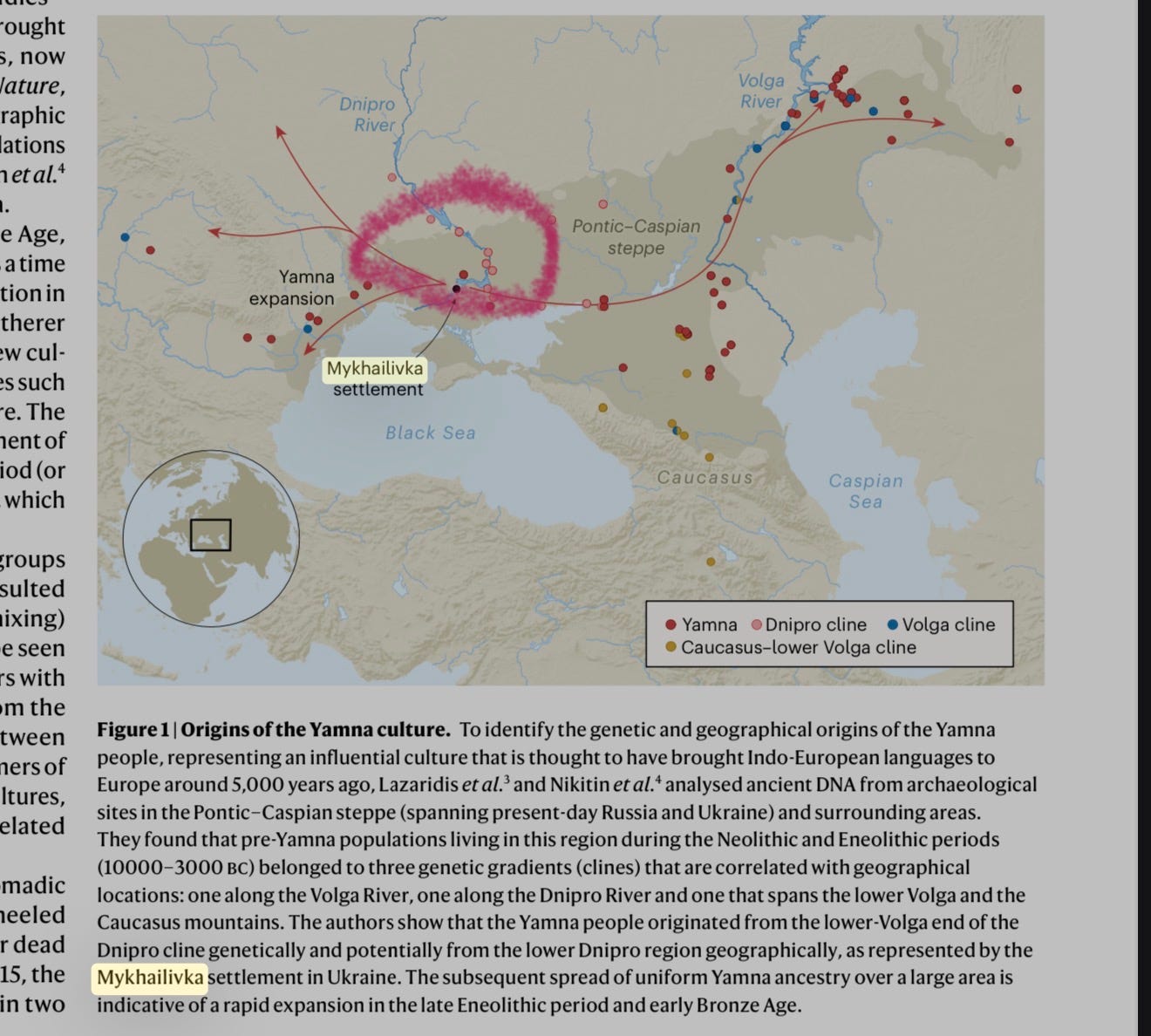
Podcast | In Defence of "Ancient Ukraine"
Description
We say ancient Greece and ancient Egypt without a flicker, and we call a Bronze Age culture in Kazakhstan the first Aryans — every one of them a modern name thrown back over a people who never bore it. The homeland of the whole Indo-European family is the Dnipro Valley. So, by the rule we already use for everyone else, there is an ancient Ukraine. To withhold the name is not scholarly caution. It is a double standard. And there is a war behind it.
Say ancient Greece, and nothing in you objects. Say ancient Egypt, ancient Rome, ancient China — all of them slide past without a snag. Now say ancient Ukraine, and for a great many people, something catches: a small resistance, a raised eyebrow, sometimes a flat correction. “But Ukraine is a modern country.” That catch — not the linguistics, not the archaeology, just the catch itself — is what this is about. Because of all the things worth defending about this work, the plainest is the right to use two ordinary words.
Part of what people feel here is simply correct. Modern Ukraine is a modern state. Its present borders, its flag, its seat at the United Nations are 20th-century phenomena. The herders who lived in the Dnipro Valley 5,500 years ago did not call themselves Ukrainians. They did not know the word, and could not have pointed to a country on a map that did not exist. All of that is true. But notice that every word of it is just as true of ancient Egypt.
The people who raised the pyramids did not call themselves Egyptians. That is a Greek word, Aigyptos, laid on them long after. And the people who live in Egypt today are, for the most part, Arabic-speaking Muslims, whose language and faith and much of their ancestry arrived more than a thousand years after the last pharaoh — about as discontinuous from the pyramid builders as a population on its own soil can be. By that same standard, ancient Egypt should be an outrage. But it troubles nobody. It troubles no one because everyone already understands, without being told, what an anachronistic name is for. Ancient Egypt does not claim that the modern nation descends in an unbroken line from the pharaohs. It names the ancient people of that land using the land’s modern moniker, because the land’s modern moniker is the handle we have.
Ancient Britain does the same. The modern English are largely descendants of Anglo-Saxon incomers, not the people who raised Stonehenge, nor the Celts — the Pretani tribe — who, after being eradicated by the Romans, then the Germanics, and then the Normans, survive as a rump in Brittany in France and in Cymru, which is Wales, in the west of the country. No one accuses a book on ancient Britain of bad faith. Ancient Greece names the Hellenes, who never called themselves Greeks at all; Graeci is a Roman’s word for them. Every single one of these is a modern label thrown backward over a people who never wore it.
Naming a People by a Country They Would Reach a Thousand Years Later
In fact, we go much further than naming the ancient people of a land by that land’s modern name. We routinely name an ancient people by the modern name of a different land — one their descendants would reach only a thousand years later. Consider the Sintashta culture, dug out of the steppe of what is now Kazakhstan.
When the Sintashta graves were discovered about 20 or 30 years ago, deep inside them were the exact copy of burial customs and funereal feasts that had been written down in the Rig Veda in India around 1100 BCE. Archaeologists and experts had assumed that these burial practices and funereal ceremonies, written down in the Rig Veda from around 1200 to 1100 BCE, had been invented. And then we find, thousands of kilometres away, the exact facsimile of them from 2000 BCE.
Every account you will read calls these people the first Aryans, or Indo-Iranians, and the names are borrowed wholesale from India and Iran — lands the Sintashta themselves never saw.