Episode Details
Back to Episodes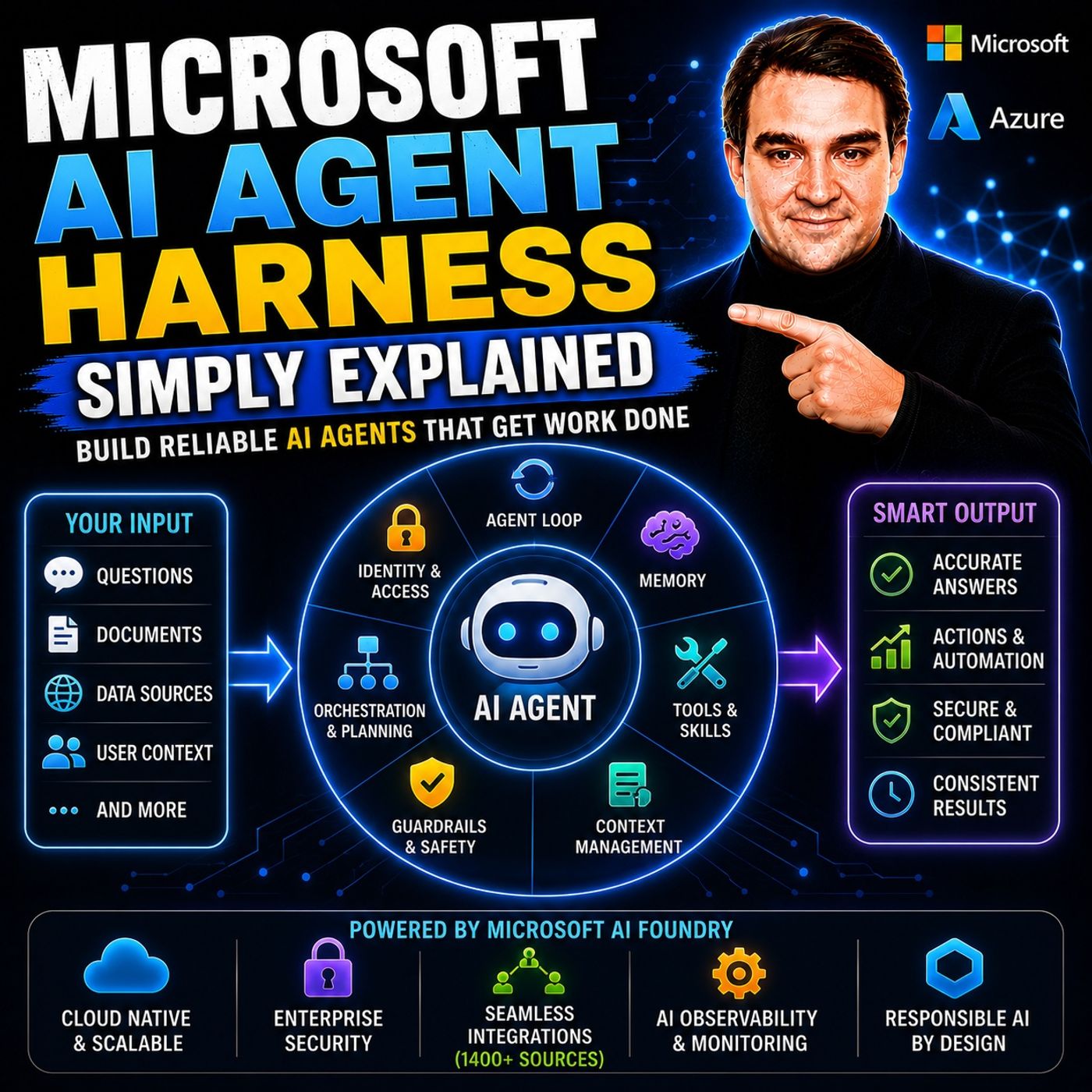
Microsoft AI Agent Harness - Simply Explained
Published 3 weeks, 2 days ago
Description
Writing the perfect AI prompt used to be the goal of every AI developer. But as businesses began asking AI to perform increasingly complex tasks—analyzing code, researching topics, coordinating workflows, and automating business processes—it became clear that prompts alone were no longer enough. Large Language Models are excellent at reasoning, but they cannot reliably manage long-running tasks, remember previous sessions, coordinate multiple tools, or enforce enterprise security on their own. In this episode of Microsoft Knowledge Nuggets, we explain the Microsoft AI Agent Harness in simple terms and show why modern AI solutions are built around complete systems rather than individual prompts. You'll learn how Microsoft AI Foundry combines memory, orchestration, context management, identity, tools, and governance into an enterprise-ready AI agent platform capable of handling real business workloads.
FROM PROMPT ENGINEERING TO HARNESS ENGINEERING
The evolution of AI development has happened in three major phases. Prompt Engineering focused on writing better instructions for language models. Context Engineering introduced technologies such as Retrieval-Augmented Generation (RAG), Model Context Protocol (MCP), and tool calling to provide AI with better information at the right time. Today, the industry has entered the era of Harness Engineering, where the focus shifts from the model itself to the complete system surrounding it. An AI agent is no longer just a model—it is a model combined with memory, orchestration, tools, guardrails, identity, and persistent context. The harness transforms a powerful language model into a reliable enterprise worker capable of completing complex, multi-step tasks over extended periods.
WHAT AN AI AGENT HARNESS ACTUALLY DOES
The AI Agent Harness provides all the capabilities that language models cannot manage independently. At its core is the agent loop, where the model repeatedly reasons, calls tools, evaluates results, and decides on the next action until the task is complete. Context management continuously summarizes conversations and prioritizes relevant information to prevent context windows from overflowing. Memory enables agents to remember previous interactions and learn from earlier tasks, while session persistence allows conversations to continue across multiple days or projects. The harness also provides enterprise tools such as web browsing, file access, database queries, code execution, and API integrations, giving AI agents the ability to perform meaningful work instead of simply generating text. Together, these capabilities create AI systems that behave more like skilled digital employees than traditional chatbots.
MICROSOFT AI FOUNDRY: THE ENTERPRISE AI AGENT PLATFORM
Microsoft AI Foundry provides the AI Agent Harness as a fully managed enterprise platform. Instead of building orchestration, identity management, context handling, security, and memory from scratch, organizations can focus entirely on their business logic while Foundry manages the underlying infrastructure. Every AI agent receives its own Microsoft Entra Agent ID, giving it a secure digital identity with auditable access to enterprise resources. Foundry also connects to more than 1,400 enterprise data sources, including Microsoft 365, SharePoint, Dynamics 365, Salesforce, Azure services, and custom business systems. Built-in procedural memory, session persistence, enterprise search, monitoring, and governance allow organizations to deploy AI agents that work securely across their existing business applications while maintaining full compliance and operational visibility.
MICROSOFT AGENT FRAMEWORK, MULTI-AGENT ORCHESTRATION, AND HERMES
This episode also explores Microsoft's Agent Framework, previously known as Semantic Kernel, which enables developers to build custom AI Agent Harnesses using Python and C#. The framework in
FROM PROMPT ENGINEERING TO HARNESS ENGINEERING
The evolution of AI development has happened in three major phases. Prompt Engineering focused on writing better instructions for language models. Context Engineering introduced technologies such as Retrieval-Augmented Generation (RAG), Model Context Protocol (MCP), and tool calling to provide AI with better information at the right time. Today, the industry has entered the era of Harness Engineering, where the focus shifts from the model itself to the complete system surrounding it. An AI agent is no longer just a model—it is a model combined with memory, orchestration, tools, guardrails, identity, and persistent context. The harness transforms a powerful language model into a reliable enterprise worker capable of completing complex, multi-step tasks over extended periods.
WHAT AN AI AGENT HARNESS ACTUALLY DOES
The AI Agent Harness provides all the capabilities that language models cannot manage independently. At its core is the agent loop, where the model repeatedly reasons, calls tools, evaluates results, and decides on the next action until the task is complete. Context management continuously summarizes conversations and prioritizes relevant information to prevent context windows from overflowing. Memory enables agents to remember previous interactions and learn from earlier tasks, while session persistence allows conversations to continue across multiple days or projects. The harness also provides enterprise tools such as web browsing, file access, database queries, code execution, and API integrations, giving AI agents the ability to perform meaningful work instead of simply generating text. Together, these capabilities create AI systems that behave more like skilled digital employees than traditional chatbots.
MICROSOFT AI FOUNDRY: THE ENTERPRISE AI AGENT PLATFORM
Microsoft AI Foundry provides the AI Agent Harness as a fully managed enterprise platform. Instead of building orchestration, identity management, context handling, security, and memory from scratch, organizations can focus entirely on their business logic while Foundry manages the underlying infrastructure. Every AI agent receives its own Microsoft Entra Agent ID, giving it a secure digital identity with auditable access to enterprise resources. Foundry also connects to more than 1,400 enterprise data sources, including Microsoft 365, SharePoint, Dynamics 365, Salesforce, Azure services, and custom business systems. Built-in procedural memory, session persistence, enterprise search, monitoring, and governance allow organizations to deploy AI agents that work securely across their existing business applications while maintaining full compliance and operational visibility.
MICROSOFT AGENT FRAMEWORK, MULTI-AGENT ORCHESTRATION, AND HERMES
This episode also explores Microsoft's Agent Framework, previously known as Semantic Kernel, which enables developers to build custom AI Agent Harnesses using Python and C#. The framework in